Questions

[3 Mark Question Answer]

🎯

Test yourself on this topic

25 questions · timed · auto-graded

Question 13 Marks
Differentiate between Uniform linear motion and Uniform circular motion.
Answer

Uniform linear motion

Uniform circular motion

The body moves along a straight line. The body moves along a circular path.
Speed and direction both remain constant. Speed is constant, but direction changes continuously.
It is not an accelerated motion. It is an accelerated motion.
View full question & answer
Question 23 Marks
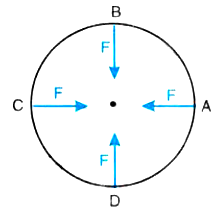
A uniform circular motion is an accelerated motion explain it. State whether the acceleration is uniform or variable? Name the force responsible to cause this acceleration. What is the direction of force at any instant? Draw diagram in support of your answer.
Answer
When the object moves in a circular path with uniform speed, it means that its magnitude of velocity does not change, only its direction changes continuously. Hence, it is considered as uniformly accelerated motion.In a uniform circular motion, the acceleration is variable.

An object in uniform circular motion experiences an inward net force. This force is called centripetal force.
The centripetal force is directed towards the center of the circular path.

Direction of force in uniform circular motion
View full question & answer
Question 33 Marks
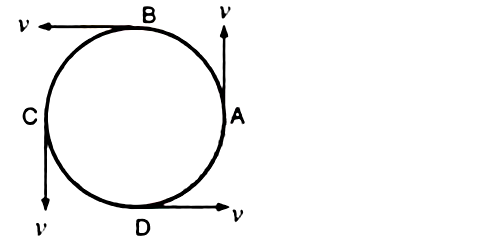
Draw a neat labelled diagram for a particle moving in a circular path with a constant speed. In you diagram show the direction of velocity at any instant.
Answer
A particle moving in a circular path with a constant speed.

View full question & answer
Question 43 Marks
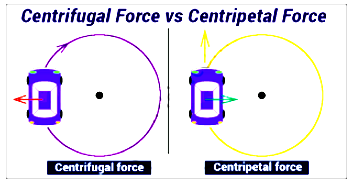
State two differences between the centripetal and centrifugal force.
Answer
Centripetal force Centrifugal force
It acts towards the centre of the circle. It acts away from the centre of the circle.
It is a real force. It is a fictitious force.
View full question & answer
Question 53 Marks
A piece of stone tied at the end of a thread is whirled in a horizontal circle. Name the force which provides the centripetal force.
  1. Is the velocity of stone uniform or variable?
  2. Is the acceleration of stone uniform or variable?
  3. What is the direction of acceleration of stone at any instant?
  4. What force does provide the centripetal force required for circular motion?
  5. Name the force and its direction which acts on the hand.
Answer
  1. The velocity of stone is variable
  2. The acceleration of stone is variable
  3. The direction of acceleration of stone is towards the centre of the circular path.
  4. Force of tension in the string provides the centripetal force required for circular motion.
  5. The reaction of tension away from the centre of the circular path.
View full question & answer
Question 63 Marks
Compare the magnitudes of centripetal and centrifugal force.
Answer
Centrifugal force describes the tendency of an object following a curved path to fly outwards, away from the center of the curve. It's not really a force; it results from inertia — the tendency of an object to resist any change in its state of rest or motion.

Centripetal force is a real force that counteracts the centrifugal force and prevents the object from "flying out," keeping it moving instead with a uniform speed along a circular path.

View full question & answer
Question 73 Marks
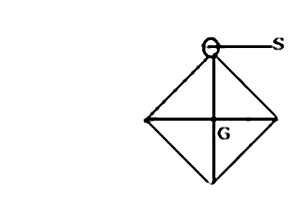
A square cardboard is suspended by passing a pin through a narrow hole at its one corner. Draw a diagram to show its rest position. In the diagram, mark the point of suspension by the letter S and the centre of gravity by the letter G.
Answer

A square cardboard in a rest position with G as a centre of gravity and
S as the point of suspension

View full question & answer
Question 83 Marks
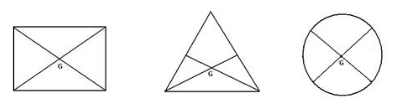
The figure shows three pieces of cardboard of uniform thickness cut into three different shapes. On each diagram draw two lines to indicate the position of the centre of gravity G.
Image
View full question & answer
Question 93 Marks
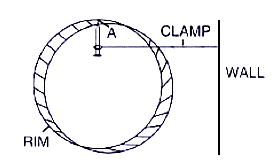
A uniform flat circular rim is balanced on a sharp vertical nai by supporting it at point A, as shown in the figure. Mark the position of the centre of gravity of the rim in the diagram by the letter G.

View full question & answer
Question 103 Marks
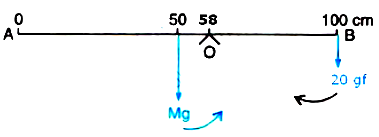
A uniform metre rule balances horizontally on a knife edge placed at the 58 cm mark when a weight of 20gf is suspended from one end.
  1. Draw a diagram of the arrangement.
  2. What is the weight of the rule?
Answer
(i)


(ii) From the principle of moments,
Anticlockwise moment $=$ Clockwise moment
$\begin{aligned}
& W \times(58-50)=20 gf \times(100-58) \\
& W \times 8=20 gf \times 42 \\
& W=\frac{20 gf \times 42}{8} \\
& W=105 gf
\end{aligned}$
View full question & answer
Question 113 Marks
A uniform metre rule is pivoted at its mid-point. A weight of 50 gf is suspended at one end of it. where should a weight of 100 gf be suspended to keep the rule horizontal?
Answer
Let the $50 gf$ weight produce the anticlockwise moment about the middle point of metre rule i.e at $50 cm$.
let a weight of $100 gf$ produce a clockwise moment about the middle point. Let its distance from the middle be $d cm$. Then
according to the principle of moments
Anticlockwise moment $=$ Clockwise moment
$50 gf x 50 cm =100 gf x d$
So $d =\frac{50 \times 50}{100}=25 cm$ from the other end
View full question & answer
Question 123 Marks
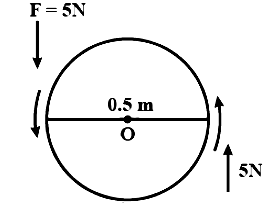
A steering wheel of diameter 0.5 m is rotated anticlockwise by applying two forces each of magnitude 5 N. Draw a diagram to show the application of forces and calculate the moment of couple applied.
Answer


Moment of couple = either force × couple arm

= 5N × 0.5m
= 2.5 Nm

View full question & answer
Question 133 Marks
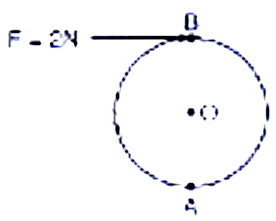
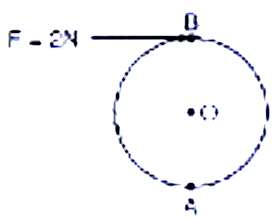
A wheel of diameter2 m is shown in the figure with the axle at O. A force F = 2 N is applied at B in the direction shown in the figure. Calculate the moment of force about Centre O and point A.

Answer
Given AB = 4m hence OA = 2m and OB = 2m

Moment of force F (=10N) at A about the point O

= F x OA = 10 x 2 = 20 Nm (clockwise)

Moment of force F (=10 N) at point B about the point O

= F x OB = 10 x 2 = 20 Nm (clockwise)

Total moment of forces about the mid-point O

= 20 + 20 = 40 Nm(clockwise)

View full question & answer
Question 143 Marks
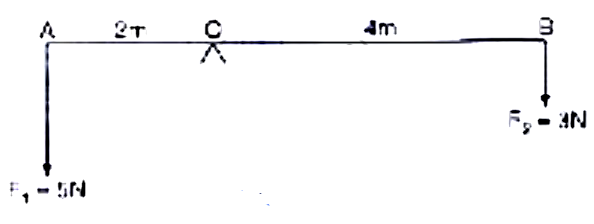
QUESIION The diagram in the figure shows two forces $F 1=5 N$ and $F 2=3 N$ acting at point A and B of a rod pivoted at a point O , such that $O A=2 m$ and $O B=4 m$

Calculate:
1) Moment of force $F_1$​​​​​​​ about $O$
2) Moment of force $F_2​​​​​​​$ about $O$
3) Total moment of the two forces about $O$
Answer
Given $A O=2 m$ and $O B=4 m 1)$ Moment of Force $F_1(=5 N)$ at $A$ about the point $O$
$= F_1 x OA$
$= 5 x 2 = 10Nm$ (anticlockwise)
2) Moment of force $F_2=(=3 N)$ at $B$ about the point $O$
$= F_2 x OB$
$= 3 x 4 = 12 Nm$ (clockwise)
$3) Total moment of forces aboutthe mid-point O = 12 - 10 = 2 Nm (clockwise)$
View full question & answer
Question 153 Marks
A wheel of diameter2 m is shown in the figure with the axle at O. A force F = 2 N is applied at B in the direction shown in the figure. Calculate the moment of force about Centre O and point A.

Answer
Given F = 2N

Diameter = 2m

The perpendicular distance between B and O = 1m

1) Moment of force at point O

= F x r

= 2 x 1 = 2 Nm (clockwise)

2) Moment of force at point A = F x r

= 2 x 2 = 4 Nm (clockwise)

View full question & answer
Question 163 Marks
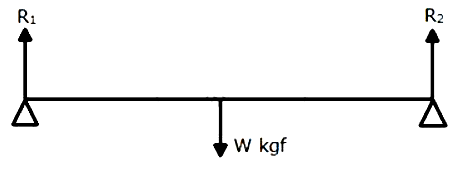
In following figure, a uniform bar of length I $m$ is supported at its ends and loaded by a weight W kgf at its middle. In equilibrium, find the reactions $R_1$ and $R_2$ at the ends.

["Hint" : "In equilibrium" "R"_1 + "R"_2 = "W" "and" "R"_1 xx 1/2 = "R"_2
$1 / 2]^2$
Answer
According to the principle of moments,
Clockwise moments $=$ anticlockwise moments
$R_1+R_2=W$
As the system is in equilibrium,
$\begin{aligned}
& R _1 \times \frac{1}{2}= R _2 \times \frac{1}{2} \\
& \because R _1= R _2
\end{aligned}$
$\because 2 R _1= W$
$\because R _1= R _2=\frac{ W }{2} kgf$
View full question & answer
Question 173 Marks
A uniform metre rule of mass 100g is balanced on a fulcrum at mark 40cm by suspending an unknown mass m at the mark 20cm.

How can it be balanced by another mass 50 g ?

Answer

From the principle of moments,

Clockwise moment= Anticlockwise moment

To balance it, 50g weight should be kept on right hand side so as to produce a clockwise moment .Let its distance from fulcrum be d cm. Then,

100g x (50-40) cm + 50g x d =50g x (40-10)cm

1000g cm + 50g x d =1500 g cm

50 g x d= 500g cm

So, d =10 cm

By suspending the mass 50g at the mark 50 cm, it can be balanced.

View full question & answer
Question 183 Marks
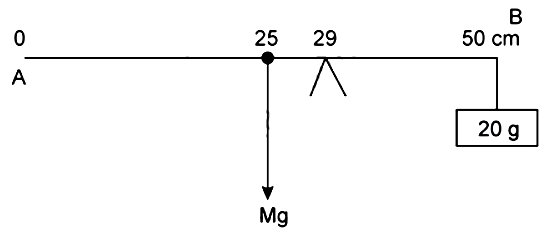
A uniform half-metre rule can be balanced at the 29.0 cm mark when a mass of 20 g is hung from its one end.
  1. Draw a diagram of the arrangement.
  2. Find the mass of the half-metre rule.
  3. In which direction would the balancing point shift if 20 g mass is shifted inside from its one end?
Answer
a.


b. The figure shows a uniform half-meter rule PQ which is balanced at the $29 cm$ mark. Let $M$ be the mass of the rule. $A$ uniform rule has the same distribution of mass throughout its length So its weight $Mg$ will act at its middle point which is at $25 cm$. The weight $mg$ produces an anticlockwise moment about point $o$. In order to balance the $20 g (0.02 kg )$ weight is tied at the $50 cm$ mark which generates a clockwise moment.
Hence from the principle of moments
Anticlockwise moment $=$ clockwise moment
$
\begin{aligned}
& M g(29-25)=20 g \times(50-29) \\
& M(4)=20 \times 21 \\
& M=\frac{20 \times 21}{4} \\
& M=105 g
\end{aligned}
$
c. We must move our balancing points in an anticlockwise manner, that is, to the left, if we move $20 g$ of mass towards the centre.
View full question & answer
Question 193 Marks
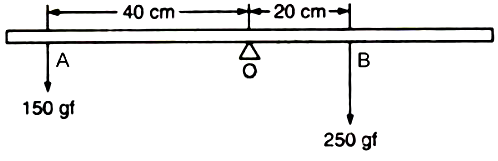
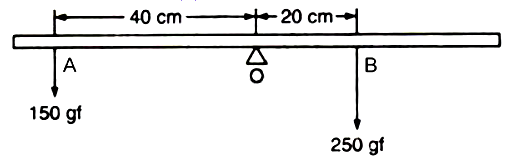
The diagram shows a uniform metre rule weighing 100gf, pivoted at its centre O. Two weights 150gf and 250gf hang from the point A and B respectively of the metre rule such that OA = 40 cm and OB = 20 cm. Calculate :

the distance from O where a 100gf weight should be placed to balance the metre rule.

Answer
From the principle of moments,
Anticlockwise moment= Clockwise moment
To balance it, $100 gf$ weight should be kept on right hand side so as to produce a clockwise moment about the $O$. Let its distance from the point $O$ be $d cm$. Then,
150 gf $x 40 cm =250$ gf $x 20 cm +100$ gf $x$ d
$6000 gf cm =5000 gf cm +100 gf x d$
$1000 gf cm =100 gf x d$
So, $d =\frac{1000 gf cm }{100 gf }=10 cm$ on the right side of $O$.
View full question & answer
Question 203 Marks
The diagram shows a uniform metre rule weighing 100gf, pivoted at its centre O. Two weights 150gf and 250gf hang from the point A and B respectively of the metre rule such that OA = 40 cm and OB = 20 cm. Calculate :

the difference of anticlockwise and clockwise moment


Answer
The difference of anticlockwise and clockwise moment= 6000- 5000= 1000gf cm
View full question & answer
Question 213 Marks
When a boy weighing 20 kgf sits at one end of a 4 m long see saw, it gets depressed at this end. How can it be brought to the horizontal position by a man weighing 40 kgf
Answer
From the principle of moments,

Anticlockwise moment = clockwise moment

20 kgf x 2 m= 40 kgf x d

So, d = (20 kgf x 2m)/40 kgf = 1 m fromthe centre on the side opposite to the boy

View full question & answer
Question 223 Marks
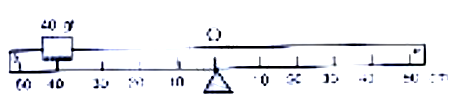
Figure shows a uniform metre rule placed on a fulcrum at its mid-point O and having a weight 40gf at the 10 cm mark and a weight of 20gf at the 90 cm mark.

How can the rule be brought in equilibrium by using an additional weight of 40 gf ?

Answer
Anticlockwise moment $= Fr$
$=40 gf \times(50-10) cm$
$=40 \times 40$
$=800 gf cm$
So, the meter rule will not be in equilibrium. It will turn in anticlockwise direction.
(ii) To balance the rule in equilibrium $40 gf$ should be kept on right side.
Let distance from middle $= d cm$
So clockwise moment becomes
$=800 gf cm +(40 gf \times d cm )$
As we know, the principle of moments states that
Anticlockwise moment $=$ Clockwise moment
$\therefore 1600 gf cm =800 gf cm +40 gf \times d cm$
Therefore,
$d =\frac{800}{40}=20 cm$
So, the additional weight should be placed at $70 cm$ mark to bring the rule in equilibrium.
View full question & answer
Question 233 Marks
The diagram below Shows a uniform bar supported at the middle point O. A weight of 40 gf is placed at a distance of 40 cm to the left of the point O. How can you balance the bar with a weight
of 80 gf?

Answer
Anticlockwise moment $=40 gf \times 40 cm$
Clockwise moment $=80 gf x d cm$
From the principle of moments,
Anticlockwise moment = Clockwise moment
$40 gf \times 40 cm =80 gf x d$
So, $d=\frac{40 g f \times 40}{80}=20 cm$ to the right of point $O$
View full question & answer
Question 243 Marks
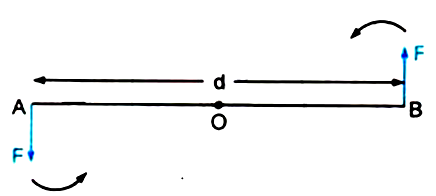
Draw a neat labelled diagram to show the direction of two forces acting on a body to produce rotation in it. Also, mark the point about which rotation takes place by the letter O.
Answer

At A and B, two equal and opposite forces each of magnitude F are applied. The two forces rotate the bar in the anticlockwise direction.
View full question & answer
Question 253 Marks

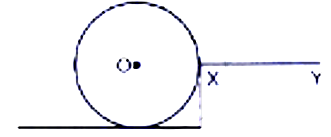
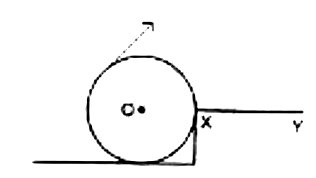
The adjacent diagram shows a heavy roller, with its axle at O. which its axle at O. which is to be raised on a pavement XY by applying a minimum possible force. show by an arrow on the diagram the point of application and the direction in which the force should be applied.

Answer

Force F should be provided in the direction as shown in the diagram.
View full question & answer
[3 Mark Question Answer] - Physics STD 10 Questions - Vidyadip