Questions

[2 Mark Question Answer]

🎯

Test yourself on this topic

16 questions · timed · auto-graded

Question 12 Marks
(a) Why the lever of the second order has mechanical advantage more than one?
(b) Why the lever of the third order has mechanical advantage less than one? Give one example of this class of lever.
Answer
The mechanical advantage of lever is given by the expression, effort arm load$ \div$ arm.
(a) In case of lever of second order, the effort arm is always longer than the lood arm and hence, its mechanical advantage is more than 1.
(b) In case of lever of the third order, the effort arm is always smaller than the load arm and hence, its mechanical advantage is less than 1. For example, a fire tong is a lever of third order.
View full question & answer
Question 22 Marks
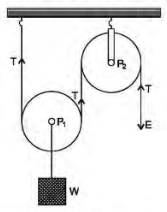
The combination of two pulleys $P _1$ and $P _2$ are used to lift up a load $W$ as shown in the figure.
Image
Complete the table using the labels from the figure. The first label is done for you.
S.No Description Label
$(a)$ Name the pulley $P_1$ Movable
$(b)$ Name the pulley $P_2$  
$(c)$ The pulley used to change the direction of effort  
$(d)$ Relation between $T$ and $E$  
$(e)$ Relation between $E$ and $W$  
Answer
 Fixed $(c) P _2 \ (d) \ T = E \ (e) \ E = W / 2$
View full question & answer
Question 42 Marks
Explain Block and Tackle system of a pulley.
Answer
In sheaf pulley system there are two sets of pulleys, each set containing two or more pulleys, these pulleys are mounted on a common axle and are of the same radius. The set of pulleys attached to the high platform is called a block, whereas the set of pulleys attached to the load is called a tackle.
View full question & answer
Question 62 Marks
Give reasons for using single fixed pulley.
Answer
Single fixed pulley is used widely because:
(a) It is always easier to apply effort in the downward direction rather than in the upward direction. Thus, the pulley helps in changing the direction of effort.
(b) One can use one's own body weight, while applying the effort in the downward direction.
View full question & answer
Question 72 Marks
Explain why the cutting edges of scissors are made longer as compared to the cutting edges of a metal cutter.
Answer
Effort gets multiplied only, if effort arm is longer than load arm. In case of scissors, as effort need not be multiplied, therefore, the effort arm is smaller than load arm.
However, in case of a metal cutter, the resistance due to metal is very large. Thus, effort needs multiplication. It is achieved by making cutting edge (load arm) smaller than the effort arm.
View full question & answer
Question 82 Marks
How will you determine the order (kind) of a lever?
Answer
Locate, which amongst the effort, the fulcrum or the load is in the middle. If the fulcrum is in the middle, the lever is of the first order. If the load is in the middle, the lever is of the second order. If the effort is in the middle, the lever is of the third order.
View full question & answer
Question 92 Marks
An effort of 8 kgf is applied on a machine through a distance of 50 cm, when a load of 100 kgf moves through a distance of 3 cm.
Calculate (a) velocity ratio (b) mechanical advantage (c) %age efficiency of the machine.
Answer
(a) Velocity ratio $=\frac{\text { Distance through which the effort moves }}{\text { Distance through which the load moves }}=\frac{50 cm}{3 cm}=16.67$.
(b) Mech. Adv. $=\frac{\text { Load }}{\text { Effort }}=\frac{100 kgf }{8 kgf }=12.5$.
(c) %age efficiency $=\frac{ MA }{ VR } \times 100=\frac{12.5}{16.67} \times 100=75 \%$.
View full question & answer
Question 102 Marks
Explain, why a machine can not be 100% efficient?
Answer
A machine can never be 100% efficient because:
(a) a part of the input is wasted in moving the parts of the machine.
(b) a part of the input is wasted in overcoming friction between the moving parts.
View full question & answer
Question 112 Marks
Prove that efficiency of a machine is the ratio between mechanical advantage and the velocity ratio.
Answer
Consider a machine which displaces a useful load '$l$' through a distance 'd', when an effort 'E' causes a displacement through distance D.
$\therefore$ Output $=$ Work done in displacing the load $=l \times d$
Input $=$ Work done by the effort in causing the displacement $= E \times D$
$\therefore$ Efficiency $=\eta=\frac{\text { Output }}{\text { Input }}=\frac{l \times d}{ E \times D }=\frac{l}{ E } \div \frac{D}{d}= MA \div VR$
$\therefore \eta=\frac{ MA }{ VR }$
View full question & answer
Question 122 Marks
Define the following terms with reference to machine:
(a) Ideal mechanical advantage (b) Efficiency
Answer
(a) Ideal mechanical advantage is the ratio between the total load (useful load + resistance due to friction and movable parts of machine) moved to the effort applied.
(b) Efficiency is the ratio between the useful output to the actual input of the machine.
View full question & answer
Question 132 Marks
Define the following terms with reference to a machine:
(a) Useful load (b) Effort (c) Ideal machine
Answer
(a) Useful load is the actual load lifted by the machine.
(b) Effort is the external force applied on a machine to overcome the load or resistance,
(c) Ideal machine is a machine whose parts are weightless and frictionless, such that the input is equal to the output
View full question & answer
Question 142 Marks
Define the following terms with reference to a machine:
(a) Total load (b) Actual mechanical advantage (c) Velocity ratio
Answer
(a) Total load is the sum of load lifted by the machine and the load due to friction and movable parts of machine.
(b) Actual mechanical advantage is the ratio between the useful load moved to the effort applied.
(c) Velocity ratio is the ratio of the distance traversed by the effort to the distance traversed by the load in the same time.
View full question & answer
Question 152 Marks
(a) Name six simple machines.
(b) Give one practical example of each machine named in (a).
Answer
(a) Inclined plane, pulley, wedge, screw, wheel and axle, and lever are examples of simple machines.
(b) Inclined plane - A ramp, Pulley Single fixed pulley, Lever-Handle of water pump, Screw A jack screw, Wedge An axe, Wheel and axle - Screw driver
View full question & answer
Question 162 Marks
(a) What is a machine?
(b) State three functions of a machine.
Answer
(a) Machine is a device by which we can overcome large resistance or gain speed or change the direction of effort applied, by applying comparatively a small force at a convenient point, and in a desired direction.
(b) (i) A machine can multiply force.
(ii) A machine can increase speed.
(iii) A machine can change the direction of effort applied
View full question & answer
[2 Mark Question Answer] - Physics STD 10 Questions - Vidyadip