Questions

[5 Mark Question Answer]

🎯

Test yourself on this topic

5 questions · timed · auto-graded

Question 14 Marks
Briefly explain the changes which take place during infancy, childhood and adulthood.
Answer
Infancy $–$ The beginning of the second stage of growth called infancy starts as soon as a child is born. Infancy starts from birth and lasts till about the child becomes two years old. During this period babies grow rapidly. They learn to sit, stand, recognize people and things around them.

Childhood $–$ Childhood lasts for about ten years $–$ from about $2$ years to $12$ years of age. Physical changes take place during childhood. You grow in size at a slow and steady rate. You continue to grow intellectually, emotionally and socially.

Adolescence $–$ Adolescence most often starts from the age of $10$ years and last till age of around $18$ years. During adolescence the body grows very quickly and changes in many ways. This is the period when lot of emotional, physical and mental development is taking place. This is because many hormonal changes taking place in the body during this period. In females at the age of $10-11$ years and in males at the age of $13-14$ $years/the reproductive organs become functional.
Image
Adulthood $–$ When are you really an adult ? There is no sign that shows that a person has$-$reached adulthood. You might look like an adult as adolescent growth ends. At that time, one would have reached Hill height with all body systems folly formed. But emotionally, intellectually and socially one keeps on growing. One takes many important decisions about where to work, live, how to spend money and how to raise a family.
One keeps growing and changing during adulthood.
View full question & answer
Question 24 Marks
Explain the process of development of a zygote into a foetus.
Answer
The process of formation of an individual from the basic unit of life, that is, zygote $($in plants it is a seed or any body part$)$ is called development. In humans the zygote after reaching the uterus begins to divide to form many more cells and becomes a ball of cells. This gets attached to the wall of the uterus for further development. The time between fertilization and birth is called pregnancy, which lasts for around $280$ days or $9$ months.

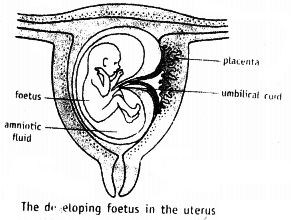
From the third week of development till the end of the second month the developing organism is called an embryo. The embryo is attached to the uterus by a special structure called placenta. Through the placenta, materials like nutrients and oxygen pass from the mother to the embryo but the blood of the mother and embryo do not mix.

Carbon dioxide and other wastes from the embryo pass to the mother’s blood through the placenta. The embryo is connected to the placenta through a cordlike structure called the umbilical cord. The embryo is surrounded by a sac$-$like membrane called amnion and it is filled with a fluid called amniotic fluid. This acts like a cushion and protects the growing embryo. The ball of cells undergoes many cell divisions.

The cells change their size, shape and turn into particular types of cells performing specific functions, such as nerve cells and blood cells. This is called cell differentiation. From these differentiated cells, tissues and organs develope which get organized and finally develop to form a new individual. From the beginning of the third month until birth the developing baby is called a foetus.
View full question & answer
Question 34 Marks
Explain the life cycle of a butterfly.
Answer
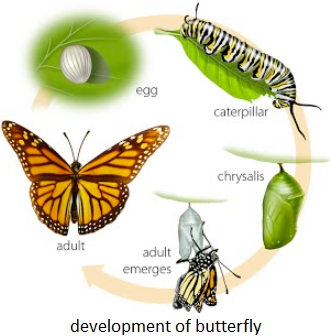
In insects, such butterflies, fertilized eggs are laid. A caterpillar hatches out from an egg. The caterpillar looks more like a worm than like a butterfly. A Caterpillar of a butterfly is called the larva. A larva eats a large quantity of leaves and grows larger until its skin bursts. A new and larger caterpillar comes out and continues to eat and grow. The process of casting off the old skin while growing is called moulting. The caterpillar then produces an outer covering called a cocoon around itself.

Inside the cocoon, the organism begins the next stage of its life cycle, called the pupa. Sometimes the pupa is called a resting stage but it is not a time of rest. There are many changes which take place inside the cocoon. Within the cocoon, the tissues of the larva reorganize to form the butterfly. Finally the cocoon breaks open and the adult butterfly comes out.Image
View full question & answer
Question 44 Marks
How is artificial pollination carried out ?
Answer
Artificial pollination is performed to produce a new variety of a crop plant with certain required characteristics. In this process two different varieties of a crop plant $($each possessing some wanted characteristics$)$ are selected. One variety of a crop plant may be high$-$yielding (higher seed producing) and the other variety may be disease$-$resistant $($resistant to diseases$)$. After selection of the parent plants, cross$-$breeding is done by artificial pollination to have a variety of crop which has characteristics of both the parent varieties. This is called hybridization. The new variety fomied is called a hybrid.
Many hybrid high$-$yielding varieties of wheat, rice and maize have been produced by the process of hybridization. In artificial pollination during hybridization, the stamens of a bisexual flower are removed before their anthers mature.
$\rightarrow$ This flower with gynoecium intact, is covered with a paper or a muslin bag to prevent natural pollination.
$\rightarrow$ When the stigma of this flower matures, pollen grains from another selected plant are taken and deposited on the stigma.
$\rightarrow$ The seeds produced after artificial pollination give rise to new hybrid variety which is generally better than the parent crops.
$\rightarrow$ They are high$-$yielding, of better quality and disease$-$resistant.
View full question & answer
Question 54 Marks
List the different types of asexual reproduction giving one example of each.
Answer
Asexual Reproduction :
It is the form of reproduction that involves only one parent organisms. Fusion of an egg and a sperm cell does not occur in it. New organisms formed is exact copy of parent.
Different methods of Asexual reproduction are :
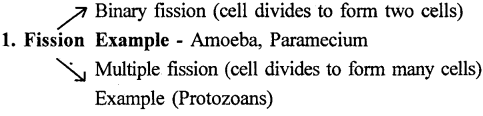
Image
$2.$ Budding : A small out$-$growth called bud grows into new organism. Example Hydra
$3.$ Spore Formation : Tiny, spherical, unicellular bodies protected by a thick wall called spore develops into new organism. Example Bacteria, fungi.
$4.$ Regeneration : In some organisms, entire body divides in to several parts and each part develops in to new complete organisms. Example $–$ Hydra, Flatworm.
$5.$ Fragmentation : In Spirogyra, the long ribbon like body breaks up in to two or more fragments. These fragments grow into new individuals.
$6.$ Vegetative Propagation : The development of a new plant from the vegetative part like a stem, root or leaf.
$(a)$ stem $–$ Potato $($underground stem$)$ Strawberry $($Aerial stem$)$
$(b)$ leaves $–$ Bryophyllum
$7.$ Artificial Propagation $–$ The methods of vegetative propagation adopted by man are called artificial propagation. These are $–$
$(a)$ Cutting $–$ Example Bougainvillea
$(b)$ Layering $–$ Example lemon, rose
$(c)$ Grafting $–$ Example Mango
$(d)$ Tissue Culture $–$ Example Asparagus, orchids
View full question & answer
[5 Mark Question Answer] - BIOLOGY STD 8 Questions - Vidyadip