Question 15 Marks
A weather forecasting plastic balloon of volume $15 m^3$ contains hydrogen of density $0.09 kg m ^{-3}$. The volume of equipment carried by the balloon is negligible compared to its own volume. The mass of an empty balloon alone is 7.15 kg . The balloon is floating in air of density of $1.3 kg m ^{-3}$. Calculate:
(i) The mass of hydrogen in the balloon,
(ii) The mass of hydrogen and balloon,
(iii) The total mass of hydrogen, balloon and equipment if the mass of equipment is $x kg$,
(iv) The mass of air displaced by balloon and
(v) The mass of equipment using the law of floatation.
(i) The mass of hydrogen in the balloon,
(ii) The mass of hydrogen and balloon,
(iii) The total mass of hydrogen, balloon and equipment if the mass of equipment is $x kg$,
(iv) The mass of air displaced by balloon and
(v) The mass of equipment using the law of floatation.
Answer
View full question & answer→Volume of plastic balloon $=15 m^3$ Mass of empty balloon $=7.15 kg$ Density of hydrogen $=0.09 kgm ^{-3}$ Density of air $=$ $1.3 kgm ^{-3}$ (i) Mass of hydrogen in the balloon= Volume of balloon $\times$ Density of hydrogen
Mass of hydrogen in the balloon $=(15 \times 0.09) kg =1.35 kg$ (ii) Mass of hydrogen and balloon $=$ Mass of empty balloon
+ Mass of hydrogen in the balloon
Mass of hydrogen balloon $=[7.15+1.35) kg =8.5 kg$ (iii) Given mass of equipment $= x$
Total mass of hydrogen, balloon and equipmemt $=(8.5+x) kg$ (iv) Weight of air displaced by the balloon $=$ upthrust
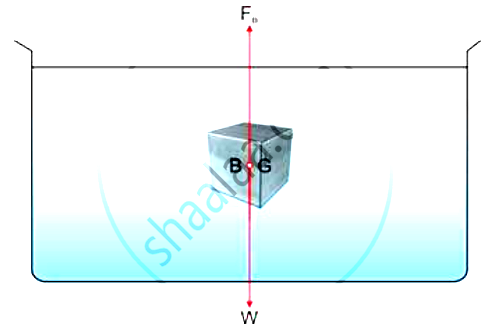
$=$ Volume of balloon x density of air x g
Mass of air displaced = Volume of balloon $x$ density of air
$=15 \times 1.3=19.5 kg( v )$ Using the law of floatation,
Mass of air displaced= Total mass of hydrogen, balloon and equipmemt
or, $19.5=8.5+x$
or, $x=11 kg$
Thus, mass of the equipment 11 kg
Mass of hydrogen in the balloon $=(15 \times 0.09) kg =1.35 kg$ (ii) Mass of hydrogen and balloon $=$ Mass of empty balloon
+ Mass of hydrogen in the balloon
Mass of hydrogen balloon $=[7.15+1.35) kg =8.5 kg$ (iii) Given mass of equipment $= x$
Total mass of hydrogen, balloon and equipmemt $=(8.5+x) kg$ (iv) Weight of air displaced by the balloon $=$ upthrust
$=$ Volume of balloon x density of air x g
Mass of air displaced = Volume of balloon $x$ density of air
$=15 \times 1.3=19.5 kg( v )$ Using the law of floatation,
Mass of air displaced= Total mass of hydrogen, balloon and equipmemt
or, $19.5=8.5+x$
or, $x=11 kg$
Thus, mass of the equipment 11 kg