Question
Describe an experiment to verify the Archimedes' principle.

Answer

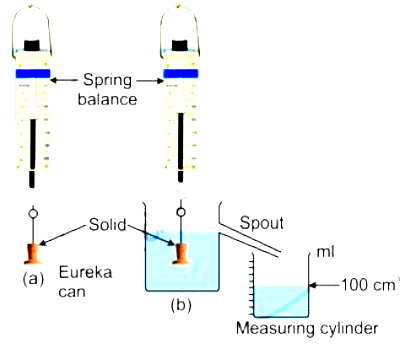
Let us take a solid and suspend it by a thin thread from the hook of a spring balance and note its weight .
Then take a eureka can and fill it with water up to its spout. Arrange a measuring cylinder below the spout of the eureka can as shown. Immerse the solid gently in water. The water displaced by the solid
gets collected in the measuring cylinder.


When water stops dripping through the spout, note the weight of the solid and volume of water collected in the measuring cylinder.
From diagram, it is clear that
Loss in weight (Weight in air – weight in water) = 300 gf – 200 gf = 100 gf
Volume of water displaced = Volume of solid $= 100 cm^3$
Because density of water $= 1 gcm^{-3}$​​​​​​​
Weight of water displaced = 100 gf = Upthrust or loss in weight
This verifies Archimedes' principle.

Need a full question paper?

Generate a complete, print-ready paper with questions like this in minutes — across 16+ boards, with answer keys.
Start Generating Free

Similar questions

Name an instrument based on this principle. State two uses of the instrument that you describe.
A micrometre screw gauge has a negative zero error of 7 divisions. While measuring the diameter of a wire the reading on main scale is 2 divisions and 79th circular scale division coincides with base line.
If the number of divisions on main scale is 10 to a centimetre and circular scale has 100 divisions, calculate
1. pitch
2. observed diameter
3. least count
4. corrected diameter.
On a 120 km track, a train travels the first 40 km at a uniform speed of 30 km/h. How fast must the train travel the next 80 km, so as to average 60 km/h for the entire trip.
QUESTION The density of ice is $0.92 g cm ^{-3}$ and that of sea water is $1.025 g cm ^{-3}$. Find the total volume of an iceberg which floats with its volume $800 cm^3$ above water.
Describe an experiment to prove that material medium is necessary for the propagation of sound.
Explain with an example, the propagation of sound in a medium.
Compare the time periods of a simple pendulum at places where $g =9.8 ms^{-2}$ and $4.36 ms^{-2}$ respectively.
Explain meaning of the terms compression and rarefaction in relation to a longitudinal wave.
Prove experimentally that images are formed as far behind in a plane mirror as the object is in front of it.
A balloon of volume $800 cm^2$ is filled with hydrogen gas of density $9 \times 10:$ gemr2. If the empty balloon weighs 0.3 gf and density of air is $1.3 \times 10^2 g gem ^2$, calculate the lifting power of balloon.