Question 14 Marks
Find the centroid of $\triangle\text{ABC}$ whose vertices are $A(2, 2), B(-4, -4)$ and $C(5, -8)$.
AnswerThe given points are $A(2, 2), B(-4, -4)$ and $C(5, -8)$.
Here, $(x_1 = 2, y_1 = 2), (x_2 = -4, y_2 = -4)$ and $(x_3 = 5, y_3 = -8)$
Let $G(x, y)$ be the centroid of $\triangle\text{ABC}.$ Then,
$\text{x}=\frac{1}{3}(\text{x}_1+\text{x}_2+\text{x}_3)$
$=\frac{1}{3}(2-4+5)$
$=1$
$\text{y}=\frac{1}{3}(\text{y}_1+\text{y}_2+\text{y}_3)$
$=\frac{1}{3}(2-4-8)$
$=\frac{-10}{3}$
Hence, the centroid of $\triangle\text{ABC}$ is $\text{G}\Big(1,\frac{-10}{3}\Big).$
View full question & answer→Question 24 Marks
If the point $A(0, 2)$ is equidistant from the points $B(3, p)$ and $C(p, 5)$, find P.
AnswerThe given points are $A(0, 2), B(3, p)$ and $C(p, 5)$.
$AB = AC \Rightarrow AB^2 = AC^2$
$\Rightarrow (3 - 0)^2 + (p - 2)^2 = (p - 0)^2 + (5 - 2)^2$
$\Rightarrow 9 + p^2 - 4p + 4 = P^2 + 9$
$\Rightarrow 4p = 4$
$ \Rightarrow p = 1$
Hence, $p = 1$
View full question & answer→Question 34 Marks
Find the lengths of the medians AD and BE of $\triangle\text{ABC}$ whose vertices are A(7, -3), B(5, 3) and C(3, 1).
AnswerThe given vertices are A(7, -3), B(5, 3) and C(3, -1).
Since D and E are the mid-points of BC and AC respectively, therefore
Coordinates of D $=\Big(\frac{5+3}{2},\frac{3-1}{2}\Big)=(4,1)$
Coordinates of E $=\Big(\frac{7+3}{2},\frac{-3-1}{2}\Big)=(5,-2)$
Now,
$\text{AD}=\sqrt{(7-4)^2+(-3-1)^2}$
$=\sqrt{9+16}=5$
$\text{BE}=\sqrt{(5-5)^2+(3+2)^2}$
$=\sqrt{0+25}=5$
Hence, AD = BE = 5 units.
View full question & answer→Question 44 Marks
Find the coordinates of a point A, where AB is a diameter of a circle with center C(2, -3) and the other end of the diameter is B(1, 4).
AnswerA, B are the end points of a diameter. Let the coordinates of A be (x, y). The point B is (1, 4).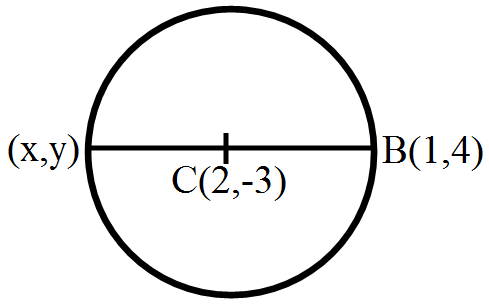
The center C(2, -3) is the mid-point of AB $\therefore\ \frac{\text{x}+1}{2}=2\Rightarrow\ \text{x}=3$ $\frac{\text{y}+2}{2}=-3\Rightarrow\ \text{y}=-10$ The points A is (3, -10) View full question & answer→Question 54 Marks
Find the ratio in which the point $P(x, 2)$ divides the join of $A(12, 5)$ and $B(4, -3).$
AnswerLet k be the ratio in which the point $P(x, 2)$ divides the joining the points $A(x_1 = 12, y_1 = 5)$ and $B(x_2 = 4, y_2 = -3)$.
Then $\text{x}=\frac{\text{k}\times4+12}{\text{k}+1}$ and $2=\frac{\text{k}\times(-3)+5}{\text{k}+1}$
Now
$2=\frac{\text{k}\times(-3)+5}{\text{k}+1}\Rightarrow\ 2\text{k}+2=-3\text{k}+5\Rightarrow\ \text{k}=\frac{3}{5}$
Hence, the required ratio is $3 : 5$.
View full question & answer→Question 64 Marks
The base QR of an equilateral triangle PQR lies on x-axis. The coordinates of the point Q are (-4, 0) and origin is the midpoint of the base. Find the coordinates of the points P and R.
Answer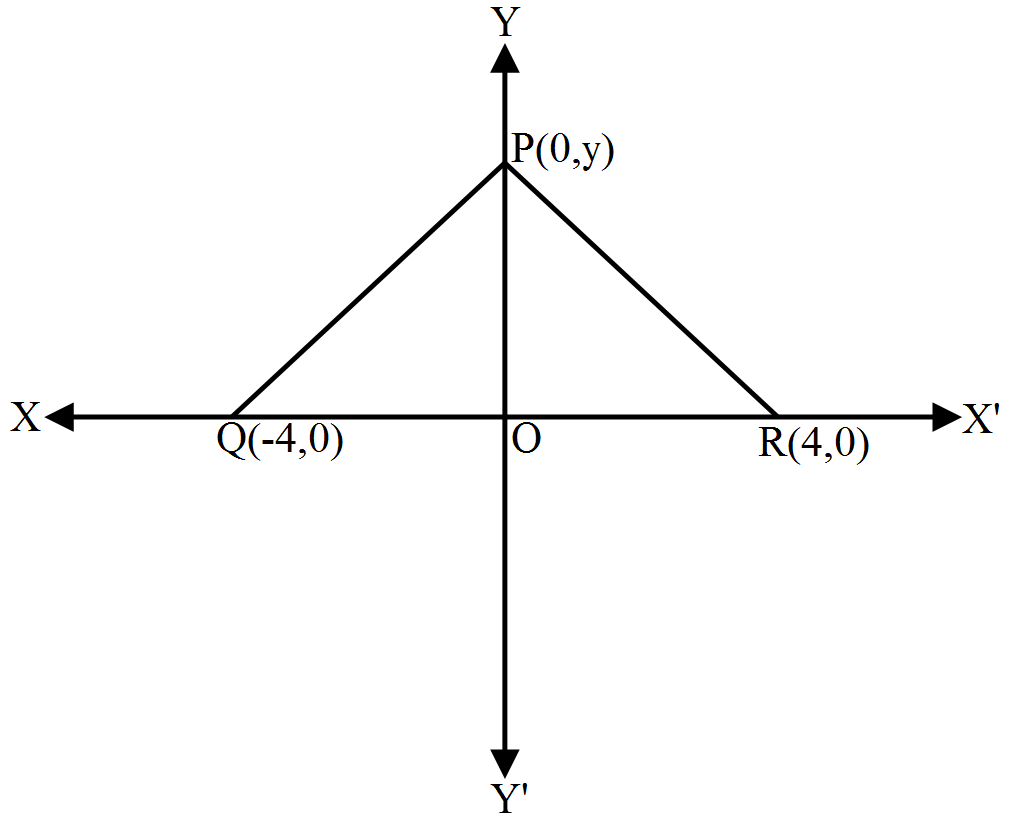
Given PQR is an equilateral triangle such that
QR lies on x-axis.
Clearly, orgin O is the mid-point of QR,
⇒ OQ = OR = 4 units
⇒ Coordinates of R are (4, 0)
Now, P lies on y-axis.
Let the coordinates of P be (0, y).
Now, PQ = QR = PR
Consider PQ = QR
$\Rightarrow\ \sqrt{(-4-0)^2+(0-\text{y})^2}=\sqrt{(4+4)^2+(0-0)^2}$
$\Rightarrow\ \sqrt{16+\text{y}^2}=\sqrt{64}$
$\Rightarrow\ 16+\text{y}^2=64$
$\Rightarrow\ \text{y}^2=48$
$\Rightarrow\ \text{y}=\pm4\sqrt{3}$
Thus, coordinates of P are $(0+4\sqrt{3})$ or $(0-4\sqrt{3})$. View full question & answer→Question 74 Marks
If the point $(x, y)$ is equidistant from the points $(a + b, b - a)$ and $(a - b, a + b)$,
prove that $bx = ay$.
AnswerIt is being given that $(x, y)$ is equidustant from the points $(a + b, b - a)$ and $(a - b, a + b)$
Thus, we have
$[x - (a + b)]^2 + [y - (b - a)]^2 = [x - (a - b)]^2 + [y - (a + b)]^2$
$\Rightarrow [(x - a) - b]^2 + [(y - b) + a]^2= [(x - a)+ b]^2 + [(y - b) - a]^2$
$\Rightarrow [(x - a) + b]^2 - [(x - a) - b]^2 = [(y - b) + a]^2 - [(y - b) - a]^2$
$\Rightarrow (x - a)^2 + b^2 + 2(x - a)b - (x - a)^2 - b^2 + 2(x - a)b$
$\Rightarrow (y - b)^2 + a^2 + 2(y - b)a - (y - b)^2 - a^2 + 2(y - b)a$
$\Rightarrow 4(x - a)b = 4(y - b)a$
$\Rightarrow bx - ab = ay - ab$
$\Rightarrow bx = ay$
View full question & answer→Question 84 Marks
Find the distance between the points:
$\text{P}(\text{a}\sin\alpha,\text{a}\cos\alpha)$ and $\text{Q}(\text{a}\cos\alpha, -\text{a}\sin\alpha)$
AnswerThe given points are $\text{P}(\text{a}\sin\alpha,\text{a}\cos\alpha)$ and $\text{Q}(\text{a}\cos\alpha, -\text{a}\sin\alpha)$
Then, $(\text{x}_1=\text{a}\sin\alpha,\text{y}_1=\text{a}\cos\alpha)$ and $(\text{x}_2=\text{a}\cos\alpha,\text{ y}_2=-\text{a}\sin\alpha)$
$\therefore\text{PQ}=\sqrt{(\text{x}_2-\text{x}_1)^2+(\text{y}_2-\text{y}_1)^2}$
$=\sqrt{(\text{a}\cos\alpha -\text{a}\sin\alpha)^2+(-\text{a}\sin\alpha -\text{a}\cos\alpha)^2}$
$=\sqrt{\text{a}^2\cos^2\alpha+\text{a}^2\sin^2\alpha+\text{a}^2\cos^2\alpha+\text{a}^2\sin^2\alpha}$
$=\sqrt{\text{a}^2(\cos^2\alpha+\sin^2\alpha)\text{a}^2(\cos^2\alpha+\sin^2\alpha)}$
$=\sqrt{\text{a}^2+\text{a}^2}$
$=\sqrt{\text{2a}^2}=\sqrt{2}\text{a}\text{ units}.$
View full question & answer→Question 94 Marks
Find the ratio in which the point (-3, k) divides the join of A(-5, -4) and B(-2, 3). Also find the value of k.
AnswerLet P is dividing the given segment joining A(-5, -4) and B(-2, 3) in the ratio r : 1.
$\therefore$ coordinates of point P $\Big(\frac{-2\text{r}+1\times(-5)}{\text{r}+1},\frac{\text{r}\times3+1\times(-4)}{\text{r}+1}\Big)\text{i.e}\Big(\frac{-2\text{r}-5}{\text{r}+1},\frac{3\text{r}-4}{\text{r}+1}\Big)$ Also, the coordinates of points P are (-3, k). $\therefore\ \frac{-2\text{r}-5}{\text{r}+1}=-3\Rightarrow\ -2\text{r}-5=-3\text{r}-3,$ $\Rightarrow\ \text{r}=2$ And $\text{k}=\frac{3\text{r}-4}{\text{r}+1}=\frac{3\times2-4}{2+1}=\frac{2}{3}$ $\therefore$ P is dividing AB in the ratio 2 : 1 and $\text{k}=\frac{2}{3}$ View full question & answer→Question 104 Marks
Show taht the following points are collinear:$A(5, 1), B(1, -1)$ and $C(11, 4)$
AnswerLet $A(x_1 = 5, y_1= 1), B(x_2 = 1, y_2= -1)$ and $C(x_3 = 11, y_3= 4)$ be the given points.
Now
$x_1(y_2 - y_3) + x_2(y_3 - y_1) + x_3(y_1 - y_2)$
$= 5(-1 - 4) + 1(4 - 1) + 11(1 + 1)$
$= -25+ 3 + 22$
$= 0$
Hence the given point are collinear.
View full question & answer→Question 114 Marks
If the vertices of $\triangle\text{ABC}$ be $A(1, -3), B(4, p)$ and $C(-9, 7)$ and its area is $15$ square units, find the values of $p$.
AnswerLet $A(x_1, y_1) = A(1, -3), B(x_2, y_2) = B(4, p)$ and $C(x_3, x_4) = C(-9, 7)$.Now,
$\text{ar}(\triangle\text{ABC})=\frac{1}{2}[\text{x}_1(\text{y}_2-\text{y}_3)+\text{x}_2(\text{y}_3-\text{y}_1)+\text{x}_3(\text{y}_1-\text{y}_2)]$
$\Rightarrow15=\frac{1}{2}[1(\text{p}-7)+4(7+3)-9(-3-\text{p})]$
$\Rightarrow15=\frac{1}{2}[10\text{p}+60]$
$\Rightarrow[10\text{p}+60]=30$
Therefore
$\Rightarrow[10\text{p}+60]=-30\text{ or}30$
$\Rightarrow10\text{p}=-9\text{ or}-30$
$\Rightarrow\text{p}=-9\text{ or}-3$
Hence, $p = -9$ or $p = -3$.
View full question & answer→Question 124 Marks
Find the distance between of the following points from the origin:
A(5, -12)
AnswerThe gven point is A(5, -12) and let O(0, 0) be the origin
Then, $\text{AO}=\sqrt{(5-0)^2+(-12-0)^2}$
$=\sqrt{5^2+(-12)^2}$
$=\sqrt{25+144}$
$=\sqrt{169}=13\text{ units}.$
View full question & answer→Question 134 Marks
In what ratio does y-axis divide the line segment joining the points (-4, 7) and (3, -7)?
AnswerLet the y-axis cut the join of A(-4, 7) and B(3, -7) at the point p in the ratio k : 1. Then,
By section formula,
Coordinates of p $=\Big(\frac{\text{k}\times3+1\times(-4)}{\text{k}+1},\frac{\text{k}\times(-7)+1\times7}{\text{k}+1}\Big)$
$=\Big(\frac{3\text{k}-4}{\text{k}+1},\frac{-7\text{k}+7}{\text{k}+1}\Big)$
But p lies on y-axis. So, its abscissa is 0.
$\therefore\ \frac{3\text{k}-4}{\text{k}+1}=0$
$\Rightarrow\ 3\text{k}-4=0$
$\Rightarrow\ 3\text{k}=4$
$\Rightarrow\ \text{k}=\frac{4}{3}$
So, the required ratio is 4 : 3.
View full question & answer→Question 144 Marks
Find the coordinates of the point on x-axis which is equidistance from the points (-2, 5) and (2, -3).
Question 154 Marks
Find the area of quadrilateral PQRS whose vertices are $P(-5, -3), Q(-4, -6), R(2, -3)$ and $S(1, 2)$
AnswerBy joining P and R, We get triangle PQR and PRS.
Let
$P(x_1, y_1) = P(-5, -3), Q(x_2, y_2) = Q(-4, -6), R(x_3, y_3) = R(2, -3)$ and $S(x_4, y_4) = S(1, 2)$.
Then
Area of $\triangle\text{PQR}=\frac{1}{2}[\text{x}_1(\text{y}_2-\text{y}_3)+\text{x}_2(\text{y}_3-\text{y}_1)+\text{x}_3(\text{y}_1-\text{y}_2)]$
$=\frac{1}{2}[(-5)(-6+3)-4(-3+3)+2(-3+6)]$
$=\frac{1}{2}[15-0+6]$
$=\frac{21}{2}\ \text{sq.units}$
Area of $\triangle\text{PRS}=\frac{1}{2}[\text{x}_1(\text{y}_3-\text{y}_4)+\text{x}_3(\text{y}_4-\text{y}_1)+\text{x}_4(\text{y}_1-\text{y}_3)]$
$=\frac{1}{2}[-5(-3-2)+2(2+3)+1(-3+3)]$
$=\frac{1}{2}[25+10+0]$
$=\frac{35}{2}\ \text{sq}.\text{units}$
So, the area of the quadrilateral is $=\frac{21}{2}+\frac{35}{2}=28\ \text{sq}.\text{units}$
View full question & answer→Question 164 Marks
Find the value of $x$ for which the points $A(x, 2), B(-3, -4)$ and $C(7, -5)$ are collinear.
AnswerLet $A(x_1, y_1) = A(x, 2), B(x_2, y_2) = B(-3, -4)$ and $C(x_3 , y_3) = C(7, -5)$
so, the condition for three collinear point is.
$x_1(y_2 - y_3) + x_2(y_3 - y_1) + x_3(y_1 - y_2) = 0$
$= x(-4 + 5) - 3(-5 - 2) + 7(2 + 4) = 0$
$= x + 21 + 42 = 0$
$= x = -63$
Hence, $x = -63.$
View full question & answer→Question 174 Marks
The midpoint of the line segment joining A(2a, 4) and B(-2, 3b) is C(1, 2a + 1). Find the values of a and b.
AnswerC(1, 2a + 1) is the mid-point of A(2a, 4) and B(-2, 3b)
$\text{x}=\frac{\text{x}_2+\text{x}_1}{2}$ and $\text{y}=\frac{\text{y}_2-\text{y}_1}{2}$
$1=\frac{-2+2\text{a}}{2}$ and $2\text{a}+1=\frac{3\text{a}+4}{2}$
2 = -2 + 2a and 4a + 2 = 3b + 4 ...(1)
a = 2 ...(2)
Putting a = 2 in (1), we get
4 × 2 + 2 = 3b + 4 ⇒ 10 - 4 = 3b
⇒ 3b = 6
$\Rightarrow\ \text{b}=\frac{6}{3}=2$
Hence, a = 2 and b = 2
View full question & answer→Question 184 Marks
Find a relation between x and y, if the points A(2, 1), B(x, y), and C(7, 5) are collinear.
AnswerLet $A (x_1 = 2, y_1 = 1), B (x_2 = x, y_2 = y)$ and $(x_3 = 7, y_3 = 5)$ be the given points.
The given point are collinear if
$x_1(y_2 - y_3) + x_2(y_3 - y_1) + x_3(y_1 - y_2) = 0$
$ \Rightarrow 2(y - 5) + x(5 - 1) + 7(1 - y) = 0 $
$\Rightarrow -2y - 10 + 4x + 7 - 7y = 0 $
$\Rightarrow 2y - 10 + 4x + 7 - 7y = 0 $
$\Rightarrow 4x - 5y - 3 = 0$
Hence, the required relation is $4x - 5y - 3 = 0.$
View full question & answer→Question 194 Marks
Find the point on the y-axis which is equidistant from the points $A(6, 5)$ and $B(-4, 3)$.
AnswerLet the required point be $C(0, y)$
Then, we have
$AC = BC$
$\Rightarrow AC^2 = BC^2$
$\Rightarrow (6 - 0)^2 + (5 - y)^2 = (-4 - 0)^2 + (3 - y)^2$
$\Rightarrow (6)^2 + (25 + y^2 - 10y) = (-4)^2 + (9 + y^2 - 6y)$
$\Rightarrow 36 + 25 + y^2 - 10y = 16 + 9 + y^2 - 6y$
$\Rightarrow 61 - 10y = 25 - 6y$
$\Rightarrow 4y = 36$
$\Rightarrow y = 9$
Hence, the required point is $C(0, 9)$.
View full question & answer→Question 204 Marks
Find the third vertex of a $\triangle\text{ABC}$ if two of its vertices are B(-3, 1) and C(0, -2), and its centroid is at the origin.
AnswerTwo vertices of $\triangle\text{ABC}$ are B(-3, 1) and C(0, -2) and third vertex be A(a, b). Then,
The coordinates of its centroid are
$\text{G}\Big(\frac{-3+0+\text{a}}{3},\frac{1-2+\text{b}}{3}\Big),\text{i.e},\text{G}\Big(\frac{-3+\text{a}}{3},\frac{-1+\text{b}}{3}\Big)$
But it is given that the centroid is G(0, 0).
$\frac{-3+\text{a}}{3}=0$ and $\frac{-1+\text{b}}{3}=0$
-3 + a = 0 and -1 + b = 0
⇒ a = 3 and b = 1
Hence the third vertices A of $\triangle\text{ABC}$ is A(3, 1).
View full question & answer→Question 214 Marks
Find the value of y for which the points $A(-3, 9), B(2, y)$ and $C(-4, -5)$ are collinear.
AnswerLet $A (x_1 = -3, y_1 = 9), B (x_2 = 2, y_2 = y)$ and $(x_3 = 4, y_3 = -5)$ be the given points.
The given point are collinear if
$x_1(y_2 - y_3) + x_2(y_3 - y_1) + x_3(y_1 - y_2) = 0$
$ \Rightarrow (-3)(y + 5) + 2(-5 - 9) + 4(9 - y) = 0 $
$\Rightarrow 3y - 15 - 28 + 36 - 4y = 0 $
$\Rightarrow 7y = 36 - 43$
$ \Rightarrow y = -1$
View full question & answer→Question 224 Marks
In what ratio does point$\Big(\frac{24}{11},\text{y}\Big)$ divide the line segment joining the points P(2, -2) and Q(3, 7)? Also, find the value of y.
Answer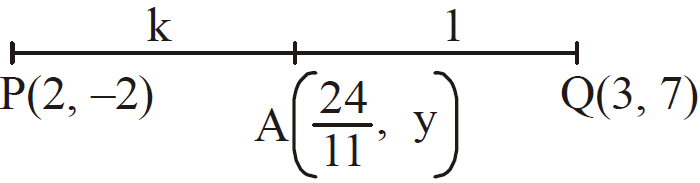
Let PA : AQ = k : 1
$\therefore \frac{2 + 3\text{k}}{\text{k + 1}} = \frac{24}{11}$
$\Rightarrow \text{k} = \frac{2}{9}$
Hence the ratio is 2 : 9.
Therefore $\text{y} = \frac{-18 + 14}{11} = \frac{-4}{11}$ View full question & answer→Question 234 Marks
Find the area of $\triangle\text{ABC}$ with $A(1, -4)$ and midpoints of sides through A being $(2, -1)$ and $(0, -1)$.
AnswerLet $(x_2, y_2)$ and $(x_3, y_3)$ be the coordinates of B and C respectively.
Since, the cordinates of $A$ are $(1, -4)$, therefore $\frac{1+\text{x}_2}{2}=2=\text{x}_2=3$
$\frac{-4+\text{y}_2}{2}=-1=\text{y}_2=2$ $\frac{-4+\text{y}_3}{2}=-1=\text{y}_3=2$
Let $A(x_1, y_1) = A(1, -4), B(x_2, y_2) = B(3, 2)$ and $C(x_3, x_4) = C(-1, 2).$
Now,
$\text{ar}(\triangle\text{ADC})=\frac{1}{2}[\text{x}_1(\text{y}_2-\text{y}_3)+\text{x}_2(\text{y}_3-\text{y}_1)+\text{x}_3(\text{y}_1-\text{y}_2)]$
$=\frac{1}{2}[1(2-2)+3(2+4)-1(-4-2)$
$=\frac{1}{2}[0+18+6]$
$=12\text{sq. units}$
Hence, the area of the triangle $\triangle\text{ABC}$ is $12sq.$ units.
View full question & answer→Question 244 Marks
Find a relation between $x$ and $y$, if the points $A(x, y), B(-5, 7)$, and $C(-4, 5)$ are collinear.
AnswerLet $A(x_1 = x, y_1 = y), B(x_2 = -5, y_2 = 7)$ and $(x_3 = -4, y_3 = 5)$ be the given points.
The given point are collinear if
$x_1(y_2 - y_3) + x_2(y_3 - y_1) + x_3(y_1 - y_2) = 0 $
$\Rightarrow x(7 - 5) + (-5)(5 - y) + (-4)(y - 7) = 0$
$ \Rightarrow 7x - 5x - 25 + 5y - 4y + 28= 0$
$ \Rightarrow 2x + y + 3 = 0$
Hence, the required relation is $2x + y + 3 = 0.$
View full question & answer→Question 254 Marks
Find the value of a, so that the point (3, a) lies on the line respresented by 2x - 3y = 5.
AnswerThe point (3, a) lies on the line 2x - 3y = 5.
If point (3, a) lies on the line 2x - 3y = 5,
Then
2x - 3y = 5
⇒ (2 × 3) - (3 × a) = 5
⇒ 6 - 3a = 5
⇒ 3a = 1
$\Rightarrow\ \text{a}=\frac{1}{3}$
Hence, the value of a is $\frac{1}{3}.$
View full question & answer→Question 264 Marks
Show that the points A(3, 0), B(4, 5), C(-1, 4) and D(-2, -1) are the vertices of a rhombus. Find its area.
Answer
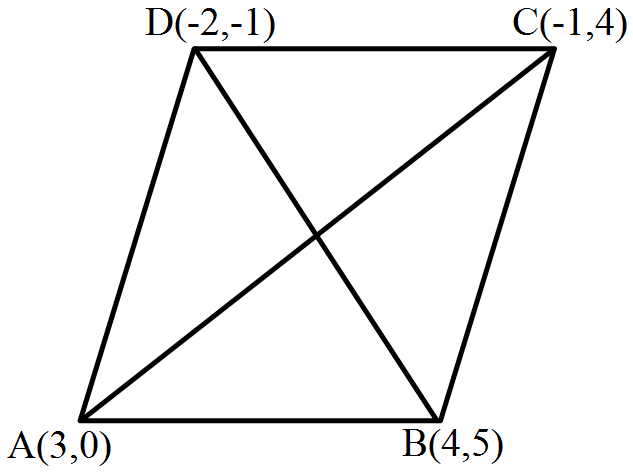 Let A(3, 0), B(4, 5) C(-1, 4) and D(-2, -1) be the angular points of a quadrilateral ABCD. Join AC and BD.
Now,
$\text{AB}=\sqrt{(4-3)^2+(5-0)^2}$
$=\sqrt{(1)^2+(5)^2}$
$=\sqrt{1+25}=\sqrt{26}\text{ units}$
$\text{BC}=\sqrt{(-1-4)^2+(4-5)^2}$
$=\sqrt{(-5)^2+(1)^2}$
$=\sqrt{25+1}=\sqrt{26}\text{ units}$
$\text{CD}=\sqrt{(-2+1)^2+(-1-4)^2}$
$=\sqrt{(-1)^2+(-5)^2}$
$=\sqrt{1+25}=\sqrt{26}\text{ units}$
$\text{DA}=\sqrt{(3+2)^2+(0+1)^2}$
$=\sqrt{(-7)^2+(2)^2}$
$=\sqrt{25+1}=\sqrt{26}\text{ units}$
$\therefore\text{AB}=\text{BC}=\text{CD}=\text{DA}=\sqrt{26}\text{ units}$
$\text{Diag}.\text{AC}=\sqrt{(-1-3)^2+(4-0)^2}$
$=\sqrt{(-4)^2+(4)^2}$
$=\sqrt{16+16}$
$=\sqrt{32}=4\sqrt{2}\text{ units}$
$\text{Diag}.\text{BD}=\sqrt{(-2-4)^2+(-1-5)^2}$
$=\sqrt{(-6)^2+(6)^2}$
$=\sqrt{36+36}$
$=\sqrt{72}=6\sqrt{2}\text{ units}$
$\therefore\text{Diag}.\text{AC}\not=\text{Diag}.\text{BD}$
Thus, ABCD is a quadrilateral having all sides equal but diagonals are unequal.
$\therefore\text{ABCD}$ is a rhombus but not a square.
$\therefore\text{Area of rhombus ABCD}$ $=\frac{1}{2}\times\text{product of its diagonals}.$
$=\Big(\frac{1}{2}\times\text{AC}\times\text{BD}\Big)$
$=\Big(\frac{1}{2}\times4\sqrt{2}\times6\sqrt{2}\Big)$
$=24\text{ sq.units}$ View full question & answer→Question 274 Marks
If the point $\text{P}\Big(\frac{1}{2},\text{y}\Big)$ lies on the line segment joining the points A(3, -5) and B(-7, 9) then find the ratio in which P divides AB. Also, find the value of y.
AnswerLet the point $\text{P}\Big(\frac{1}{2},\text{y}\Big)$ divides the line segment joining the points A(3, -5) and B(-7, 9) in the ratio k : 1.
Then, by section formula,
Coordinates of P $=\Big(\frac{\text{k}\times(-7)+1\times3}{\text{l}+1},\frac{\text{k}\times9+1\times(-5)}{\text{k}+1}\Big)$
$=\Big(\frac{-7\text{k}+3}{\text{k}+1},\frac{\text{k}\times9+1\times(-5)}{\text{k}+1}\Big)$
$=\Big(\frac{-7\text{k}+3}{\text{k}+1},\frac{9\text{k}-5}{\text{k}+1}\Big)$
Given, coordinates of P $=\Big(\frac{1}{2},\text{y}\Big)$
$\therefore\ \frac{-7\text{k}+3}{\text{k}+1}=\frac{1}{2}$
$\Rightarrow\ -14\text{k}+6=\text{k}+1$
$\Rightarrow\ 15\text{k}=5$
$\Rightarrow\ \text{k}=\frac{1}{3}$
So, the required ratio is 1 : 3.
Also,
$\Rightarrow\ \frac{9\text{k}-5}{\text{k}+1}=\text{y}$
$\Rightarrow\ \frac{9\times\frac{1}{3}-5}{\frac{1}{3}+1}=\text{y}$
$\Rightarrow\ \frac{3-5}{\frac{4}{3}}=\text{y}$
$\Rightarrow\ \text{y}=\frac{-6}{4}=\frac{-3}{2}$
View full question & answer→Question 284 Marks
For what value of $y$ are the points $P(1, 4), Q(3, y)$ and $R(-3, 16)$ are collinear.
AnswerLet $P(1, 4) = Q(3, y)$ and $R(-3, 16)$ are the given points.
then, $(x_1 = 1, y_1 = 4), (x_2 = 3, y_2 = y)$ and $(x_3 = -3, y_3 = 16)$It is given that the points $A, B$ and $C$ are collinear.
therefore, $x_1(y_2 - y_3) + x_2(y_3 - y_1) + x_3(y_1 - y_2) = 0 $
$\Rightarrow 1(y - 16) + 3(16 - 4) + (-3) + (4 - y) = 0$
$ \Rightarrow 1(y - 16) + 3(12) - 3(4 - y) = 0 $
$\Rightarrow y - 16 + 36 - 12 + 3y = 0 $
$\Rightarrow 8 + 4y = 0 $
$\Rightarrow 4y = -8$
$\Rightarrow\text{y}=\frac{-8}{4}=-2$ when $y = -2$, the given points are collinear.
View full question & answer→Question 294 Marks
Find the distance between of the following points from the origin:
B(-5, 5)
AnswerThe gven point is A(-5, 5) and let O(0, 0) be the origin
Then, $\text{BO}=\sqrt{(-5-0)^2+(5-0)^2}$
$=\sqrt{5^2+(-5)^2}$
$=\sqrt{25+25}$
$=\sqrt{50}=5\sqrt2\text{ units}.$
View full question & answer→Question 304 Marks
Find the area of the triangle formed by joining the midpoint of the sides of the triangle whose vertices are $A(2, 1), B(4, 3)$ and $C(2, 5)$.
AnswerThe vertices of the teriangle are $A (2, 1), B (4, 3)$ and $C (2, 5).$
Coordinates of midpoint of $AB = P (x_1, y_1)$ $=\Big(\frac{2+4}{2},\frac{1+3}{2}\Big)=(3,\ 2)$
Coordinates of midpoint of $BC = Q (x_2, y_2)$ $=\Big(\frac{4+2}{2},\frac{3+5}{2}\Big)=(3,\ 4)$
Coordinates of midpoint of $AC = R (x_3, y_3)$ $=\Big(\frac{2+2}{2},\frac{1,+5}{2}\Big)=(3,\ 2)$
Area of $\triangle\text{PQR}=\frac{1}{2}[\text{x}_1(\text{y}_2-\text{y}_3)+\text{x}_2(\text{y}_3-\text{y}_1)+\text{x}_3(\text{y}_1-\text{y}_2)]$
$=\frac{1}{2}[3(4-3)+3(3-2)+2(2-4)$
$=\frac{1}{2}[3+3-4]$
$=1 \text{sq.units}$
Hence, the area of the required triangle is $1\ sq$. unit.
View full question & answer→Question 314 Marks
Show that the points A(3, 1), B(0, -2), C(1, 1) and D(4, 4) are the vertices of a parallelogram ABCD.
AnswerLet A(3, 1), B(0, -2), C(1, 1) and D(4, 4) be the vertices of quadrilateral join AC, BD. AC and BD, intersect other at the point O.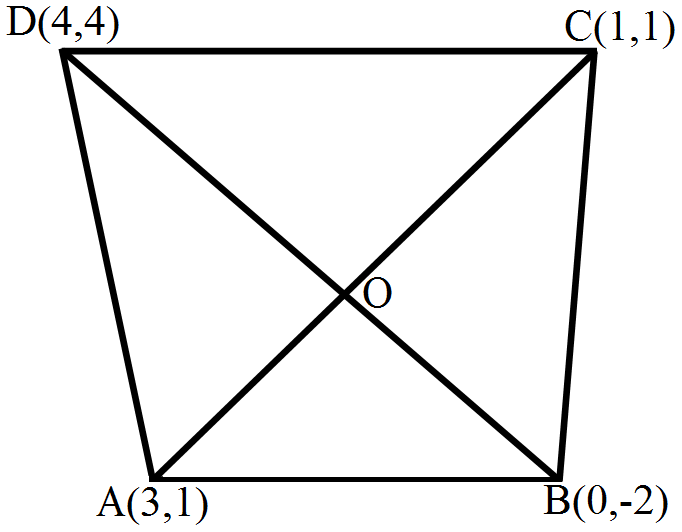
We know that the diagonal of a parallelogram bisect each other. Therefore, O is mid-point of AC as well as that of BD. Now mid-point of AC is $\Big(\frac{3+1}{2},\frac{1+1}{2}\Big)\text{i.e},(2,1)$ And mid-point of BD is $\Big(\frac{0+4}{2},\frac{-2+4}{2}\Big)\text{i.e},(2,1)$ Mid-point of AC is the same as mid-point of BD. Hence, A, B, C, D are the vertices of a parallelogram ABCD. View full question & answer→Question 324 Marks
Show that the following points are the vertices of a square:
P(0, -2), Q(3, 1), R(0, 4) and S(-3, 1)
AnswerLet P(0, -2), Q(3, 1) R(0, 4) and S(-3, 1) be the angular points of quad. PQRS.
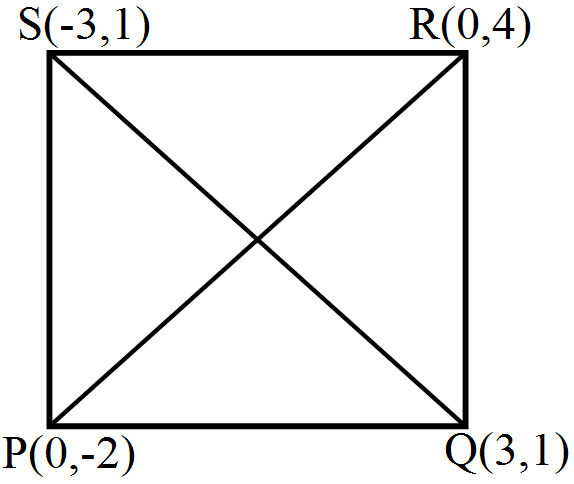
Join PR and QSD
Now,
$\text{PQ}=\sqrt{(3-0)^2+(1+2)^2}$
$=\sqrt{(3)^2+(3)^2}$
$=\sqrt{9+9}=\sqrt{18}=3\sqrt{2}\text{ units}$
$\text{QR}=\sqrt{(0-3)^2+(4-1)^2}$
$=\sqrt{(-3)^2+(3)^2}$
$=\sqrt{9+9}=\sqrt{18}=3\sqrt{2}\text{ units}$
$\text{RS}=\sqrt{(-3-0)^2+(1-4)^2}$
$=\sqrt{(-3)^2+(-3)^2}$
$=\sqrt{9+9}=\sqrt{18}=3\sqrt{2}\text{ units}$
$\text{SP}=\sqrt{(0+3)^2+(-2-1)^2}$
$=\sqrt{(3)^2+(-3)^2}$
$=\sqrt{9+9}=\sqrt{18}=3\sqrt{2}\text{ units}$
Thus, $\text{PQ}=\text{QR}=\text{RS}=\text{SP}$
$\text{Diag}.\text{PR}=\sqrt{(0-0)^2+(4+2)^2}$
$=\sqrt{(6)^2}=6\text{ units}$
$\text{Diag}.\text{QS}=\sqrt{(-3-3)^2+(1-1)^2}$
$=\sqrt{(-6)^2}=6\text{ units}$
$\therefore\text{Diag}.\text{PR}=\text{Diag}.\text{QS}$
Thus, PQRS is a quadrilateral in which all sides are equal and the diagonals are equal
Hence, quad. PQRS is a square View full question & answer→Question 334 Marks
If two adjacent vertices of a parallelogram are (3, 2) and (-1, 0) and the diagonals intersect at (2, -5) then find the coordinates of the other two vertices.
Answer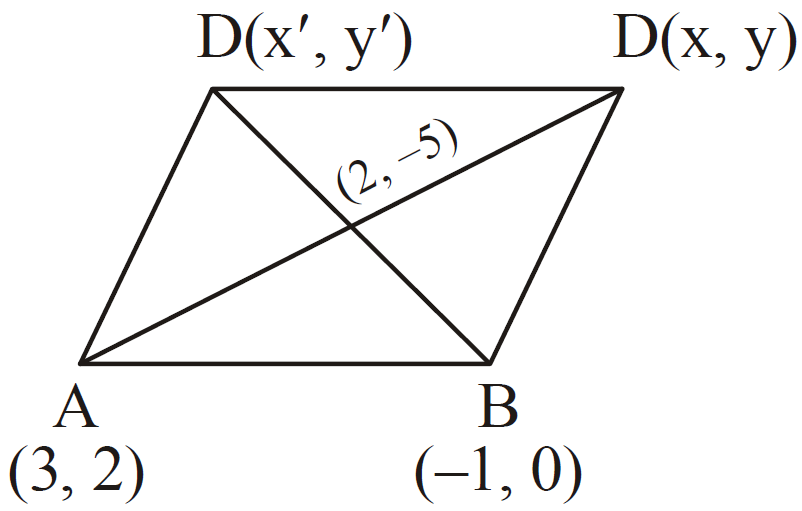
Let other two coordinates are:
(x, y) and (x', y')
$2 = \frac{\text{x + 3}}{2}$
$\Rightarrow \text{x = 1}$
And
$-5 = \frac{2 + \text{y}}{2}$
$\text{y} = -12$
Again
$\frac{-1 +\text{x}'}{2} = 2$
$\text{x}' = 5$
And
$\frac{0 \text{ + } \text{y}'}{2} = -5$
$\text{y}' = -10$
Hence co-ordinates are (1, –12) and (5, –10). View full question & answer→Question 344 Marks
Find the area of $\triangle\text{ABC}$ whose vertices are:
$A(1, 2), B(-2, 3)$ and $C(-3, -4)$
Answer$A(1, 2), B(-2, 3)$ and $C(-3, -4)$ are the vertices of
Then, $(x_1 = 1, y_1= 2), (x_2 = -2, y_2 = 3)$ and $(x_3 = -3, y_3 = -4)$
Area of triangle ABC
$=\frac{1}{2}\big\{\text{x}_1(\text{y}_2-\text{y}_3)+\text{x}_2(\text{y}_3-\text{y}_1)+\text{x}_3(\text{y}_1-\text{y}_2)\big\}$
$=\frac{1}{2}\big\{1(3-(-4))+(-2))(-4-2)+(-3)(2-3)\big\}$
$=\frac{1}{2}\big\{1(3+4)-2(-6)-3(-1)\big\}$
$=\frac{1}{2}\big\{7+12+3\big\}$
$=\frac{1}{2}(22)$
$=11\ \text{sq}.\text{units}$
View full question & answer→Question 354 Marks
Show that the following points are the vertices of a square:
A(6, 2), B(2, 1), C(1, 5) and D(5, 6)
AnswerLet A(6, 2), B(2, 1) C(1, 5) and D(5, 6) be the angular points of quad. ABCD. Join AC and BD
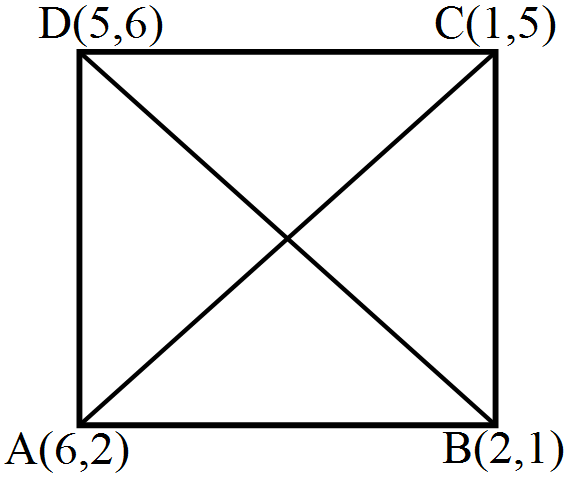
Now,
$\text{AB}=\sqrt{(2-6)^2+(1-2)^2}$
$=\sqrt{(-4)^2+(-1)^2}$
$=\sqrt{16+1}=\sqrt{17}\text{units}$
$\text{BC}=\sqrt{(1-2)^2+(5-1)^2}$
$=\sqrt{(-1)^2+(4)^2}$
$=\sqrt{1+16}=\sqrt{17}\text{units}$
$\text{CD}=\sqrt{(5-1)^2+(6-5)^2}$
$=\sqrt{(4)^2+(1)^2}$
$=\sqrt{16+1}=\sqrt{17}\text{units}$
$\text{DA}=\sqrt{(6-5)^2+(2-6)^2}$
$=\sqrt{(1)^2+(-4)^2}$
$=\sqrt{1+16}=\sqrt{17}\text{units}$
$\text{AB}=\text{BC}=\text{CD}=\text{DA}$
$\text{Diag}.\text{AC}=\sqrt{(1-6)^2+(5-2)^2}$
$=\sqrt{(-5)^2+(3)^2}$
$=\sqrt{25+9}=\sqrt{34}\text{units}$
$\text{Diag}.\text{BD}=\sqrt{(5-2)^2+(6-1)^2}$
$=\sqrt{(3)^2+(5)^2}$
$=\sqrt{9+25}=\sqrt{34}\text{units}$
$\therefore\text{Diag}.\text{AC}=\text{Diag}.\text{BD}$
Thus, all sides of quad. ABCD are equal and diagonals are also equal
Quad. ABCD is a square. View full question & answer→Question 364 Marks
Find the area of quadrilateral ABCD whose vertices are A(-7, 5), B(-6, -7), C(-3, -8) and D(2, 3).
Question 374 Marks
$A(7, -3), B(5, 3)$ and $C(3, -1)$ are the vertices of a $\triangle\text{ABC}$ and is its median. Prove that the median AD divides
$\triangle\text{ABC}$ into two triangles of equal areas.
AnswerThe vertices of the teriangle are $A (7, -3), B (5, 3)$ and $C (3, -1)$. Coordinates of D $=\Big(\frac{5+3}{2},\frac{3-3}{2}\Big)=(4,\ 1)$ For the area of the triangle $ADC,$ let $A (x_1, y_1) = A (7, -3), D (x_2, y_2) = D (4, 1)$ and $C (x_3, x_4) = C (3, -1).$
Then,
Area of $\triangle\text{ADC}=\frac{1}{2}[\text{x}_1(\text{y}_2-\text{y}_3)+\text{x}_2(\text{y}_3-\text{y}_1)+\text{x}_3(\text{y}_1-\text{y}_2)]$
$=\frac{1}{2}[7(1+1)+4(-1+3)+3(-3-1)$
$=\frac{1}{2}[14+8-12]$
$=5\text{sq. units}$ Now, for the area of triangle ABD, let Area of $\triangle\text{ABC}=\frac{1}{2}[\text{x}_1(\text{y}_2-\text{y}_3)+\text{x}_2(\text{y}_3-\text{y}_1)+\text{x}_3(\text{y}_1-\text{y}_2)]$
$=\frac{1}{2}[7(3-1)+5(1+3)+4(-3-3)$
$=\frac{1}{2}[14+20-24]$
$=5\text{sq. units}$ Thus, $\text{ar}(\triangle\text{ADC})=\text{ar}(\triangle\text{ABD})=5\text{sq}.\ \text{units}.$ Hence, AD divides $\triangle\text{ABC}$ into two triangles of equal areas.
View full question & answer→Question 384 Marks
Find the area of $\triangle\text{ABC}$ with vertices $A(0, -1), B(2, 1)$ and $C(0, 3)$. Also, find the area of the triangle formed by joining the midpoints of its sides. Show that the ratio of the areas of two triangles is $4 : 1$
AnswerLet $A (x_1 = 0), y_1 = -1), B (x_2 = 2, y_2 = 1)$ and $C(x_3 = 0, y_3 = 3)$ be the given points. then
$\text{ar}(\triangle\text{ABC})=\frac{1}{2}[\text{x}_1(\text{y}_2-\text{y}_3)+\text{x}_2(\text{y}_3-\text{y}_1)+\text{x}_3(\text{y}_1-\text{y}_2)]$
$=\frac{1}{2}[0(1-3)+2(3+1)+0(-1-1)$
$=\frac{1}{2}\times8=4\text{sq.}\ \text{units}$
So, the area of the triangle $\triangle\text{ABC}$ is 4sq. units.
Let $D(a_1, b_1), E(a_2, b_2),$ and $F(a_3, b_3)$ be the midpoint of $AB, BC$ and $AC$ respectively.
Then,
$\text{a}_1=\frac{0+2}{2}=1,$ $\text{b}_1=\frac{-1+1}{2}=0$
$\text{a}_2=\frac{2+0}{2}=1,$ $\text{b}_2=\frac{1+3}{2}=2$
$\text{a}_3=\frac{0+0}{2}=0,$ $\text{b}_3=\frac{-1+3}{2}=1$
Thus, the coordinates of $D, E$ and $F$ are $D(a_1 = 1, b_1 = 0), E(a_2 = 1, b_2 = 2)$ and $F(a_3 = 0, b_3 = 1).$
Now,
$\text{ar}(\triangle\text{DEF})=\frac{1}{2}[\text{a}_1(\text{b}_2-\text{b}_3)+\text{a}_2(\text{b}_3-\text{b}_1)+\text{a}_3(\text{b}_1-\text{b}_2)]$
$=\frac{1}{2}[1(2-1)+1(1-0)+0(0-2)]$
$=\frac{1}{2}[1+1+1]$
$=1\text{sq.}\ \text{unit}$
So, the area of the triangle $\triangle\text{DEF}$ is $1\ sq$. unit.
Hence, $\triangle\text{ABC}:\triangle\text{DEF}=4:1$
View full question & answer→Question 394 Marks
Using the distance formula, show taht the given points are collinear:
(6, 9), (0, 1) and (-6, -7)
AnswerLet A(6, 9), B(0, 1) and C(-6, -7) be the given points
Then,
$\text{AB}=\sqrt{(0-6)^2+(1-9)^2}=\sqrt{(6)^2+(-8)^2}$
$=\sqrt{36+64}=\sqrt{100}=10\text{ units}$
$\text{BC}=\sqrt{(-6-0)^2+(-7-1)^2}=\sqrt{(-6)^2+(-8)^2}$
$=\sqrt{36+64}=\sqrt{100}=10\text{ units}$
$\text{AC}=\sqrt{(-6-6)^2+(-7-9)^2}=\sqrt{(-12)^2+(-16)^2}$
$=\sqrt{144+256}=\sqrt{400}=20\text{ units}$
$\therefore\text{AB}+\text{AC}=10+10=20\text{ units}=\text{BC}$
$\Rightarrow\text{AB}+\text{AC}=\text{BC}$
Hence, the given points are collinear.
View full question & answer→Question 404 Marks
Using the distance formula, show taht the given points are collinear:
(1, -1), (5, 2) and (9, 5)
AnswerLet A(1, -1), B(5, 2) and C(9, 5) be the given points
Then,
$\text{AB}=\sqrt{(1-5)^2+(-1-2)^2}=\sqrt{(4)^2+(-3)^2}$
$=\sqrt{16+9}=\sqrt{25}=5\text{ units}$
$\text{BC}=\sqrt{(5-9)^2+(2-5)^2}=\sqrt{(-4)^2+(-3)^2}$
$=\sqrt{16+9}=\sqrt{25}=5\text{ units}$
$\text{AC}=\sqrt{(1-9)^2+(-1-5)^2}=\sqrt{(-8)^2+(-6)^2}$
$=\sqrt{64+36}=\sqrt{100}=10\text{ units}$
$\therefore\text{AB}+\text{AC}=5+5=10\text{ units}=\text{BC}$
$\Rightarrow\text{AB}+\text{AC}=\text{BC}$
Hence, the given points are collinear.
View full question & answer→Question 414 Marks
Show that the points (-3, -3), (3, 3) and $(-3\sqrt{3},3\sqrt{3})$ are the vertices of an equilateral triangle.
View full question & answer→Question 424 Marks
Show that the points A(6, 1), B(8, 2), C(9, 4) and D(7, 3) are the vertices of a rhombus. Find its area.
AnswerLet A(6, 1), B(8, 2) C(9, 4) and D(7, 3) be the angular points of quad. ABCD. Join AC and BD.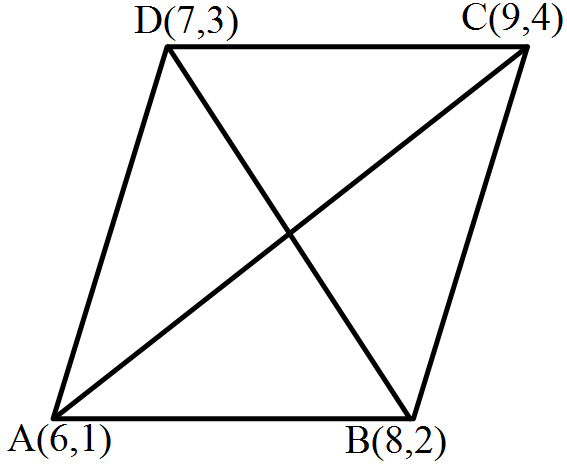
Now, $\text{AB}=\sqrt{(8-6)^2+(2-1)^2}$ $=\sqrt{(2)^2+(1)^2}$ $=\sqrt{4+1}=\sqrt{5}\text{ units}$ $\text{BC}=\sqrt{(9-8)^2+(4-2)^2}$ $=\sqrt{(1)^2+(2)^2}$ $=\sqrt{1+4}=\sqrt{5}\text{ units}$ $\text{CD}=\sqrt{(7-9)^2+(3-4)^2}$ $=\sqrt{(-2)^2+(-1)^2}$ $=\sqrt{4+1}=\sqrt{5}\text{ units}$ $\text{DA}=\sqrt{(7-6)^2+(3-1)^2}$ $=\sqrt{(1)^2+(2)^2}$ $=\sqrt{1+4}=\sqrt{5}\text{ units}$ Thus, $\text{AB}=\text{BC}=\text{CD}=\text{DA}=\sqrt{5}\text{ units}$ $\text{Diag}.\text{AC}=\sqrt{(9-6)^2+(4-1)^2}$ $=\sqrt{(3)^2+(3)^2}$ $=\sqrt{9+9}$ $=\sqrt{18}=3\sqrt{2}\text{ units}$ $\text{Diag}.\text{BD}=\sqrt{(7-8)^2+(3-2)^2}$ $=\sqrt{(-1)^2+(1)^2}$ $=\sqrt{1+1}$ $=\sqrt{2}\text{ units}$ $\therefore\text{Diag}.\text{AC}\not=\text{Diag}.\text{BD}$ Thus, ABCD is a quadrilateral having all sides equal but diagonals are unequal. Hence, ABCD is a rhombus. $\text{Area of rhombus ABCD}$ $=\frac{1}{2}\times\text{product of its diagonals}.$ $=\Big(\frac{1}{2}\times\text{AC}\times\text{BD}\Big)$ $=\Big(\frac{1}{2}\times3\sqrt{2}\times\sqrt{2}\Big)$ $=3\text{ sq.units}$ View full question & answer→Question 434 Marks
Using the distance formula, show taht the given points are collinear:
(-2, 5), (0, 1) and (2, -3).
AnswerLet A(-2, 5), B(0, 1) and C(2, -3) be the given points
Then,
$\text{AB}=\sqrt{(0-2)^2+(1-5)^2}=\sqrt{(2)^2+(-4)^2}$
$=\sqrt{4+16}=\sqrt{20}=2\sqrt{5}\text{ units}$
$\text{BC}=\sqrt{(2+0)^2+(-3-1)^2}=\sqrt{(2)^2+(-4)^2}$
$=\sqrt{4+16}=\sqrt{20}=2\sqrt{5}\text{ units}$
$\text{AC}=\sqrt{(2+2)^2+(-3-5)^2}=\sqrt{(4)^2+(-8)^2}$
$=\sqrt{16+64}=\sqrt{80}=4\sqrt{5}\text{ units}$
$\therefore\text{AB}+\text{AC}=2\sqrt{5}+2\sqrt{5}=4\sqrt{5}\text{ units}=\text{BC}$
$\Rightarrow\text{AB}+\text{AC}=\text{BC}$
Hence, the given points are collinear.
View full question & answer→Question 444 Marks
In what ratio is the line segments joining A(2, -3) and B(5, 6) divided by the x-axis? Also, find the coordinates of the point of divesion.
AnswerLet the x-axis cut the join of A(2, -3) and B(5, 6) in the ratio k : 1, at the point P. Then, by the section forfmula, the coordinates of P are $\Big(\frac{5\text{k}+2}{\text{k}+1},\frac{6\text{k}-3}{\text{k}+1}\Big)$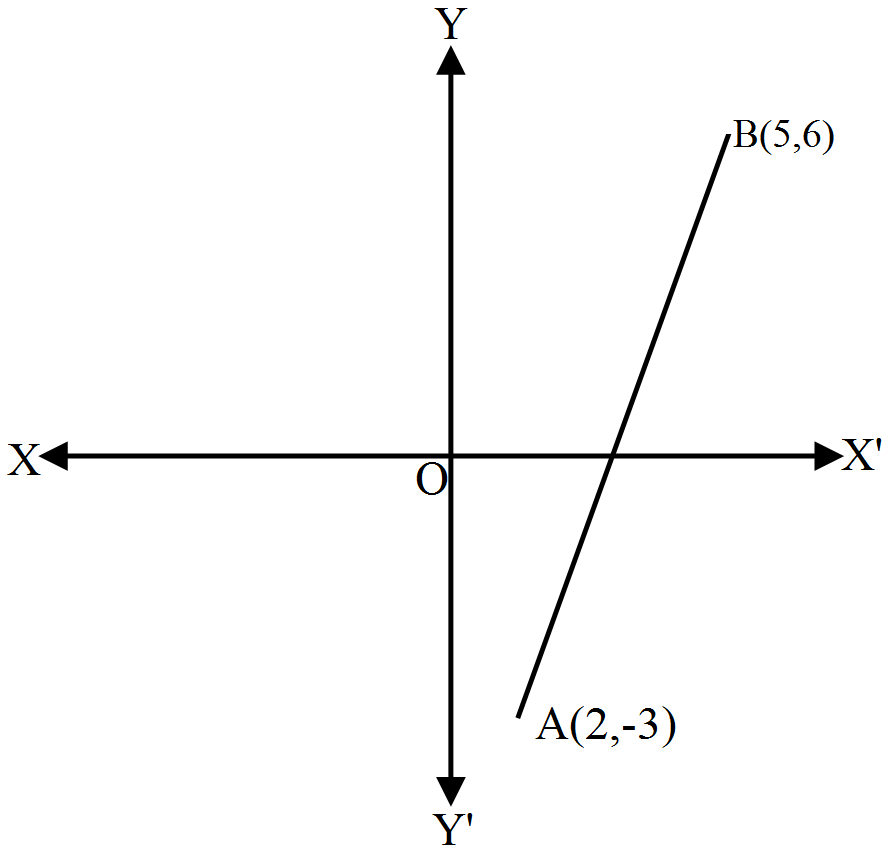
But P lies on the x-axis so, its ordinate must be 0. $\therefore\ \frac{6\text{k}-3}{\text{k}+1}=0$ $\Rightarrow\ 6\text{k}-3=0,\text{k}=\frac{1}{2}$ So the required ratio 1 : 2 Thus the x-axis divides AB in the ratio 1 : 2 Putting $\text{k}=\frac{1}{2}$ in $\frac{5\text{k}+2}{\text{k}+1},$ we get the point P as $\text{P}\bigg(\frac{5\times\frac{1}{2}+2}{\frac{1}{2}+1},0\bigg)$ or P(3, 0) Thus, P is (3, 0) and k = 1 : 2. View full question & answer→Question 454 Marks
Show taht the following points are collinear:$A(-5, 1), B(5, 5)$ and $C(10, 7)$
AnswerLet $A(x_1 = -5, y_1= 1), B(x_2 = 5, y_2= 5)$ and $C(x_3 = 10, y_3= 7)$ be the given points.
Now
$x_1(y_2 - y_3) + x_2(y_3 - y_1) + x_3(y_1 - y_2)$
$= (-4)(5 - 7) + 5(7 - 1) + 10(1 - 5)$
$= -5(-2) + 5(6) + 10(-4)$
$= 10 + 30 - 40$
$= 0$
Hence the given point are collinear.
View full question & answer→Question 464 Marks
A line intersects the y-axis and x-axis at the points $P$ and $Q$ respectively. If $(2, -5)$ is the midpoint Of $PQ$ then find the coordinates of $P$ and $Q$.
AnswerThe mid-point of the line segment joining the points $P(x_1, y_1)$ and $Q(x_2, y_2)$ is $\Big(\frac{\text{x}_1+\text{x}_2}{2},\frac{\text{y}_1+\text{y}_2}{2}\Big)$
Let the coordinates of the point $P$ and $Q$ be $(0, b)$ and $(a, 0)$ respectively.
Mid point is $\Big(\frac{0+\text{a}}{2},\frac{\text{b}+0}{2}\Big)=\Big(\frac{\text{a}}{2},\frac{\text{b}}{2}\Big)$
Compare it with the given mid-point $(2, -5)$.
$\frac{\text{a}}{2}=2,\frac{\text{b}}{2}=-5$
$\text{a}=4,\text{b}=-4$
Coordinates $P$ and $Q$ are $(0, -10)$ and $(4, 0)$ respectively.
View full question & answer→Question 474 Marks
Show that the following points are the vertices of a rectangle:
A(0, -4), B(6, 2), C(3, 5) and D(-3, -1)
AnswerLet A(0, -4), B(6, 2), C(3, 5) and D(-3, -1) are the vertices of quad. ABCD. Then,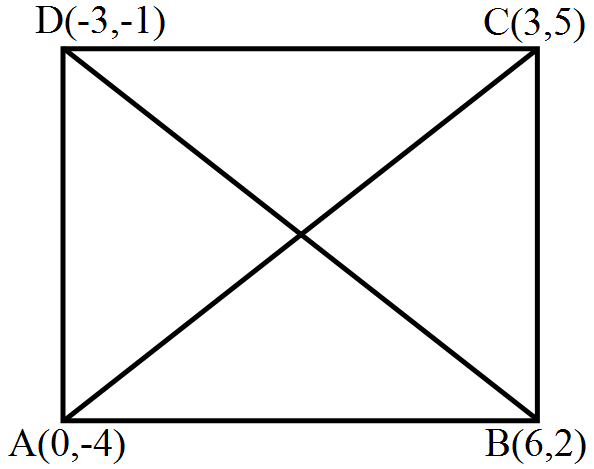
$\text{AB}=\sqrt{(6-0)^2+(2+4)^2}$ $=\sqrt{(6)^2+(6)^2}$ $=\sqrt{36+36}=\sqrt{72}=6\sqrt{2}\text{ units}$ $\text{BC}=\sqrt{(3-6)^2+(5-2)^2}$ $=\sqrt{(-3)^2+(3)^2}$ $=\sqrt{9+9}=\sqrt{18}=3\sqrt{2}\text{ units}$ $\text{DC}=\sqrt{(-3-3)^2+(-1-5)^2}$ $=\sqrt{(-6)^2+(-6)^2}$ $=\sqrt{36+36}=\sqrt{72}=6\sqrt{2}\text{ units}$ $\text{AD}=\sqrt{(-3-0)^2+(-1+4)^2}$ $=\sqrt{(-3)^2+(3)^2}$ $=\sqrt{9+9}=\sqrt{18}=3\sqrt{2}\text{ units}$ Thus, $\text{AB}=\text{DC}$ and $\text{AD}=\text{BC}$ $\text{Diag}.\text{AC}=\sqrt{(3-0)^2+(5+4)^2}$ $=\sqrt{(3)^2+(9)^2}$ $=\sqrt{9+81}$ $=\sqrt{90}=3\sqrt{10}\text{ units}$ $\text{Diag}.\text{BD}=\sqrt{(-3-6)^2+(-1-2)^2}$ $=\sqrt{(-9)^2+(-3)^2}$ $=\sqrt{81+9}$ $=\sqrt{90}=3\sqrt{10}\text{ units}$ Thus, ABCD is a quadrilateral whose opposite sides are equal and the diagonals are equal. Hence, quad. ABCD is a rectangle. View full question & answer→Question 484 Marks
The base BC of an equilateral triangle ABC lies on y-axis. The coordinates of the point C are (0, -3). The origin is the midpoint of the base. Find the coordinates of the points A and B. Also, find the coordinates of another points D such that ABCD is a rhombus.
Answer
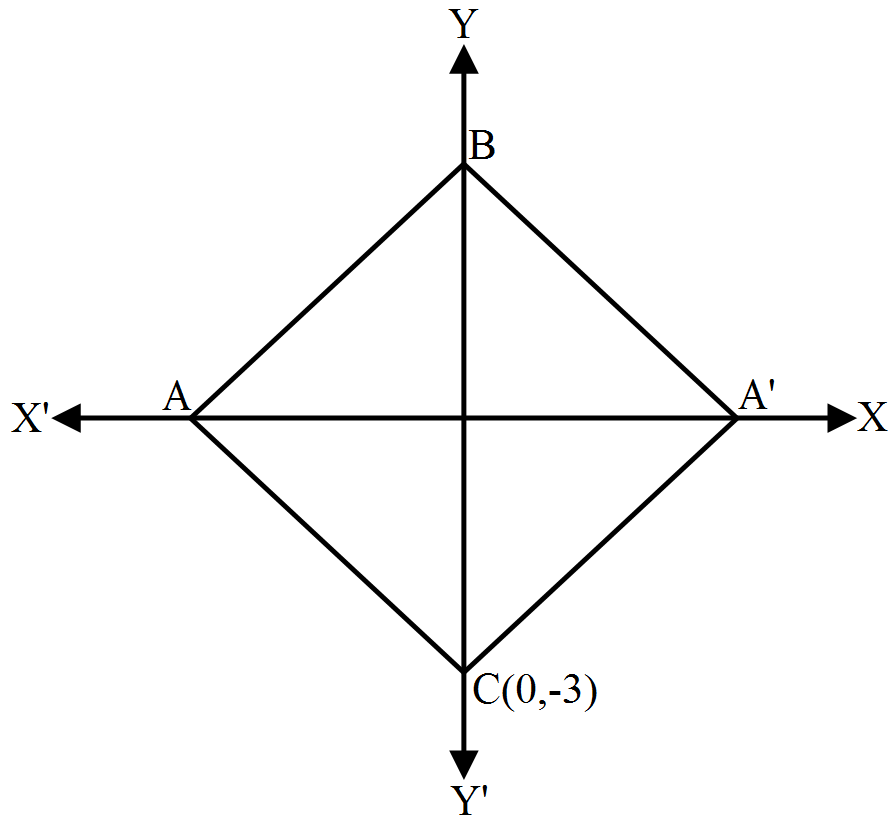 The base BC of an equilateral triangle ABC lies on y-axis and O is the mid-point of base BC.
⇒ OC = OB = 3 units
$\therefore$ Coordinates of B are (0, 3).
Since OX is perpendicular to BC and altitude of equilater triangle passes throught the opposite vertex A, A lies on x-axis.
Let the coordinates of A be (x, 0).
Since AB = BC, we have
$\sqrt{(\text{x}-0)^2+(0-3)^2}=\sqrt{(0-0)^2+(3+3)^2}$
$\Rightarrow\ \sqrt{\text{x}^2+9}=\sqrt{36}$
$\Rightarrow\ \text{x}^2+9=36$
$\Rightarrow\ \text{x}^2=27$
$\Rightarrow\ \text{x}=\pm3\sqrt{3}$
$\therefore$ Coordinates A are $(3\sqrt{3},0)$ or $(-3\sqrt{3},0)$
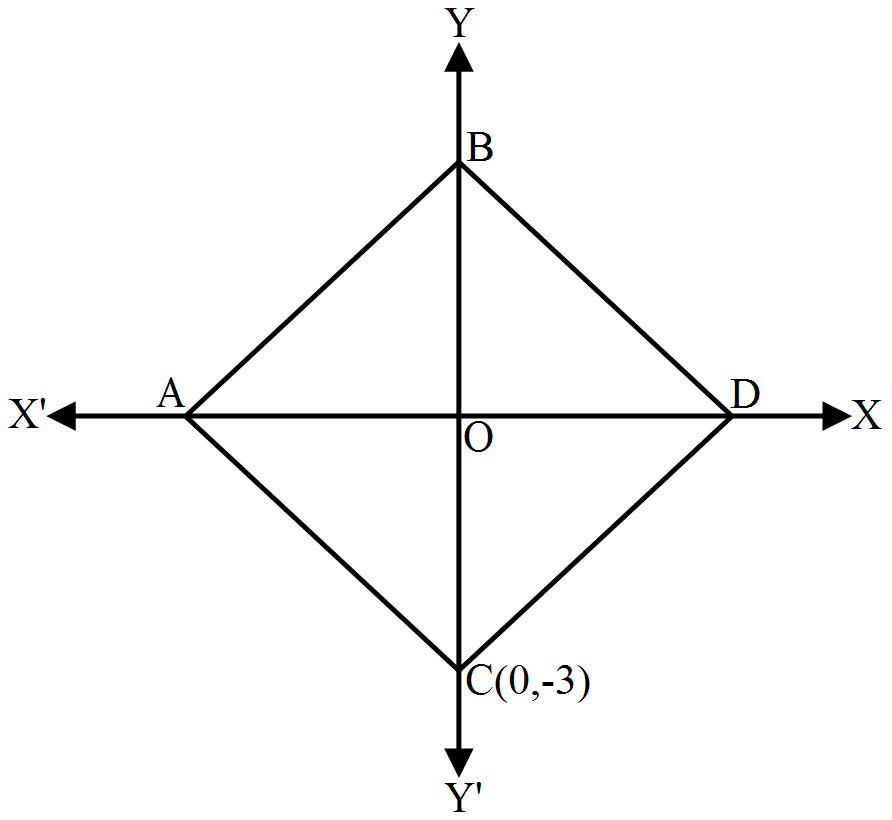 Since ABCD is a rhombus,
⇒ Coordinates of D $=(3\sqrt{3},0)$ View full question & answer→Question 494 Marks
If the points A(4, 3) and B(x, 5) lie on the circle with centre O(2, 3), find the value of x.
Question 504 Marks
Prove that the point A(2, 4), B(2, 6) and $\text{C}(2+\sqrt{3},5)$ are the vertices of an equilateral triangle.
AnswerGiven: A(2, 4), B(2, 6) and $\text{C}(2+\sqrt{3},5)$
$\text{AB}=\sqrt{(2-2)^2+(6-4)^2}$
$=\sqrt{0+2}=\sqrt{4}=2\text{ units}$
$\text{BC}=\sqrt{(2+\sqrt{3}-2)^2+(5-6)^2}$
$=\sqrt{(\sqrt{3})^2+(-1)^2}$
$=\sqrt{3+1}=\sqrt{4}=2\text{ units}$
$\text{AC}=\sqrt{(2+\sqrt{3}-2)^2+(5-4)^2}$
$=\sqrt{(\sqrt{3})^2+(1)^2}$
$=\sqrt{3+1}=\sqrt{4}=2\text{ units}$
We find that AB = BC = AC
Hence, the given points are the vertices of an equilateral triangle.
View full question & answer→