Question
Using the distance formula, show taht the given points are collinear:
(1, -1), (5, 2) and (9, 5)

Answer

Let A(1, -1), B(5, 2) and C(9, 5) be the given points
Then,
$\text{AB}=\sqrt{(1-5)^2+(-1-2)^2}=\sqrt{(4)^2+(-3)^2}$
$=\sqrt{16+9}=\sqrt{25}=5\text{ units}$
$\text{BC}=\sqrt{(5-9)^2+(2-5)^2}=\sqrt{(-4)^2+(-3)^2}$
$=\sqrt{16+9}=\sqrt{25}=5\text{ units}$
$\text{AC}=\sqrt{(1-9)^2+(-1-5)^2}=\sqrt{(-8)^2+(-6)^2}$
$=\sqrt{64+36}=\sqrt{100}=10\text{ units}$
$\therefore\text{AB}+\text{AC}=5+5=10\text{ units}=\text{BC}$
$\Rightarrow\text{AB}+\text{AC}=\text{BC}$
Hence, the given points are collinear.

Need a full question paper?

Generate a complete, print-ready paper with questions like this in minutes — across 16+ boards, with answer keys.

Start Generating Free

Similar questions

The following data gives the information on the observed life time (in hour) of 225 electrical components:
Lifetime (in hours)Frequency
0 - 2010
20 - 4035
40 - 6052
60 - 8061
80 - 10038
100 - 12029
Determine the modal life time of the components.
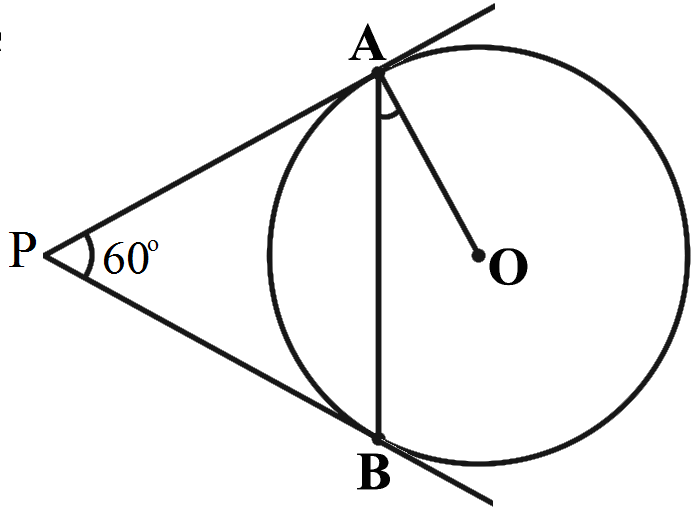
In the given figure, PA and PB are two tangents to the circle with centre O. If $\angle\text{APB}=60^\circ$ then find the measure of $\angle\text{OAB}.$
The mean of the following frequency distribution is $62.8$ and the sum of all the frequencies is $50$. Compute the missing frequency.
Class
$0-20$
$20-40$
$40-60$
$60-80$
$80-100$
$100-120$
Frequency
$5$
$f_1$
$10$
$f_2$
$7$
$8$
Following is the breakup of expenditure of a family on different times of consumption.
ItemFoodClothingRentEducationFuelMedicineMiscellaneous
Expenditure in ₹160020060015010080270
Draw a pie diagram of the above data.
Solve the following systems of equations:
$\frac{6}{\text{x}+\text{y}}=\frac{7}{\text{x}-\text{y}}+3$
$\frac{1}{2(\text{x}+\text{y})}=\frac{1}{3(\text{x}-\text{y})}$ where $\text{x}+\text{y}\neq0$ and $\text{x}-\text{y}\neq0.$

Image
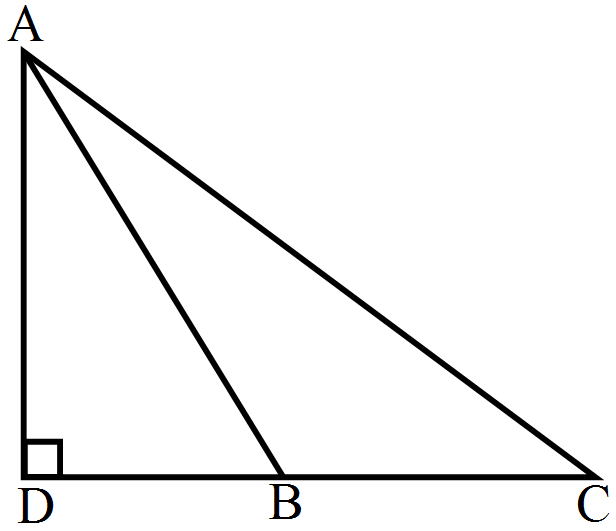
In the given figure, $\triangle\text{ABC}$ is an obtuse triangle, obtuse-angled at $B$. If $\text{AD}\perp\text{CB}$ (produced) prove that $AC^2 = AB^2+ BC^2 +2BC.BD.$
​​​​​​​
Find the values of k for which the given quadratic equation has real and distinct roots:
$x^2 - kx + 9 = 0$
If $\alpha$ and $\beta$ are the zeroes of the quadratic polynomial $f(x) = ax^2 + bx + c$, find evaluate:$\frac{\beta}{\text{a}\alpha+\text{b}}+\frac{\alpha}{\text{a}\beta+\text{b}} $
Find the lengths of the median of $A B C$ whose vertices are $A(7,-3), B(5,3), C(3,-1) . \quad$