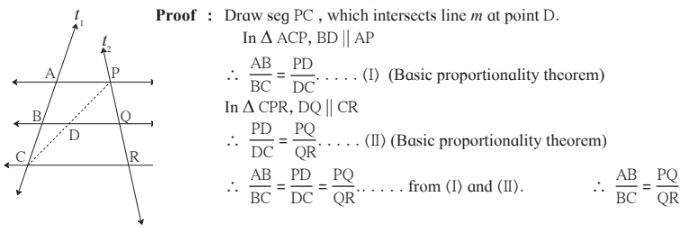
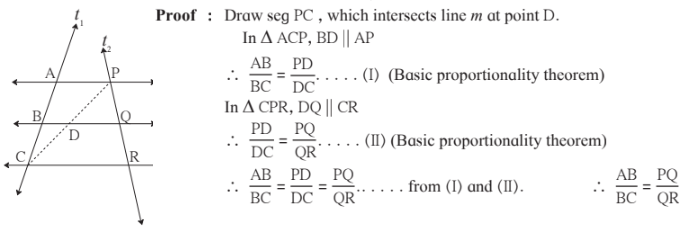
Prove The Theorem : The ratio of the intercepts made on a transversal by three parallel lines is equal to the ratio of the corrosponding intercepts made on any other transversal by the same parallel lines.
Answer
Given : line $l \|$ line $m \|$ line $n$ $t_1$ and $t_2$ are transversals. Transversal $t_1$ intersects the lines in points A, B, C and $\mathrm{t}_2$ intersects the lines in points $\mathrm{P}$, Q, R. To prove : $\frac{\mathrm{AB}}{\mathrm{BC}}=\frac{\mathrm{PQ}}{\mathrm{QR}}$
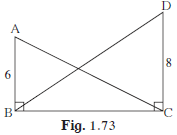
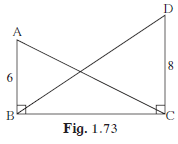
In figure 1.73, ∠ABC = ∠DCB = 90° AB = 6, DC = 8 then $\frac{ A (\triangle ABC )}{ A (\triangle DCB )}=?$
Answer
$\text { We know that, Area of triangle }=\frac{1}{2} \times \text { base } \times \text { height }$
$ \Rightarrow \frac{ A (\triangle ABC )}{ A (\triangle DCB )}=\frac{\frac{1}{2} \times BC \times AB }{\frac{1}{2} \times BC \times DC }$.
$ =\frac{ AB }{ DC }$
$=\frac{6}{8}$
$=\frac{3}{4}$
Ratio of areas of two triangles with equal heights is 2 : 3. If base of the smaller triangle is 6 cm then what is the corresponding base of the bigger triangle?
Answer
(PROPERTY:Areas of triangles with equal heights are proportional to their corresponding bases.)
$\Rightarrow \frac{ A (\text { smaller triangle })}{ A (\text { bigger triangle })}=\frac{\text { base(smaller triangle })}{\text { base(bigger triangle) }} $
$ \Rightarrow \frac{2}{3}=\frac{6}{\text { base(bigger triangle) }}$
⇒ base(bigger triangle) = 9 cm
Areas of two similar triangles are 225 sq.cm & 81 sq.cm. If a side of the smaller triangle is 12 cm, then find corresponding side of the bigger triangle.
Answer
Let area of one(bigger) triangle be ' $A$ ', other(smaller) triangle be ' $B$ ',corresponding side of smaller triangle be ' $a$ ' and bigger triangle be 'b'.
$\Rightarrow \frac{ A }{ B }=\frac{ b ^2}{ a ^2}(\text { By theorem })$
And $a =12 cm, A =225 sq \cdot cm , B=81 sq \cdot cm$......(Given)
$\Rightarrow \frac{225}{81}=\frac{b^2}{12^2}$
$\Rightarrow b^2=\frac{225 \times 144}{81} $
$\Rightarrow b=\sqrt{ } 400 $
$\Rightarrow b=20 cm$
If ΔABC ~ ΔPQR, A (ΔABC) = 80, A(ΔPQR) = 125, then fill in the blanks.
$\frac{ A (\Delta ABC )}{ A (\Delta \ldots)}=\frac{80}{125} \quad \therefore \frac{ AB }{ PQ }=\frac{\square}{\square}$
Answer
$\because \triangle ABC \sim \triangle PQR \Rightarrow \frac{ A (\triangle ABC )}{ A (\Delta PQR )}=\frac{80}{125}(\because A (\triangle PQR )=125 \text { is given })$
$\Rightarrow \frac{ A (\triangle ABC )}{ A (\triangle PQR )}=\frac{ AB ^2}{ PQ ^2}$
$\Rightarrow \frac{ AB }{ PQ }=\sqrt{\frac{A(\Delta ABC )}{ A (\triangle PQR )}}$
$\Rightarrow \frac{ AB }{ PQ }=\frac{4}{5}$
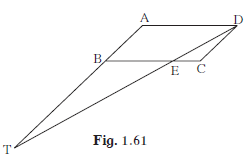
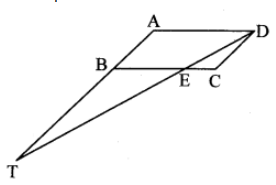
□ ABCD is a parallelogram point E is on side BC. Line DE intersects ray AB in point T. Prove that DE × BE = CE × TE.
Answer
In Δ CED and ΔBET⇒ ∠ CED≅ ∠ BET (opposite angles)
⇒ ∠ CDE≅ ∠ BTE (Alternate angles)
(∵ AB||DC ⇒ BT||DC, as BT is extension to AB)
⇒ Δ CED ~ Δ BET (By AA Test)
$\Rightarrow \frac{ CE }{ DE }=\frac{ BE }{ TE }$ (corresponding sides are proportional)
⇒ DE× BE = CE×TE
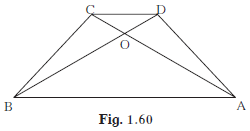
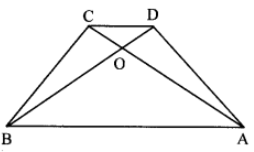
In trapezium ABCD, (Figure 1.60) side AB || side DC, diagonals AC and BD intersect in point O. If AB = 20, DC = 6, OB = 15 then find OD.
Answer
In Δ AOB and ΔCOD⇒ ∠ AOB≅ ∠ COD (opposite angles)
⇒ ∠ CDO≅ ∠ ABO (Alternate angles ∵ AB||DC)
⇒ Δ AOB ~ Δ COD (By AA Test)
$\Rightarrow \frac{ AB }{ DC }=\frac{ OB }{ OD } \text { (corresponding sides are proportional) } $
$ \Rightarrow OD =\frac{ OB \times DC }{ AB } $
$ \Rightarrow O D=\frac{15 \times 6}{20} $
$ \Rightarrow O D=4.5$
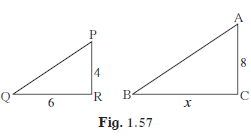
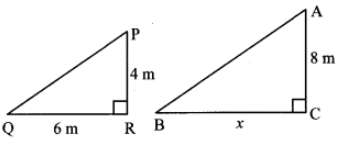
As shown in figure 1.57, two poles of height 8 m and 4 m are perpendicular to the ground. If the length of shadow of smaller pole due to sunlight is 6 m then how long will be the shadow of the bigger pole at the same time?
Answer
∵ the shadows are measured at the same time⇒ angle of of elevation will be equal for both the pole
⇒ Δ PQR~Δ ABC ………(By AA Test)
$\Rightarrow \frac{ PR }{ AC }=\frac{ QR }{ BC } $
$ \Rightarrow BC =\frac{ QR \times AC }{ PR } $
$ \Rightarrow x =\frac{6 \times 8}{4}$
⇒ x = 12 m
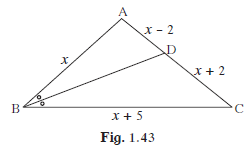
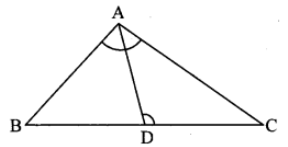
In Δ ABC, seg BD bisects ∠ ABC. If AB = x, BC = x + 5, AD = x – 2, DC = x + 2, then find the value of x.
Answer
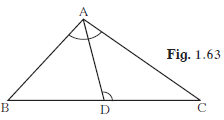
Theorem: The bisector of an angle of a triangle divides the side opposite to the angle in the ratio of the remaining sides
$\Rightarrow \frac{A D}{D C}=\frac{A B}{B C}$
$\Rightarrow \frac{x-2}{x+2}=\frac{x}{x+5}$
$\Rightarrow x ( x +2)=( x -2)( x +5)$
$\Rightarrow x ^2+2 x = x ^2-2 x +5 x -10$
$\Rightarrow x ^2+2 x - x ^2+2 x -5 x +10=0$
$\Rightarrow x =10$
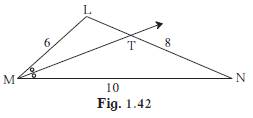
In Δ LMN, ray MT bisects ∠ LMN If LM = 6, MN = 10, TN = 8, then find LT.
Answer
Theorem: The bisector of an angle of a triangle divides the side opposite to the angle in the ratio of the remaining sides.
$\Rightarrow \frac{ LT }{ TN }=\frac{ LM }{ MN }$
$\Rightarrow LT =\frac{ LM \times TN }{ MN } $
$ \Rightarrow LT =\frac{6 \times 8}{10}$
⇒ LT = 4.8
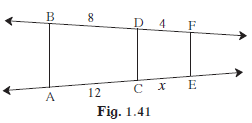
In figure 1.41, if AB || CD || FE then find x and AE.
Answer
Theorem: The ratio of the intercepts made on a transversal by three parallel lines is equal to the ratio of the corresponding intercepts made on any other transversal by the same parallel lines.
$\Rightarrow \frac{ BD }{ DF }=\frac{ AC }{ CE } $
$ \Rightarrow \frac{8}{4}=\frac{12}{ x }$
$ \Rightarrow x =\frac{12 \times 4}{8}$
⇒ x = 6
Now,AE = AC + CE
= 12 + x
= 12 + 6
⇒ AE = 18
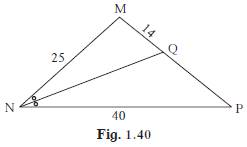
Theorem: The bisector of an angle of a triangle divides the side opposite to the angle in the ratio of the remaining sides.And ∵ NQ is angle bisector of ∠N
$\Rightarrow \frac{M Q}{Q P}=\frac{M N}{N P} $
$ \Rightarrow \frac{14}{Q P}=\frac{25}{40} $
$\Rightarrow Q P=\frac{14 \times 40}{25}$
⇒ QP = 22.4
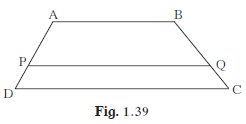
In trapezium ABCD, side AB || side PQ || side DC, AP = 15, PD = 12, QC = 14, find BQ.
Answer
By Basic Proportionality Theorem(Theorem : If a line parallel to a side of a triangle intersects the remaining sides in two distinct points, then the line divides the sides in the same proportion.)
$\Rightarrow \frac{ AP }{ PD }=\frac{ BQ }{ QC }$
$\Rightarrow \frac{15}{12}=\frac{ BQ }{14} $
$\Rightarrow BQ =\frac{15 \times 14}{12}$
⇒ BQ = 17.5
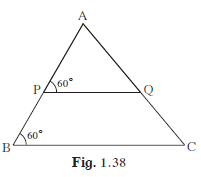
Measures of some angles in the figure are given. Prove that $\frac{AP}{PB} = \frac{AQ}{QC}$
Answer
Here, PQ||BC (∵ ∠ APQ≅ ∠ ABC)(PROPERTY: If a transversal intersects two lines so that corresponding angles are congruent, then the lines are parallel)
∴ By Basic Proportionality Theorem
(Theorem : If a line parallel to a side of a triangle intersects the remaining sides in two distinct points, then the line divides the sides in the same proportion.)
$\Rightarrow \frac{AP}{PB} = \frac{AQ}{QC}$
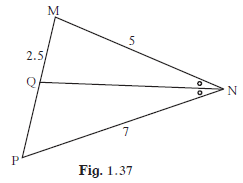
In Δ MNP, NQ is a bisector of ∠N. If MN = 5, PN = 7 MQ = 2.5 then find QP.
Answer
Theorem: The bisector of an angle of a triangle divides the side opposite to the angle in the ratio of the remaining sides.
$\Rightarrow \frac{ MQ }{ QP }=\frac{ MN }{ NP }$
$ \Rightarrow \frac{2.5}{ QP }=\frac{5}{7} $
$ \Rightarrow QP \times 5=2.5 \times 7 $
$ \Rightarrow QP =\frac{2.5 \times 7}{5}$
⇒ QP = 3.5
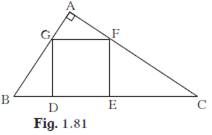
In figure 1.81, the vertices of square DEFG are on the sides of ΔABC, ∠A = 90°. Then prove that $D E^2=B D \times E C$
(Hint : Show that ΔGBD is similar to ΔDFE. Use GD = FE = DE.)
Answer
Proof:In □ DEFG is a square
⇒ GF||DE
⇒ GF||BC
Now,In Δ AGF and Δ DBG
⇒ ∠ AGF≅ ∠ DBG (corresponding angles)
⇒ ∠ GDB≅ ∠ FAG (Both are 90° )
⇒ Δ AGF~Δ DBG ……(1) (AA similarity)
Now,In Δ AGF and Δ EFC
⇒ ∠ AFG≅ ∠ ECF (corresponding angles)
⇒ ∠ GAF≅ ∠ FEC (Both are 90° )
⇒ Δ AGF~Δ EFC ……(2) (AA similarity)
From (1) & (2), we have-
⇒ Δ EFC~Δ DBG
$\Rightarrow \frac{ EF }{ BD }=\frac{ EC }{ DG }$
⇒ EF× DG = BD× EC
Now,∵ DEFG is a square
⇒ DE = EF = DG
⇒ DE× DE = BD× EC
⇒ $DE^2$= BD× EC
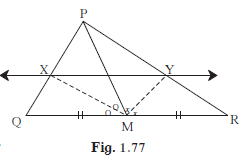
In ΔPQR seg PM is a median. Angle bisectors of ∠PMQ and ∠PMR intersect side PQ and side PR in points X and Y respectively. Prove that XY || QR.
Complete the proof by filling in the boxes. In $\triangle PMQ$, ray MX is bisector of $\angle PMQ$.
$\therefore\frac{\square}{\square}=\frac{\square}{\square}......... (I)$ theorem of angle bisector.
In $\triangle PMR$, ray MY is bisector of $\angle PMR$.
$\therefore\frac{\square}{\square}=\frac{\square}{\square}.........(II)$ theorem of angle bisector.
But $\frac{M P}{M Q}=\frac{M P}{M R}$ $\qquad$
$\therefore \frac{ PX }{ XQ }=\frac{ PY }{ YR }$ $\qquad$
$\therefore XY||QR......$ converse of basic proportionality theorem.
Answer
$\therefore \frac{ PM }{ MQ }=\frac{ PX }{ XQ }............ (I)$ theorem of angle bisector.
AND
$\therefore \frac{ PM }{ MR }=\frac{ PY }{ YR }.........(II)$ theorem of angle bisector.
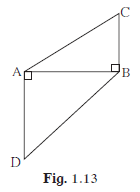
If figure 1.13 BC ⊥ AB, AD ⊥ AB, BC = 4, AD = 8, then find $\frac{ A (\Delta ABC )}{ A (\Delta ADB )}$
Answer
Here, $\triangle ABC$ and $\triangle ADB$ has common Base. $\therefore \frac{\operatorname{Ar}(\triangle ABC )}{\operatorname{Ar}(\triangle ADB )}=\frac{\text { height of } \triangle ABC }{\text { height of } \triangle ADB }$
(PROPERTY: Areas of triangles with equal bases are proportional to their corresponding heights.)
$\Rightarrow \frac{\operatorname{Ar}(\triangle ABC )}{\operatorname{Ar}(\triangle ADB )}=\frac{ BC }{ AD } $
$=\frac{4}{8}$
$=\frac{1}{2}$
ΔMNT ~ ΔQRS. Length of altitude drawn from point T is 5 and length of altitude drawn from point S is 9. Find the ratio $\frac{ A (\Delta MNT )}{ A (\Delta QRS )}$
Answer
$\frac{ A (\Delta MNT )}{ A (\Delta QRS )}=\frac{(\text { altitude from } T )^2}{(\text { altitude frm } S)^2}$
$ =\frac{5^2}{9^2} $
$ =\frac{25}{81}$
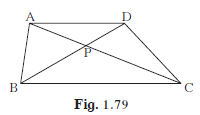
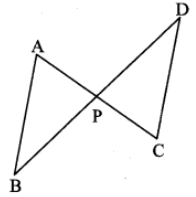
In trapezium $A B C D$, side $A B \|$ side $C D$, diagonal $A C$ and $B D$ intersect each other at point $P$. Then prove that $\frac{A(\Delta \mathrm{ABP})}{\mathrm{A}(\Delta \mathrm{CPD})}=\frac{\mathrm{AB}^2}{\mathrm{CD}^2}$.
Answer
In trapezium $\mathrm{ABCD}$ side $\mathrm{AB} \|$ side $\mathrm{CD}$ In $\triangle \mathrm{APB}$ and $\triangle \mathrm{CPD}$ $\angle \mathrm{PAB} \cong \angle \mathrm{PCD}$ alternate angles $\angle \mathrm{APB} \cong \angle \mathrm{CPD}$ opposite angles $\therefore \triangle \mathrm{APB} \sim \triangle \mathrm{CPD}$ AA test of similarity $\frac{\mathrm{A}(\Delta \mathrm{APB})}{\mathrm{A}(\Delta \mathrm{CPD})}=\frac{\mathrm{AB}^2}{\mathrm{CD}^2} \ldots \ldots$ theorem of areas of similar triangles
Ratio of corresponging sides of two similar triangles is $2:5,$ If the area of the small triangle is $64$ sq.cm. then what is the area of the bigger triangle ?
Answer
Assume that $\triangle \mathrm{ABC} \sim \triangle \mathrm{PQR}$.
$\triangle \mathrm{ABC}$ is smaller and $\triangle \mathrm{PQR}$ is bigger triangle.
$ \therefore \frac{\mathrm{A}(\triangle \mathrm{ABC})}{\mathrm{A}(\triangle \mathrm{PQR})}=\frac{(2)^2}{(5)^2}=\frac{4}{25} \ldots \ldots . . . \text { ratio of areas of similar triangles }$
$\therefore \frac{64}{\mathrm{~A}(\Delta \mathrm{PQR})}=\frac{4}{25}$
$4 \times \mathrm{A}(\triangle \mathrm{PQR})=64 \times 25$
$\mathrm{~A}(\Delta \mathrm{PQR})=\frac{64 \times 25}{4}=400$
$\therefore \text { area of bigger triangle }=400 \mathrm{sq} . \mathrm{cm} . $
$\triangle \mathrm{ABC} \sim \triangle \mathrm{PQR}, \mathrm{A}(\triangle \mathrm{ABC})=16, \mathrm{~A}(\triangle \mathrm{PQP})=25$, then find the value of ratio $\frac{\mathrm{AB}}{\mathrm{PQ}}$.
Answer
$: \triangle \mathrm{ABC} \sim \triangle \mathrm{PQR}$
$\therefore \frac{\mathrm{A}(\triangle \mathrm{ABC})}{\mathrm{A}(\Delta \mathrm{PQR})}=\frac{\mathrm{AB}^2}{\mathrm{PQ}^2}\text{ .......... theorem of areas of similar triangles}$
$\therefore \frac{16}{25}=\frac{\mathrm{AB}^2}{\mathrm{PQ}^2} \quad \therefore \frac{\mathrm{AB}}{\mathrm{PQ}}=\frac{4}{5}\text{.......... taking square roots} $
theorem of areas of similar triangles taking square roots
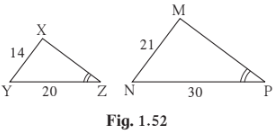
Can we say that the two triangles in figure $1.52$ similar, according to information given? If yes, by which test ?
Answer
$\Delta \mathrm{XYZ}$ and $\Delta \mathrm{MNP}$,
$\frac{X Y}{M N}=\frac{14}{21}=\frac{2}{3},$
$\frac{Y Z}{N P}=\frac{20}{30}=\frac{2}{3}$
It is given that $\angle \mathrm{Z} \cong \angle \mathrm{P}$.
But $\angle \mathrm{Z}$ and $\angle \mathrm{P}$ are not included angles by sides which are in proportion.
: $\Delta \mathrm{XYZ}$ and $\Delta \mathrm{MNP}$ can not be said to be similar.
Given : line $l \|$ line $m \|$ line $n$ $t_1$ and $t_2$ are transversals. Transversal $t_1$ intersects the lines in points A, B, C and $\mathrm{t}_2$ intersects the lines in points $\mathrm{P}$, Q, R. To prove : $\frac{\mathrm{AB}}{\mathrm{BC}}=\frac{\mathrm{PQ}}{\mathrm{QR}}$
If $\triangle ABC \sim \triangle DEF$ such that the area of $\triangle ABC$ is $9 cm^2$ and the area of $\triangle D E F$ is $16 cm^2$. If $B C=2.1$ cm . Find length of EF.
A vertical pole of a length 6 m casts a shadow of 4 m long on the ground. At the same time a tower casts a shadow 28 m long. Find the height of the tower.
The ratio of the areas of two triangles with equal height is $3: 2$. The base of the larger triangle is 18 cm . Find the corresponding base of the smaller triangle.
Prove The Theorem : If a line divides any two sides of a triangle in the same ratio, then the line is parallel to the third side.
Answer
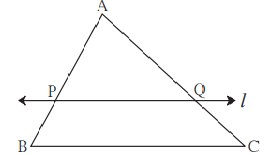
In figure, line l interesects the side AB and side AC of $\triangle ABC$ in the points P and Q respectively and $\frac{A P}{P B}=\frac{A Q}{Q C}$, hence line $l \|$seg BC. This theorem can be proved by indirect method.
Prove The Theorem : The ratio of the intercepts made on a transversal by three parallel lines is equal to the ratio of the corrosponding intercepts made on any other transversal by the same parallel lines.
Answer
Given : line $l \|$ line $m \|$ line $n$ $t_1$ and $t_2$ are transversals. Transversal $t_1$ intersects the lines in points A, B, C and $\mathrm{t}_2$ intersects the lines in points $\mathrm{P}$, Q, R. To prove : $\frac{\mathrm{AB}}{\mathrm{BC}}=\frac{\mathrm{PQ}}{\mathrm{QR}}$
ΔMNT ~ ΔQRS. Length of altitude drawn from point T is 5 and length of altitude drawn from point S is 9. Find the ratio $\frac{ A (\Delta MNT )}{ A (\Delta QRS )}$
Answer
$\begin{array}{l}\frac{ A (\Delta MNT )}{ A (\Delta QRS )}=\frac{(\text { altitude from } T )^2}{\text { (altitude frm } S ^2} \\ =\frac{5^2}{9^2} \\ =\frac{25}{81}\end{array}$
Areas of two similar triangles are 225 sq.cm & 81 sq.cm. If a side of the smaller triangle is 12 cm, then find corresponding side of the bigger triangle.
$J A B C D$ is a parallelogram. Point $E$ is on side $B C$. Line $D E$ intersects ray $A B$ in point $T$. Prove that $D E \times B E=C E \times T E$.
Answer
$\begin{array}{l}\text { In } \triangle CED \text { and } \triangle BET \\ \Rightarrow \angle CED \cong \angle BET \text { (opposite angles) } \\ \Rightarrow \angle CDE \cong \angle BTE \text { (Alternate angles) } \\ (\because AB \| DC \Rightarrow BT \| DC \text {, as } BT \text { is extension to } AB ) \\ \Rightarrow \triangle CED \sim \triangle BET \text { (By AA Test) } \\ \Rightarrow \frac{ CE }{ DE }=\frac{ BE }{ TE } \text { (corresponding sides are proportional) } \\ \Rightarrow DE \times BE = CE \times TE \end{array}$
As shown in the adjoining figure, two poles of height 8 m and 4 m are perpendicular to the ground. If the length of shadow of smaller pole due to sunlight is 6 m, then how long will be the shadow of the bigger pole at the same time?
Answer
$\because$ the shadows are measured at the same time $\Rightarrow$ angle of of elevation will be equal for both the pole $\begin{array}{l} \Rightarrow \triangle PQR \sim \triangle ABC \ldots \ldots . . \text { (By AA Test) } \\ \Rightarrow \frac{ PR }{ AC }=\frac{ QR }{ BC } \\ \Rightarrow BC =\frac{ QR \times AC }{ PR } \\ \Rightarrow x =\frac{6 \times q }{4} \\ \Rightarrow x =12 m \end{array}$ (By AA Test)