MCQ 512 Marks
The value of
$\left(1+2 \omega+\omega^2\right)^{3 n}-\left(1+\omega+2 \omega^2\right)^{3 n}=$
- ✓
$0$
- B
- C
$\omega$
- D
$\omega^2$
Answer(A)
$\left[\left(1+\omega+\omega^2\right)+\omega\right]^{3 n}-\left[\left(1+\omega+\omega^2\right)+\omega^2\right]^{3 n}$
$=\omega^{3 n}-\left(\omega^2\right)^{3 n}$
$=\left(\omega^3\right)^{ n }-\left(\omega^3\right)^{2 n }$
$=1^n-1^{2 n}$
$=0$
View full question & answer→MCQ 522 Marks
If $1, \omega, \omega^2$ are the cube roots of unity, then $\frac{1}{1+2 \omega}+\frac{1}{2+\omega}-\frac{1}{1+\omega}=$
- A
- B
$\omega$
- C
$\omega^2$
- ✓
$0$
Answer(D)
$\frac{1}{1+2 \omega}+\frac{1}{2+\omega}-\frac{1}{1+\omega}$
$=\frac{2+\omega+1+2 \omega}{(1+2 \omega)(2+\omega)}-\frac{1}{\left(-\omega^2\right)}$
$=\frac{3+3 \omega}{2+5 \omega+2 \omega^2}+\frac{\omega}{\omega^3}$
$=\frac{3+3 \omega}{2+5 \omega+2 \omega^2}+\omega$
$=\frac{3+3 \omega+2 \omega+5 \omega^2+2 \omega^3}{2+5 \omega+2 \omega^2}$
$=\frac{5+5 \omega+5 \omega^2}{2+5 \omega+2 \omega^2}=\frac{5\left(1+\omega+\omega^2\right)}{2+5 \omega+2 \omega^2}$
$=0$$\ldots\left[\because 1+\omega+\omega^2=0\right]$
View full question & answer→MCQ 532 Marks
If $\omega$ is a complex cube root of unity, then $\left(1+\omega-2 \omega^2\right)^4+\left(4+\omega+4 \omega^2\right)^4=$
Answer(B)
$\left(1+\omega-2 \omega^2\right)^4+\left(4+\omega+4 \omega^2\right)^4$
$=\left(-3 \omega^2\right)^4+[4(-\omega)+\omega]^4$
$=81 \omega^8+(-3 \omega)^4$
$=81\left(\omega^3\right)^2 \cdot \omega^2+81 \omega^4$
$=81 \omega^2+81 \omega$
$=-81 \quad \ldots .\left[\because 1+\omega+\omega^2=0\right]$
View full question & answer→MCQ 542 Marks
If $\omega$ is a complex cube root of unity, then $\left(2+5 \omega+2 \omega^2\right)^6=$
Answer(C)
$\left(2+5 \omega+2 \omega^2\right)^6=\left[2\left(1+\omega^2\right)+5 \omega\right]^6$
$=[2(-\omega)+5 \omega]^6$
$=[-2 \omega+5 \omega]^6$
$=(3 \omega)^6$
$=3^6 \cdot \omega^6$
$=729$
View full question & answer→MCQ 552 Marks
The two numbers such that each one is square of the other are
- A
$\omega, \omega^3$
- B
$-i, i$
- C
$-1,1$
- ✓
$\omega, \omega^2$
AnswerCorrect option: D. $\omega, \omega^2$
(D)
Since $(\omega)^2=\omega^2$ and $\left(\omega^2\right)^2=\omega^4=\omega \omega^3=\omega$
View full question & answer→MCQ 562 Marks
$\sum_{k=1}^6\left(\sin \frac{2 \pi k}{7}-i \cos \frac{2 \pi k}{7}\right)=$
Answer(C)
$\sum_{ k =1}^6\left(\sin \frac{2 \pi k }{7}- i \cos \frac{2 \pi k }{7}\right)$
$=- i \sum_{ k =1}^6\left(\cos \frac{2 \pi k }{7}+ i \sin \frac{2 \pi k }{7}\right)$
$=-i\left[\left(\cos \frac{2 \pi}{7}+i \sin \frac{2 \pi}{7}\right)+\left(\cos \frac{4 \pi}{7}+i \sin \frac{4 \pi}{7}\right)\right.$ $\left.+\ldots .+\left(\cos \frac{12 \pi}{7}+i \sin \frac{12 \pi}{7}\right)\right]$
$=-i\left[\left(\cos \frac{2 \pi}{7}+i \sin \frac{2 \pi}{7}\right)+\left(\cos \frac{2 \pi}{7}+i \sin \frac{2 \pi}{7}\right)^2\right.$ $\left.+\ldots .+\left(\cos \frac{2 \pi}{7}+i \sin \frac{2 \pi}{7}\right)^6\right]$
$=- i \left[\frac{x\left(x^6-1\right)}{x-1}\right]$, where $x=\cos \frac{2 \pi}{7}+ i \sin \frac{2 \pi}{7}$
$=- i \left[\frac{x^7-x}{x-1}\right]=- i \left[\frac{1-x}{x-1}\right]$
$\ldots\left[\begin{array}{rl}\because x^7 & =\left(\cos \frac{2 \pi}{7}+i \sin \frac{2 \pi}{7}\right)^7 \\ & =\cos 2 \pi+i \sin 2 \pi=1\end{array}\right]$
$= i \left(\frac{x-1}{x-1}\right)= i$
View full question & answer→MCQ 572 Marks
If $\left(\frac{3}{2}+i \frac{\sqrt{3}}{2}\right)^{50}=3^{25}(x-i y)$, where $x, y$ are real and $i =\sqrt{-1}$, then the ordered pair $(x, y)$ is given by
- A
$(0,3)$
- B
$\left(\frac{1}{2}, \sqrt{3}\right)$
- C
$(-3,0)$
- ✓
$\left(\frac{1}{2},-\frac{\sqrt{3}}{2}\right)$
AnswerCorrect option: D. $\left(\frac{1}{2},-\frac{\sqrt{3}}{2}\right)$
(D)
$\left(\frac{3}{2}+ i \frac{\sqrt{3}}{2}\right)^{50}=\left[\sqrt{3}\left(\frac{\sqrt{3}}{2}+ i \cdot \frac{1}{2}\right)\right]^{50}$
$=3^{25}\left(\frac{\sqrt{3}}{2}+ i \cdot \frac{1}{2}\right)^{50}=3^{25}\left(\cos \frac{\pi}{6}+ i \cdot \sin \frac{\pi}{6}\right)^{50}$
$=3^{25}\left[\cos \left(\frac{50 \pi}{6}\right)+ i \cdot \sin \left(\frac{50 \pi}{6}\right)\right]$
....[By De Moivre's theorem]
$\therefore \quad 3^{25}\left[\cos \left(\frac{25 \pi}{3}\right)+ i \sin \left(\frac{25 \pi}{3}\right)\right]=3^{25}(x- i y)$
$\Rightarrow x- i y=\cos \left(\frac{25 \pi}{3}\right)+ i \sin \left(\frac{25 \pi}{3}\right)$
Equating real and imaginary parts, we get
$x=\cos \left(\frac{25 \pi}{3}\right)=\cos \left(8 \pi+\frac{\pi}{3}\right)$
$\Rightarrow x=\cos \left(\frac{\pi}{3}\right) \Rightarrow x=\frac{1}{2}$
and $y=-\sin \left(\frac{25 \pi}{3}\right)=-\sin \left(8 \pi+\frac{\pi}{3}\right)$
$\Rightarrow y=-\sin \left(\frac{\pi}{3}\right)=-\frac{\sqrt{3}}{2}$
$\therefore \quad(x, y)=\left(\frac{1}{2},-\frac{\sqrt{3}}{2}\right)$
View full question & answer→MCQ 582 Marks
If $\alpha, \beta$ are roots of the equation $x^2-4 x+8=0$ then for any $n \in N, \alpha^{2 n}+\beta^{2 n}=$
- A
$2^{2 n+1} \cos \frac{n \pi}{2}$
- B
$2^{3 n} \cos \frac{n \pi}{2}$
- ✓
$2^{3 n+1} \cos \frac{n \pi}{2}$
- D
$2^{3 n} \cos \frac{n \pi}{4}$
AnswerCorrect option: C. $2^{3 n+1} \cos \frac{n \pi}{2}$
(C)
$x^2-4 x+8=0$
$\Rightarrow(x-2)^2=-4 \Rightarrow x=2 \pm 2 i$
$\therefore \quad \alpha^{2 n}+\beta^{2 n}=2^{2 n}(1+i)^{2 n}+2^{2 n}(1-i)^{2 n}$
$=2^{2 n } \cdot 2^{ n }\left(\frac{1}{\sqrt{2}}+\frac{ i }{\sqrt{2}}\right)^{2 n }+2^{2 n } \cdot 2^{ n }\left(\frac{1}{\sqrt{2}}-\frac{ i }{\sqrt{2}}\right)^{2 n }$
$=2^{3 n}\left(\cos \frac{\pi}{4}+i \sin \frac{\pi}{4}\right)^{2 n}+2^{3 n}\left(\cos \frac{\pi}{4}-i \sin \frac{\pi}{4}\right)^{2 n}$
$-2^{3 n} \cdot 2 \cos \frac{n \pi}{2}-2^{3 n+1} \cos \frac{n \pi}{2}$
View full question & answer→MCQ 592 Marks
If $z=\frac{1+i \sqrt{3}}{\sqrt{3}+i}$, then $(z)^{100}$ lies in
- A
$I^{\text {st }}$ quadrant
- B
$II^{\text {nd }}$ quadrant
- ✓
III ${ }^{\text {rd }}$ quadrant
- D
IV ${ }^{\text {th }}$ quadrant
AnswerCorrect option: C. III ${ }^{\text {rd }}$ quadrant
(C)
$z=\frac{1+i \sqrt{3}}{\sqrt{3}+i} \Rightarrow z=\frac{1+i \sqrt{3}}{\sqrt{3}+i} \times \frac{\sqrt{3}-i}{\sqrt{3}-i}$
$z=\frac{\sqrt{3}+3 i-i+\sqrt{3}}{3+1}=\frac{2(\sqrt{3}+i)}{4}$
$\Rightarrow \quad z=\frac{\sqrt{3}+i}{2}=\left[\cos \frac{\pi}{6}+i \sin \frac{\pi}{6}\right]$
Now $\bar{z}=\cos \frac{\pi}{6}-i \sin \frac{\pi}{6}$
$\Rightarrow(\bar{z})^{100}=\left[\cos \frac{\pi}{6}-i \sin \frac{\pi}{6}\right]^{100}$
$\Rightarrow(\overline{ z })^{100}=\cos \frac{50 \pi}{3}- i \sin \frac{50 \pi}{3}$
$=\cos \frac{2 \pi}{3}-i \sin \frac{2 \pi}{3}=\frac{-1-i \sqrt{3}}{2}$
$(\overline{ Z })^{100}$ lies in III ${ }^{\text {rd }}$ quadrant.
View full question & answer→MCQ 602 Marks
$(-\sqrt{3}+i)^{53}$, where $i^2=-1$, is equal to
AnswerCorrect option: C. $2^{53}\left(\frac{\sqrt{3}}{2}+\frac{1}{2} i \right)$
(C)
$(-\sqrt{3}+ i )^{53}=2^{53}\left(\frac{-\sqrt{3}}{2}+\frac{ i }{2}\right)^{53}$
$=2^{53}\left(\cos 150^{\circ}+ i \sin 150^{\circ}\right)^{53}$
$=2^{53}\left[\cos \left(150^{\circ} \times 53\right)+i \sin \left(150^{\circ} \times 53\right)\right]$
$=2^{53}\left[\cos \left(22 \pi+30^{\circ}\right)+i \sin \left(22 \pi+30^{\circ}\right)\right]$
$=2^{53}\left[\cos 30^{\circ}+i \sin 30^{\circ}\right]$
$=2^{53}\left[\frac{\sqrt{3}}{2}+ i \frac{1}{2}\right]$
View full question & answer→MCQ 612 Marks
If $z=\left(\frac{\sqrt{3}}{2}+\frac{i}{2}\right)^5+\left(\frac{\sqrt{3}}{2}-\frac{i}{2}\right)^5$, then
- A
$\operatorname{Re}( z )=0$
- ✓
$\operatorname{Im}( z )=0$
- C
$\operatorname{Re}(z)>0, \operatorname{Im}(z)>0$
- D
$\operatorname{Re}(z)>0, \operatorname{Im}(z)<0$
AnswerCorrect option: B. $\operatorname{Im}( z )=0$
(B)
Given that $z=\left(\frac{\sqrt{3}}{2}+i \frac{1}{2}\right)^5+\left(\frac{\sqrt{3}}{2}-i \frac{1}{2}\right)^5$
$=\left[\cos \left(\frac{\pi}{6}\right)+ i \sin \left(\frac{\pi}{6}\right)\right]^5+\left[\cos \left(\frac{\pi}{6}\right)- i \sin \left(\frac{\pi}{6}\right)\right]^5$
$=\cos \frac{5 \pi}{6}+i \sin \frac{5 \pi}{6}+\cos \frac{5 \pi}{6}-i \sin \frac{5 \pi}{6}$
Hence, $\operatorname{Im}( z )=0$
View full question & answer→MCQ 622 Marks
$\left(\frac{1+i}{\sqrt{2}}\right)^8+\left(\frac{1-i}{\sqrt{2}}\right)^8=$
Answer(B)
$\left(\frac{1+ i }{\sqrt{2}}\right)^8+\left(\frac{1- i }{\sqrt{2}}\right)^8$
$=\left(\frac{1}{\sqrt{2}}+i \frac{1}{\sqrt{2}}\right)^8+\left(\frac{1}{\sqrt{2}}-i \frac{1}{\sqrt{2}}\right)^8$
$=\left(\cos \frac{\pi}{4}+i \sin \frac{\pi}{4}\right)^8+\left(\cos \frac{\pi}{4}-i \sin \frac{\pi}{4}\right)^8$
$=\cos \frac{8 \pi}{4}+i \sin \frac{8 \pi}{4}+\cos \frac{8 \pi}{4}-i \sin \frac{8 \pi}{4}$
$=\cos 2 \pi+\cos 2 \pi$
$=1+1=2$
View full question & answer→MCQ 632 Marks
Which of the following is a fourth root of $\frac{1}{2}+\frac{ i \sqrt{3}}{2} ?$
- A
$\cos \frac{\pi}{2}+i \sin \frac{\pi}{2}$
- ✓
$\cos \frac{\pi}{12}+i \sin \frac{\pi}{12}$
- C
$\cos \frac{\pi}{6}+i \sin \frac{\pi}{6}$
- D
$\cos \frac{\pi}{3}+i \sin \frac{\pi}{3}$
AnswerCorrect option: B. $\cos \frac{\pi}{12}+i \sin \frac{\pi}{12}$
(B)
$\frac{1}{2}+ i \frac{\sqrt{3}}{2}=\left(\cos \frac{\pi}{3}+ i \sin \frac{\pi}{3}\right)$
Now, $\left(\frac{1}{2}+ i \frac{\sqrt{3}}{2}\right)^{\frac{1}{4}}=\left(\cos \frac{\pi}{3}+ i \sin \frac{\pi}{3}\right)^{\frac{1}{4}}$
$=\left(\cos \frac{\pi}{12}+ i \sin \frac{\pi}{12}\right)$
View full question & answer→MCQ 642 Marks
If $i z ^4+1=0$, then z can take the value
AnswerCorrect option: B. $\cos \frac{\pi}{8}+ i \sin \frac{\pi}{8}$
(B)
$i z^4=-1 \Rightarrow z^4=\frac{-1}{i} \Rightarrow z^4=i \Rightarrow z=(i)^{\frac{1}{4}}$
$\Rightarrow z=(0+i)^{\frac{1}{4}} \Rightarrow z=\left(\cos \frac{\pi}{2}+i \sin \frac{\pi}{2}\right)^{\frac{1}{4}}$
$\Rightarrow z =\cos \frac{\pi}{8}+ i \sin \frac{\pi}{8}$ (using DeMoivre's theorem)
View full question & answer→MCQ 652 Marks
If $a=\sqrt{2 i}$, then which of the following is correct?
- ✓
$a=1+i$
- B
$a=1-i$
- C
$a=-(\sqrt{2}) i$
- D
$a=-1-i$
AnswerCorrect option: A. $a=1+i$
(A)
$a =\sqrt{2 i }=\sqrt{2} i ^{1 / 2}=\sqrt{2}\left(\cos \frac{\pi}{2}+ i \sin \frac{\pi}{2}\right)^{1 / 2}$
$=\sqrt{2}\left(\cos \frac{\pi}{4}+i \sin \frac{\pi}{4}\right)=\sqrt{2}\left(\frac{1}{\sqrt{2}}+\frac{1}{\sqrt{2}} i\right)=1+i$
View full question & answer→MCQ 662 Marks
If $\left(\frac{1+\cos \theta+i \sin \theta}{i+\sin \theta+i \cos \theta}\right)^4=\cos n \theta+i \sin n \theta$, then $n$ is equal to
Answer(D)
$\left[\frac{1+\cos \theta+i \sin \theta}{i+\sin \theta+i \cos \theta}\right]^4=\left[\frac{(1+\cos \theta)+i \sin \theta}{\sin \theta+i(1+\cos \theta)}\right]^4$
$=\left[\frac{2 \cos ^2 \frac{\theta}{2}+i 2 \sin \frac{\theta}{2} \cos \frac{\theta}{2}}{2 \sin \frac{\theta}{2} \cos \frac{\theta}{2}+i\left(2 \cos ^2 \frac{\theta}{2}\right)}\right]^4$
$=\left[\frac{\cos \frac{\theta}{2}+ i \sin \frac{\theta}{2}}{\sin \frac{\theta}{2}+ i \cos \frac{\theta}{2}}\right]^4=\frac{1}{ i ^4}\left[\frac{\cos \frac{\theta}{2}+ i \sin \frac{\theta}{2}}{\cos \frac{\theta}{2}- i \sin \frac{\theta}{2}}\right]^4$
$=\left(\cos \frac{\theta}{2}+i \sin \frac{\theta}{2}\right)^4 \cdot\left(\cos \frac{\theta}{2}-i \sin \frac{\theta}{2}\right)^{-4}$
$=\left(\cos \frac{\theta}{2}+ i \sin \frac{\theta}{2}\right)^4 \cdot\left(\cos \frac{\theta}{2}+ i \sin \frac{\theta}{2}\right)^4$
$=\left(\cos \frac{\theta}{2}+ i \sin \frac{\theta}{2}\right)^8=\cos 4 \theta+ i \sin 4 \theta$
Therefore, $n =4$
View full question & answer→MCQ 672 Marks
$\left(\frac{1+\cos \phi+i \sin \phi}{1+\cos \phi-i \sin \phi}\right)^n=$
- A
$\cos n \phi-i \sin n \phi$
- ✓
$\cos n \phi+i \sin n \phi$
- C
$\sin n \phi+i \cos n \phi$
- D
$\sin n \phi-i \cos n \phi$
AnswerCorrect option: B. $\cos n \phi+i \sin n \phi$
(B)
L.H.S.
$=\left[\frac{2 \cos ^2(\phi / 2)+2 i \sin (\phi / 2) \cos (\phi / 2)}{2 \cos ^2(\phi / 2)-2 i \sin (\phi / 2) \cos (\phi / 2)}\right]^{ n }$
$=\left[\frac{\cos (\phi / 2)+ i \sin (\phi / 2)}{\cos (\phi / 2)- i \sin (\phi / 2)}\right]^{ n }$
$=\left[\frac{ e ^{ i (\phi / 2)}}{ e ^{- i (\phi / 2)}}\right]^{ n }$
$=\left( e ^{ i \phi}\right)^{ n }$
$=\cos n \phi+i \sin n \phi$
View full question & answer→MCQ 682 Marks
The value of $\left[\frac{1-\cos \frac{\pi}{10}+i \sin \frac{\pi}{10}}{1-\cos \frac{\pi}{10}-i \sin \frac{\pi}{10}}\right]^{10}=$
Answer(B)
Let $\cos \frac{\pi}{10}-i \sin \frac{\pi}{10}=z$ and $\cos \frac{\pi}{10}+i \sin \frac{\pi}{10}=\frac{1}{z}$
$\therefore\left(\frac{1-z}{1-\frac{1}{z}}\right)^{10}=\left\{\frac{-(z-1) z}{(z-1)}\right\}^{10}$
$=(- z )^{10}$
$=z^{10}=\left(\cos \frac{\pi}{10}-i \sin \frac{\pi}{10}\right)^{10}$
$=\cos \pi-i \sin \pi=-1$
View full question & answer→MCQ 692 Marks
If $\frac{1}{x}+x=2 \cos \theta$, then $x^n+\frac{1}{x^n}$ is equal to
- ✓
$2 \cos n \theta$
- B
$2 \sin n \theta$
- C
$\cos n \theta$
- D
$\sin n \theta$
AnswerCorrect option: A. $2 \cos n \theta$
(A)
$x+\frac{1}{x}=2 \cos \theta$
$\Rightarrow x^2-2 x \cos \theta+1=0$
$\Rightarrow x=\cos \theta \pm i \sin \theta \Rightarrow x^n=\cos n \theta \pm i \sin n \theta$
$\Rightarrow \frac{1}{x}=\frac{1}{\cos \theta \pm i \sin \theta} \Rightarrow \frac{1}{x}=\cos \theta \mp i \sin \theta$
$\Rightarrow \frac{1}{x^{ n }}=\cos n \theta \mp i \sin n \theta$
Thus, $x^{ n }+\frac{1}{x^{ n }}=2 \cos n \theta$
View full question & answer→MCQ 702 Marks
$\frac{(\cos 2 \theta-i \sin 2 \theta)^4(\cos 4 \theta+i \sin 4 \theta)^{-5}}{(\cos 3 \theta+i \sin 3 \theta)^{-2}(\cos 3 \theta-i \sin 3 \theta)^{-9}}=$
- ✓
$\cos 49 \theta- i \sin 49 \theta$
- B
$\cos 23 \theta- i \sin 23 \theta$
- C
$\cos 49 \theta+i \sin 49 \theta$
- D
$\cos 21 \theta+ i \sin 21 \theta$
AnswerCorrect option: A. $\cos 49 \theta- i \sin 49 \theta$
(A)
$\frac{(\cos 2 \theta-i \sin 2 \theta)^4(\cos 4 \theta+i \sin 4 \theta)^{-5}}{(\cos 3 \theta+i \sin 3 \theta)^{-2}(\cos 3 \theta-i \sin 3 \theta)^{-9}}$
$=\frac{\left[(\cos \theta+i \sin \theta)^{-2}\right]^4\left[(\cos \theta+i \sin \theta)^4\right]^{-5}}{\left[(\cos \theta+i \sin \theta)^3\right]^{-2}\left[(\cos \theta+i \sin \theta)^{-3}\right]^{-9}}$
$=\frac{(\cos \theta+i \sin \theta)^{-8}(\cos \theta+i \sin \theta)^{-20}}{(\cos \theta+i \sin \theta)^{-6}(\cos \theta+i \sin \theta)^{27}}$
$=(\cos \theta+ i \sin \theta)^{-8-20+6-27}$
$=(\cos \theta+ i \sin \theta)^{-49}$
$=\cos 49 \theta- i \sin 49 \theta$
View full question & answer→MCQ 712 Marks
$\left(-\frac{1}{2}+\frac{\sqrt{3}}{2} i\right)^{1000}=$
- A
$\frac{1}{2}+\frac{\sqrt{3}}{2} i$
- B
$\frac{1}{2}-\frac{\sqrt{3}}{2} i$
- ✓
$-\frac{1}{2}+\frac{\sqrt{3}}{2} i$
- D
AnswerCorrect option: C. $-\frac{1}{2}+\frac{\sqrt{3}}{2} i$
(C)
Since $\omega=-\frac{1}{2}+\frac{1}{2} i \sqrt{3}$
$\therefore \quad \omega^{1000}=\omega^{999} \omega=\left(\omega^3\right)^{333} \omega=\omega=-\frac{1}{2}+\frac{\sqrt{3}}{2} i$
View full question & answer→MCQ 722 Marks
The value of $\left(1-\omega+\omega^2\right)\left(1-\omega^2+\omega\right)^6$, where $\omega, \omega^2$ are cube roots of unity, is
- A
$128 \omega$
- B
$-128 \omega^2$
- ✓
$-128 \omega$
- D
$128 \omega^2$
AnswerCorrect option: C. $-128 \omega$
(C)
$\left(1-\omega+\omega^2\right)\left(1-\omega^2+\omega\right)^6=(-2 \omega)\left(-2 \omega^2\right)^6$
$=-128 \omega$
View full question & answer→MCQ 732 Marks
$\left(1-\omega+\omega^2\right)^5+\left(1+\omega-\omega^2\right)^5=$
Answer(C)
$\left(1-\omega+\omega^2\right)^5+\left(1+\omega-\omega^2\right)^5$
$=(-2 \omega)^5+\left(-2 \omega^2\right)^5$
$=-32 \omega^3 \omega^2-32 \omega^9 \omega$
$=-32\left(\omega^2+\omega\right)$
$=32$
View full question & answer→MCQ 742 Marks
If $\omega$ is an imaginary cube root of unity, $\left(1+\omega-\omega^2\right)^7$ equals
- A
$128 \omega$
- B
$-128 \omega$
- C
$128 \omega^2$
- ✓
$-128 \omega^2$
AnswerCorrect option: D. $-128 \omega^2$
(D)
$\left(1+\omega-\omega^2\right)^7=\left(-\omega^2-\omega^2\right)^7$
$=\left(-2 \omega^2\right)^7$
$=-128 \omega^{14}$
$=-128 \omega^{12} \omega^2$
$=-128 \omega^2$
View full question & answer→MCQ 752 Marks
If $1, \omega, \omega^2$ are the cube roots of unity, then $\omega^2(1+\omega)^3-\left(1+\omega^2\right) \omega=$
Answer(D)
$\omega^2(1+\omega)^3-\left(1+\omega^2\right) \omega=\omega^2\left(-\omega^2\right)^3-\omega(-\omega)$
$=-\omega^2+\omega^2=0$
View full question & answer→MCQ 762 Marks
If $\omega$ is a complex cube root of unity, then $\frac{1}{\omega}+\frac{1}{\omega^2}$ =
- A
- ✓
$-1$
- C
$\frac{1}{\omega}$
- D
$-\frac{1}{\omega}$
Answer(B)
$\frac{1}{\omega}+\frac{1}{\omega^2}=\frac{\omega+\omega^2}{\omega^3}=\frac{-1}{1}=-1$
View full question & answer→MCQ 772 Marks
If $\omega$ is a complex cube root of unity, then the value of $\omega^{99}+\omega^{100}+\omega^{101}$ is
Answer(D)
$\omega^{99}+\omega^{100}+\omega^{101}=\omega^{99}\left[1+\omega+\omega^2\right]=0$
View full question & answer→MCQ 782 Marks
If $1, \omega, \omega^2$ are the cube roots of unity, then their product is
Answer(D)
$1 \cdot \omega \cdot \omega^2=\omega^3=1$
View full question & answer→MCQ 792 Marks
If $2 \operatorname{cis} \frac{7 \pi}{5}$ is one of the values of $z ^{1/5}$, then $z =$
Answer(B)
$z^{\frac{1}{5}}=2 \operatorname{cis} \frac{7 \pi}{5}$
$\Rightarrow z^{\frac{1}{5}}=2\left(\cos \frac{7 \pi}{5}+i \sin \frac{7 \pi}{5}\right)$
$\Rightarrow z=2^5\left(\cos \frac{7 \pi}{5}+i \sin \frac{7 \pi}{5}\right)^5$
$=2^5(\cos 7 \pi+i \sin 7 \pi)$
$=32(-1+0)$
$=-32$
View full question & answer→MCQ 802 Marks
$(\sin \theta+i \cos \theta)^n$ is equal to
- A
$\cos n \theta+i \sin n \theta$
- B
$\sin n \theta+i \cos n \theta$
- ✓
$\cos n\left(\frac{\pi}{2}-\theta\right)+i \sin n\left(\frac{\pi}{2}-\theta\right)$
- D
$\cos n\left(\frac{\pi}{2}-\theta\right)-i \sin n\left(\frac{\pi}{2}-\theta\right)$
AnswerCorrect option: C. $\cos n\left(\frac{\pi}{2}-\theta\right)+i \sin n\left(\frac{\pi}{2}-\theta\right)$
(C)
$(\sin \theta+ i \cos \theta)^{ n }=\left[\cos \left(\frac{\pi}{2}-\theta\right)+ i \sin \left(\frac{\pi}{2}-\theta\right)\right]^{ n }$
$=\cos n\left(\frac{\pi}{2}-\theta\right)+i \sin n\left(\frac{\pi}{2}-\theta\right)$
View full question & answer→MCQ 812 Marks
The value of $\frac{4\left(\cos 75^{\circ}+ i \sin 75^{\circ}\right)}{0.4\left(\cos 30^{\circ}+ i \sin 30^{\circ}\right)}$ is
- A
$\frac{\sqrt{2}}{10}(1+i)$
- B
$\frac{\sqrt{2}}{10}(1-i)$
- C
$\frac{10}{\sqrt{2}}(1-i)$
- ✓
$\frac{10}{\sqrt{2}}(1+i)$
AnswerCorrect option: D. $\frac{10}{\sqrt{2}}(1+i)$
(D)
$\frac{4\left(\cos 75^{\circ}+ i \sin 75^{\circ}\right)}{0.4\left(\cos 30^{\circ}+ i \sin 30^{\circ}\right)}$
$=10\left(\cos 75^{\circ}+i \sin 75^{\circ}\right)\left(\cos 30^{\circ}-i \sin 30^{\circ}\right)$
$=10\left(\cos 45^{\circ}+i \sin 45^{\circ}\right)=\frac{10}{\sqrt{2}}(1+i)$
View full question & answer→MCQ 822 Marks
$\frac{(\cos \theta+i \sin \theta)^4}{(\sin \theta+i \cos \theta)^5}$ is equal to
- A
$\cos \theta- i \sin \theta$
- B
$\cos 9 \theta- i \sin 9 \theta$
- C
$\sin \theta- i \cos \theta$
- ✓
$\sin 9 \theta- i \cos 9 \theta$
AnswerCorrect option: D. $\sin 9 \theta- i \cos 9 \theta$
(D)
$\frac{(\cos \theta+ i \sin \theta)^4}{(\sin \theta+ i \cos \theta)^5}=\frac{(\cos \theta+ i \sin \theta)^4}{ i ^5\left(\frac{1}{ i } \sin \theta+\cos \theta\right)^5}$
$=\frac{(\cos \theta+i \sin \theta)^4}{i(\cos \theta-i \sin \theta)^5}=\frac{(\cos \theta+i \sin \theta)^4}{i(\cos \theta+i \sin \theta)^{-5}}$
$=\frac{1}{i}(\cos \theta+i \sin \theta)^9=\sin 9 \theta-i \cos 9 \theta$
View full question & answer→MCQ 832 Marks
Suppose that $z _1, z _2, z _3$ are three vertices of an equilateral triangle in the Argand plane. Let $\alpha=\frac{1}{2}(\sqrt{3}+ i )$ and $\beta$ be a non-zero complex number. The points $\alpha z_1+\beta, \alpha z_2+\beta, \alpha z_3+\beta$ will be
- ✓
the vertices of an equilateral triangle
- B
the vertices of an isosceles triangle
- C
- D
the vertices of a scalene triangle
AnswerCorrect option: A. the vertices of an equilateral triangle
(A)
$\frac{1}{\left(\alpha z_1+\beta\right)-\left(\alpha z_2+\beta\right)}+\frac{1}{\left(\alpha z_2+\beta\right)-\left(\alpha z_3+\beta\right)}$ $+\frac{1}{\left(\alpha z_3+\beta\right)-\left(\alpha z_1+\beta\right)}$
$=\frac{1}{\alpha\left(z_1-z_2\right)}+\frac{1}{\alpha\left(z_2-z_3\right)}+\frac{1}{\alpha\left(z_3-z_1\right)}$
$=\frac{1}{\alpha}\left[\frac{1}{\left(z_1-z_2\right)}+\frac{1}{\left(z_2-z_3\right)}+\frac{1}{\left(z_3-z_1\right)}\right]=0$
Hence, $\alpha z_1+\beta, \alpha z_2+\beta, \alpha z_3+\beta$ are vertices of an equilateral triangle.
View full question & answer→MCQ 842 Marks
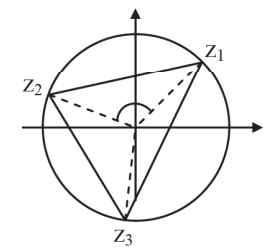
Let $z_1$ be a fixed point on the circle of radius 1 centered at the origin in the Argand plane and $z _1 \neq \pm 1$. Consider an equilateral triangle inscribed in the circle with $z _1, z _2, z _3$ as the vertices taken in the counter clockwise direction. Then $z _1 z _2 z _3$ is equal to
- A
$z _1^2$
- ✓
$z_1^3$
- C
$z_1^4$
- D
$Z _1$
AnswerCorrect option: B. $z_1^3$
(B)
Let $z _1= re ^{ i \alpha}, z _2= r . e ^{ i \left(\alpha+\frac{2 \pi}{3}\right)}, z _3= r . e ^{ i \left(\alpha+\frac{4 \pi}{3}\right)}$
$Z _1 Z _2 Z _3= r ^3 e ^{ i \left(\alpha+\alpha+\frac{2 \pi}{3}+\alpha+\frac{4 \pi}{3}\right)}$
$= r ^3 e ^{ i (3 \alpha+2 \pi)}$
$=r^3 e^{i 3 \alpha}$
$=\left( re ^{ i \alpha}\right)^3$
$= z _1^3$
View full question & answer→MCQ 852 Marks
Let $z =\cos \theta+ i \sin \theta$. Then, the value of $\sum_{m=1}^{15} \operatorname{Im}\left(z^{2 m-1}\right)$ at $\theta=2^{\circ}$ is
- A
$\frac{1}{\sin 2^{\circ}}$
- B
$\frac{1}{3 \sin 2^{\circ}}$
- C
$\frac{1}{2 \sin 2^{\circ}}$
- ✓
$\frac{1}{4 \sin 2^{\circ}}$
AnswerCorrect option: D. $\frac{1}{4 \sin 2^{\circ}}$
(D)
Given, $z =\cos \theta+ i \sin \theta= e ^{ i \theta}$
$\therefore \quad \sum_{ m =1}^{15} \operatorname{Im}\left( z ^{2 m-1}\right)=\sum_{ m =1}^{15} \operatorname{Im}\left( e ^{ i \theta}\right)^{2 m-1}=\sum_{ m =1}^{15} \operatorname{Im} e ^{ i (2 m-1) \theta}$
$=\sin \theta+\sin 3 \theta+\sin 5 \theta+\ldots .+\sin 29 \theta$
$=\frac{\sin \left(\frac{\theta+29 \theta}{2}\right) \sin \left(\frac{15 \times 2 \theta}{2}\right)}{\sin \left(\frac{2 \theta}{2}\right)}$
$=\frac{\sin (15 \theta) \sin (15 \theta)}{\sin \theta}$
At $\theta=2^{\circ}$,
$\sum_{m=1}^{15} \operatorname{Im}\left(z^{2 m-1}\right)=\frac{\sin ^2 30^{\circ}}{\sin 2^{\circ}}=\frac{1}{4 \sin 2^{\circ}}$
View full question & answer→MCQ 862 Marks
If $a = e ^{ i \theta}$, then $\frac{1+ a }{1- a }$ is equal to
AnswerCorrect option: C. $i \cot \frac{\theta}{2}$
(C)
$\frac{1+ a }{1- a }=\frac{1+ e ^{ i \theta}}{1- e ^{ i \theta}}$
$=\frac{1+\cos \theta+i \sin \theta}{1-\cos \theta-i \sin \theta}$
$=\frac{2 \cos ^2 \frac{\theta}{2}+2 i \sin \frac{\theta}{2} \cos \frac{\theta}{2}}{2 \sin ^2 \frac{\theta}{2}-2 i \sin \frac{\theta}{2} \cos \frac{\theta}{2}}$
$=\cot \frac{\theta}{2}\left[\frac{\cos \frac{\theta}{2}+i \sin \frac{\theta}{2}}{\sin \frac{\theta}{2}-i \cos \frac{\theta}{2}}\right]$
$=\cot \frac{\theta}{2}\left[\frac{ e ^{\frac{ i \theta}{2}}}{-\cos \left(\frac{\pi}{2}+\frac{\theta}{2}\right)- i \sin \left(\frac{\pi}{2}+\frac{\theta}{2}\right)}\right]$
$=\cot \frac{\theta}{2}\left[\frac{ e ^{\frac{ i \theta}{2}}}{- e ^{ i \left(\frac{\pi}{2}+\frac{\theta}{2}\right)}}\right]$
$=-\cot \frac{\theta}{2} e ^{\frac{-1 \pi}{2}}$
$=-\cot \frac{\theta}{2}\left[\cos \frac{\pi}{2}- i \sin \frac{\pi}{2}\right]$
$=i \cot \frac{\theta}{2}$
View full question & answer→MCQ 872 Marks
$\left(\frac{1+\cos \left(\frac{\pi}{12}\right)+i \sin \left(\frac{\pi}{12}\right)}{1+\cos \left(\frac{\pi}{12}\right)-i \sin \left(\frac{\pi}{12}\right)}\right)^{72}$ is equal to
Answer(C)
$\left(\frac{1+\cos \left(\frac{\pi}{12}\right)+ i \sin \left(\frac{\pi}{12}\right)}{1+\cos \left(\frac{\pi}{12}\right)- i \sin \left(\frac{\pi}{12}\right)}\right)^{72}$
$=\left[\frac{2 \cos ^2 \frac{\pi}{24}+2 i \sin \frac{\pi}{24} \cos \frac{\pi}{24}}{2 \cos ^2 \frac{\pi}{24}-2 i \sin \frac{\pi}{24} \cos \frac{\pi}{24}}\right]^{72}$
$=\left[\frac{\cos \frac{\pi}{24}+i \sin \frac{\pi}{24}}{\cos \frac{\pi}{24}-i \sin \frac{\pi}{24}}\right]^{72}$
$=\left[\frac{e^{\frac{i \pi}{24}}}{e^{-\frac{i \pi}{24}}}\right]^{72}$
$=\left[e^{\frac{i \pi}{12}}\right]^{72}$
$= e ^{6 \pi i }$
$=\cos 6 \pi+i \sin 6 \pi$
$=1$
View full question & answer→MCQ 882 Marks
If $z=r(\cos \theta+i \sin \theta)$, then the value of $\frac{z}{\bar{z}}+\frac{\bar{z}}{z}$ is
- A
$\cos 2 \theta$
- ✓
$2 \cos 2 \theta$
- C
$2 \cos \theta$
- D
$2 \sin \theta$
AnswerCorrect option: B. $2 \cos 2 \theta$
(B)
$z=r(\cos \theta+i \sin \theta)=r e^{i \theta}$
$\overline{ z }= r (\cos \theta- i \sin \theta)= re ^{-1 \theta}$
$\therefore \quad \frac{ Z }{ Z }+\frac{\overline{ Z }}{ Z }=\frac{ re ^{ i \theta}}{ re ^{- i \theta}}+\frac{ re ^{- i \theta}}{ re ^{ i \theta}}= e ^{2 i \theta}+ e ^{-2 i \theta}$
$=(\cos 2 \theta+i \sin 2 \theta)+(\cos 2 \theta-i \sin 2 \theta)$
$=2 \cos 2 \theta$
View full question & answer→MCQ 892 Marks
If $z=r e^{i 0}$, then $\left|e^{i z}\right|=$
- A
$e^{r \sin \theta}$
- ✓
$e^{-r \sin 0}$
- C
$e ^{-r \cos \theta}$
- D
$e^{t \cos \theta}$
AnswerCorrect option: B. $e^{-r \sin 0}$
(B)
$z=r e^{i \theta}=r(\cos \theta+i \sin \theta)$
$\Rightarrow iz = ir (\cos \theta+ i \sin \theta)=- r \sin \theta+ ir \cos \theta$
$\Rightarrow e ^{1 z}= e ^{(- r \sin \theta+ ir \cos \theta)}= e ^{- r \sin \theta} e ^{ ri \cos \theta}$
$\Rightarrow\left| e ^{ iz }\right|=\left| e ^{- r \sin \theta} \| e ^{ ri \cos \theta}\right|$
$=\left| e ^{- r \sin \theta}\right||\cos ( r \cos \theta)+ i \sin ( r \cos \theta)|$
$= e ^{- r \sin \theta}\left[\left\{\cos ^2( r \cos \theta)+\sin ^2( r \cos \theta)\right\}\right]^{\frac{1}{2}}$
$= e ^{- r \sin \theta} \quad \ldots\left[\because \cos ^2 \theta+\sin ^2 \theta=1\right]$
View full question & answer→MCQ 902 Marks
If $z_1=\sqrt{2}\left(\cos \frac{\pi}{4}+i \sin \frac{\pi}{4}\right)$ and $z_2=\sqrt{3}\left(\cos \frac{\pi}{3}+i \sin \frac{\pi}{3}\right)$, then $\left|z_1 z_2\right|$ is
- A
- B
$\sqrt{2}$
- ✓
$\sqrt{6}$
- D
$\sqrt{3}$
AnswerCorrect option: C. $\sqrt{6}$
(C)
$z _1 z _2=\left[\sqrt{2}\left(\cos \frac{\pi}{4}+ i \sin \frac{\pi}{4}\right)\right]\left[\sqrt{3}\left(\cos \frac{\pi}{3}+ i \sin \frac{\pi}{3}\right)\right]$
$=\sqrt{6} e ^{ i \pi / 4} \cdot e ^{ i \pi / 3}=\sqrt{6} e ^{ i \left(\frac{7 \pi}{12}\right)}$
$=\sqrt{6}\left(\cos \frac{7 \pi}{12}+i \sin \frac{7 \pi}{12}\right)$
$\therefore\left|z_1 z_2\right|=\sqrt{6}$
View full question & answer→MCQ 912 Marks
If $-1+\sqrt{-3}= re ^{ i \theta}$, then $\theta$ is equal to
- A
$\frac{\pi}{3}$
- B
$-\frac{\pi}{3}$
- ✓
$\frac{2 \pi}{3}$
- D
$-\frac{2 \pi}{3}$
AnswerCorrect option: C. $\frac{2 \pi}{3}$
(C)
Here, $-1+\sqrt{-3}= re ^{ i \theta}$
$\Rightarrow-1+ i \sqrt{3}= re ^{ i \theta}$
$=r \cos \theta+i r \sin \theta$
Equating real and imaginary parts, we get
$r \cos \theta=-1$ and $r \sin \theta=\sqrt{3}$
Hence, $\tan \theta=-\sqrt{3}$
$\Rightarrow \tan \theta=\tan \frac{2 \pi}{3}$
Hence, $\theta=\frac{2 \pi}{3}$
View full question & answer→MCQ 922 Marks
Real part of $e ^{ i \theta}$ is
- ✓
$e ^{\cos \theta}[\cos (\sin \theta)]$
- B
$e^{\cos \theta}[\cos (\cos \theta)]$
- C
$e ^{\sin \theta}[\sin (\cos \theta)]$
- D
$e^{\sin \theta}[\sin (\sin \theta)]$
AnswerCorrect option: A. $e ^{\cos \theta}[\cos (\sin \theta)]$
(A)
$e ^{ i \theta}= e ^{\cos \theta+ i \sin \theta}= e ^{\cos \theta}\left[ e ^{ i \sin \theta}\right]$
$= e ^{\cos \theta}[\cos (\sin \theta)+ i \sin (\sin \theta)]$
∴ Real part of $e ^{ i \theta}$ is $e ^{\cos \theta}[\cos (\sin \theta)]$.
View full question & answer→MCQ 932 Marks
If $(1+i \sqrt{3})^9=a+i b$, then $b$ is equal to
Answer(C)
$1+ i \sqrt{3}=2\left(\frac{1}{2}+ i \frac{\sqrt{3}}{2}\right)=2\left[\cos \frac{\pi}{3}+ i \sin \frac{\pi}{3}\right]=2 e ^{\frac{ i \pi}{3}}$
$\therefore \quad(1+ i \sqrt{3})^9=\left(2 e ^{ i \pi / 3}\right)^9=2^9 \cdot e ^{ i (3 \pi)}$
$=2^9(\cos 3 \pi+i \sin 3 \pi)$
$=-2^9$
$\therefore \quad a + ib =(1+ i \sqrt{3})^9=-2^9$
$\therefore b =0$
View full question & answer→MCQ 942 Marks
The amplitude of $e ^{e-1 \theta}$ is equal to
- A
$\sin \theta$
- ✓
$-\sin \theta$
- C
$e^{\cos \theta}$
- D
$e^{\sin \theta}$
AnswerCorrect option: B. $-\sin \theta$
(B)
Let $z = e ^{ e ^{ e \theta}}= e ^{\cos \theta- i \sin \theta}= e ^{\cos \theta} e ^{- i \sin \theta}$
$= e ^{\cos \theta}[\cos (\sin \theta)- i \sin (\sin \theta)]$
$= e ^{\cos \theta} \cos (\sin \theta)- ie ^{\cos \theta} \sin (\sin \theta)$
$\therefore \operatorname{amp}(z)=\tan ^{-1}\left[-\frac{ e ^{\cos \theta} \sin (\sin \theta)}{ e ^{\cos \theta} \cos (\sin \theta)}\right]$
$=\tan ^{-1}[\tan (-\sin \theta)]$
$=-\sin \theta$
View full question & answer→MCQ 952 Marks
Complex number $z=\frac{i-1}{\cos (\pi / 3)+i \sin (\pi / 3)}$ polar form is
- ✓
$\sqrt{2}\left(\cos \frac{5 \pi}{12}+ i \sin \frac{5 \pi}{12}\right)$
- B
$\sqrt{2}\left(\cos \frac{\pi}{4}+i \sin \frac{\pi}{4}\right)$
- C
$\sqrt{2}\left(\cos \frac{\pi}{6}+i \sin \frac{\pi}{6}\right)$
- D
AnswerCorrect option: A. $\sqrt{2}\left(\cos \frac{5 \pi}{12}+ i \sin \frac{5 \pi}{12}\right)$
(A)
$Z=\frac{i-1}{\cos (\pi / 3)+i \sin (\pi / 3)}$
$=\frac{i-1}{\frac{1}{2}+\frac{i \sqrt{3}}{2}}=\frac{2(i-1)}{1+i \sqrt{3}}$
$=\frac{2( i -1)}{1+ i \sqrt{3}} \times \frac{1- i \sqrt{3}}{1- i \sqrt{3}}=\frac{2 i +2 \sqrt{3}-2+2 i \sqrt{3}}{1+3}$
$=\frac{2(-1+i+\sqrt{3}+i \sqrt{3})}{4}$
$=\frac{1}{2}[(\sqrt{3}-1)+ i (\sqrt{3}+1)]$
$\therefore|z|=\sqrt{\frac{1}{4}(3+1-2 \sqrt{3}+3+1+2 \sqrt{3})}=\sqrt{\frac{8}{4}}=\sqrt{2}$
$\theta=\tan ^{-1}\left(\frac{\sqrt{3}+1}{\sqrt{3}-1}\right)=\tan ^{-1}\left(\frac{1+\frac{1}{\sqrt{3}}}{1-\frac{1}{\sqrt{3}}}\right)$
$=\tan ^{-1} 1+\tan ^{-1}\left(\frac{1}{\sqrt{3}}\right)=\frac{\pi}{4}+\frac{\pi}{6}=\frac{5 \pi}{12}$
∴ the polar form of $z=\sqrt{2}\left(\cos \frac{5 \pi}{12}+i \sin \frac{5 \pi}{12}\right)$
View full question & answer→MCQ 962 Marks
$(-1+ i \sqrt{3})^{20}$ is equal to
Answer(D)
Let $z =-1+ i \sqrt{3}, r =\sqrt{1+3}=2$
$\theta=\tan ^{-1}\left(\frac{\sqrt{3}}{-1}\right)=\frac{2 \pi}{3}$
$\therefore \quad z=2\left(\cos \frac{2 \pi}{3}+i \sin \frac{2 \pi}{3}\right)$
$\therefore \quad(z)^{20}=\left[2\left(\cos \frac{2 \pi}{3}+i \sin \frac{2 \pi}{3}\right)\right]^{20}$
$=2^{20}\left(\cos \frac{2 \pi}{3}+ i \sin \frac{2 \pi}{3}\right)^{20}$
$=2^{20}\left(-\frac{1}{2}+ i \frac{\sqrt{3}}{2}\right)^{20}$
View full question & answer→MCQ 972 Marks
$\frac{1+7 i}{(2-i)^2}=$
- ✓
$\sqrt{2}\left(\cos \frac{3 \pi}{4}+i \sin \frac{3 \pi}{4}\right)$
- B
$\sqrt{2}\left(\cos \frac{\pi}{4}+ i \sin \frac{\pi}{4}\right)$
- C
$\left(\cos \frac{3 \pi}{4}+i \sin \frac{3 \pi}{4}\right)$
- D
$\left(\cos \frac{\pi}{4}- i \sin \frac{\pi}{4}\right)$
AnswerCorrect option: A. $\sqrt{2}\left(\cos \frac{3 \pi}{4}+i \sin \frac{3 \pi}{4}\right)$
(A)
$\frac{1+7 i}{(2-i)^2}=\frac{(1+7 i)}{(3-4 i)} \frac{(3+4 i)}{(3+4 i)}=\frac{-25+25 i}{25}=-1+i$
Let $z =x| i y=-1| i$
$\therefore \quad r \cos \theta=-1$ and $r \sin \theta=1$
$\therefore \quad \theta=\frac{3 \pi}{4}$ and $r=\sqrt{2}$
Thus, $\frac{1+7 i}{(2-i)^2}=\sqrt{2}\left[\cos \frac{3 \pi}{4}+i \sin \frac{3 \pi}{4}\right]$
View full question & answer→MCQ 982 Marks
If $|z|=4$ and $\arg z=\frac{5 \pi}{6}$, then $z=$
- A
$2 \sqrt{3}-2 i$
- B
$2 \sqrt{3}+2 i$
- ✓
$-2 \sqrt{3}+2 i$
- D
$-\sqrt{3}+i$
AnswerCorrect option: C. $-2 \sqrt{3}+2 i$
(C)
Let $z =x+ i y$, then $| z |= r =\sqrt{x^2+y^2}=4$
and $\theta=\frac{5 \pi}{6}=150^{\circ}$
$\therefore \quad x= r \cos \theta=4 \cos 150^{\circ}=-2 \sqrt{3}$
and $y= r \sin \theta=4 \sin 150^{\circ}=\frac{4}{2}=2$
$\therefore \quad z =x+ i y=-2 \sqrt{3}+2 i$
Trick:Since $\arg z=\frac{5 \pi}{2}=150^{\circ}$, here the complex number must lie in second quadrant, so (A) and (B) are rejected. Also $|z|=4$ which satisfies (C) only.
View full question & answer→MCQ 992 Marks
If $\frac{3+i \sin \theta}{4-i \cos \theta}, \theta \in[0,2 \pi]$, is a real number, then an argument of $\sin \theta+ i \cos \theta$ is
- A
$\pi-\tan ^{-1}\left(\frac{3}{4}\right)$
- ✓
$\pi-\tan ^{-1}\left(\frac{4}{3}\right)$
- C
$\tan ^{-1}\left(\frac{4}{3}\right)$
- D
$-\tan ^{-1}\left(\frac{3}{4}\right)$
AnswerCorrect option: B. $\pi-\tan ^{-1}\left(\frac{4}{3}\right)$
(B)
Let $z=\frac{3+i \sin \theta}{4-i \cos \theta}$
$=\frac{3+i \sin \theta}{4-i \cos \theta} \times \frac{(4+i \cos \theta)}{(4+i \cos \theta)}$
$=\frac{12-\sin \theta \cos \theta+ i (4 \sin \theta+3 \cos \theta)}{16+\cos ^2 \theta}$
z is a real number.
$\therefore \quad \operatorname{Im}( z )=0$
$\Rightarrow \frac{4 \sin \theta+3 \cos \theta}{16+\cos ^2 \theta}=0$
$\Rightarrow 4 \sin \theta+3 \cos \theta=0$
$\Rightarrow \tan \theta=\frac{-3}{4}$
$\arg (\sin \theta+i \cos \theta)=\pi+\tan ^{-1}\left(\frac{\cos \theta}{\sin \theta}\right)$
$=\pi+\tan ^{-1}\left(-\frac{4}{3}\right)$
$=\pi-\tan ^{-1}\left(\frac{4}{3}\right)$
View full question & answer→MCQ 1002 Marks
Let $z, \omega$ be complex numbers such that $\bar{z}+i \bar{\omega}=0$ and $\arg (z \omega)=\pi$. Then $\arg (z)$ equals
- ✓
$\frac{3 \pi}{4}$
- B
$\frac{\pi}{2}$
- C
$\frac{\pi}{4}$
- D
$\frac{5 \pi}{4}$
AnswerCorrect option: A. $\frac{3 \pi}{4}$
(A)
$\overline{ z }+ i \bar{\omega}=0$
$\Rightarrow \overline{ z }=- i \bar{\omega} \Rightarrow z = i \omega$
$\Rightarrow \omega=\frac{ z }{ i } \Rightarrow \omega=- iz$
Now, $\arg (z \omega)=\pi$
$\Rightarrow \arg ( z (- iz ))=\pi \Rightarrow \arg \left(- iz ^2\right)=\pi$
$\Rightarrow \arg (- i )+2 \arg ( z )=\pi$
$\Rightarrow-\frac{\pi}{2}+2 \arg (z)=\pi \Rightarrow 2 \arg (z)=\frac{3 \pi}{2}$
$\Rightarrow \arg (z)=\frac{3 \pi}{4}$
View full question & answer→