MCQ 1012 Marks
If $z$ and $\omega$ are two non-zero complex numbers such that $|z|=|\omega|$ and $\operatorname{Arg}(z)+\operatorname{Arg}(\omega)=\pi$, then $z =$
- A
$\bar{\omega}$
- ✓
$-\bar{\omega}$
- C
$\omega$
- D
$-\omega$
AnswerCorrect option: B. $-\bar{\omega}$
(B)
Let $| z |=|\omega|= r$ and $\operatorname{Arg} \omega=\theta$
Then, $\omega=r \operatorname{cis} \theta, \operatorname{Arg} z=\pi-\theta$
$\therefore \quad z=r \operatorname{cis}(\pi-\theta)$
$= r [\cos (\pi-\theta)+ i \sin (\pi-\theta)]$
$=r[-\cos \theta+i \sin \theta]$
$=-r(\cos \theta-i \sin \theta)$
$=-\bar{\omega}$
View full question & answer→MCQ 1022 Marks
If $z_1$ and $z_2$ are two non-zero complex numbers such that $\left|z_1+z_2\right|=\left|z_1\right|+\left|z_2\right|$, then $\arg \left(z_1\right)-\arg \left(z_2\right)$ is equal to
- A
$-\pi$
- B
$-\frac{\pi}{2}$
- C
$\frac{\pi}{2}$
- ✓
$0$
Answer(D)
$\left| z _1+ z _2\right|=\left| z _1\right|+\left| z _2\right|$
$\Rightarrow\left| z _1+ z _2\right|^2=\left| z _1\right|^2+\left| z _2\right|^2+2\left| z _1 \| z _2\right|$
$\Rightarrow\left| z _1\right|^2+\left| z _2\right|^2+2 \operatorname{Re}\left| z _1 \overline{ z }_2\right|$
$=\left|z_1\right|^2+\left|z_2\right|^2+2\left|z_1 \| z_2\right|$
$\Rightarrow 2 \operatorname{Re}\left| z _1 z _2\right|=2\left| z _1 \| z _2\right|$
$\Rightarrow 2\left| z _1\left\| z _2\left|\cos \left(\theta_1-\theta_2\right)=2\right| z _1\right\| z _2\right|$
$\Rightarrow \cos \left(\theta_1-\theta_2\right)=1 \Rightarrow \theta_1-\theta_2=0$
$\therefore \quad \arg \left( z _1\right)=\arg \left( z _2\right)$
Alternate method:
$\left|z_1+z_2\right|=\left|z_1\right|+\left|z_2\right|$
$\Rightarrow z_1, z_2$ lies on same straight line.
$\therefore \quad \arg z_1=\arg z_2 \Rightarrow \arg z_1-\arg z_2=0$
View full question & answer→MCQ 1032 Marks
If $\left|z_1+z_2\right|=\left|z_1-z_2\right|$, then the difference in the amplitudes of $z _1$ and $z _2$ is
- A
$\frac{\pi}{4}$
- B
$\frac{\pi}{3}$
- ✓
$\frac{\pi}{2}$
- D
$0$
AnswerCorrect option: C. $\frac{\pi}{2}$
(C)
Squaring the given relations implies that
$x_1 x_2+y_1 y_2=0$
Now, $a m p z _1-a m p z _2$
$=\tan ^{-1}\left(\frac{y_1}{x_1}\right)-\tan ^{-1}\left(\frac{y_2}{x_2}\right)$
$=\tan ^{-1}\left(\frac{\frac{y_1}{x_1}-\frac{y_2}{x_2}}{1+\frac{y_1 y_2}{x_1 x_2}}\right)=\tan ^{-1}\left(\frac{y_1 x_2-y_2 x_1}{x_1 x_2+y_1 y_2}\right)$
$=\tan ^{-1} \infty=\frac{\pi}{2}$
View full question & answer→MCQ 1042 Marks
The modulus of the complex number $z$ such that $|z+3-i|=1$ and $\arg z=\pi$ is equal to
Answer(D)
Since $\arg (z)=\pi$
$\therefore \quad$ it lies on negative side of X -axis.
Let $z =x$, where $x<0$
$|z+3-i|=1$
$\Rightarrow|x+3- i |=1 \Rightarrow \sqrt{(x+3)^2+1^2}=1$
$\Rightarrow(x+3)^2+1=1 \Rightarrow(x+3)^2=0 \Rightarrow x=-3$
$\therefore \quad|z|=3$
View full question & answer→MCQ 1052 Marks
The amplitude of $\sin \frac{\pi}{5}+i\left(1-\cos \frac{\pi}{5}\right)$ is
- A
$\frac{\pi}{5}$
- B
$\frac{2 \pi}{5}$
- ✓
$\frac{\pi}{10}$
- D
$\frac{\pi}{15}$
AnswerCorrect option: C. $\frac{\pi}{10}$
(C)
$\sin \frac{\pi}{5}+i\left(1-\cos \frac{\pi}{5}\right)=2 \sin \frac{\pi}{10} \cos \frac{\pi}{10}+2 i \sin ^2 \frac{\pi}{10}$
$=2 \sin \frac{\pi}{10}\left(\cos \frac{\pi}{10}+i \sin \frac{\pi}{10}\right)$
For amplitude, $\tan \theta=\frac{\sin \frac{\pi}{10}}{\cos \frac{\pi}{10}}=\tan \frac{\pi}{10}$
$\Rightarrow \theta=\frac{\pi}{10}$
View full question & answer→MCQ 1062 Marks
The amplitude of the complex number $z=\sin \alpha+i(1-\cos \alpha)$ is
AnswerCorrect option: B. $\frac{\alpha}{2}$
(B)
$z=\sin \alpha+i(1-\cos \alpha)$
$\Rightarrow \operatorname{amp}(z)=\tan ^{-1}\left(\frac{1-\cos \alpha}{\sin \alpha}\right)$
$=\tan ^{-1}\left(\frac{2 \sin ^2 \frac{\alpha}{2}}{2 \sin \frac{\alpha}{2} \cos \frac{\alpha}{2}}\right)$
$=\tan ^{-1}\left(\tan \left(\frac{\alpha}{2}\right)\right)=\frac{\alpha}{2}$
View full question & answer→MCQ 1072 Marks
If $z=1-\cos \alpha+i \sin \alpha$, then amp $z=$
AnswerCorrect option: D. $\frac{\pi}{2}-\frac{\alpha}{2}$
(D)
$\operatorname{amp}(z)=\tan ^{-1}\left(\frac{\sin \alpha}{1-\cos \alpha}\right)$
$=\tan ^{-1}\left(\cot \frac{\alpha}{2}\right)$
$=\tan ^{-1}\left\{\tan \left(\frac{\pi}{2}-\frac{\alpha}{2}\right)\right\}=\frac{\pi}{2}-\frac{\alpha}{2}$
View full question & answer→MCQ 1082 Marks
If $\arg z<0$, then $\arg (-z)-\arg (z)$ is equal to
- ✓
$\pi$
- B
$-\pi$
- C
$-\frac{\pi}{2}$
- D
$\frac{\pi}{2}$
Answer(A)
Since $\arg (z)<0$ i.e., -ve
we choose $\arg (z)=-\theta$, where $\theta$ is $+v e$
$\arg (- z )=\pi-\theta$
$\therefore \quad \arg (- z )-\arg ( z )=\pi-\theta+\theta=\pi$
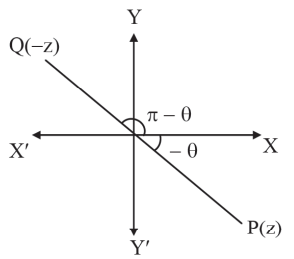
View full question & answer→MCQ 1092 Marks
If $0<\operatorname{amp}(z)<\pi$, then $\operatorname{amp}(z)-\operatorname{amp}(-z)=$
- A
$0$
- B
$2 amp ( z )$
- ✓
$\pi$
- D
Answer(C)
$\operatorname{amp}(z)-\operatorname{amp}(-z)$
$=\tan ^{-1}\left(\frac{y}{x}\right)-\left(\tan ^{-1}\left(\frac{y}{x}\right)-\pi\right)=\pi$
View full question & answer→MCQ 1102 Marks
If $\arg (z)=\theta$, then $\arg (\bar{z})=$
- A
$\theta$
- ✓
$-\theta$
- C
$\pi-\theta$
- D
$\theta-\pi$
AnswerCorrect option: B. $-\theta$
View full question & answer→MCQ 1112 Marks
If $z=\frac{1-i \sqrt{3}}{1+i \sqrt{3}}$, then $\arg (z)=$
- A
$60^{\circ}$
- B
$120^{\circ}$
- ✓
$240^{\circ}$
- D
$300^{\circ}$
AnswerCorrect option: C. $240^{\circ}$
(C)
$\arg \left(\frac{1-i \sqrt{3}}{1+i \sqrt{3}}\right)=\arg (1-i \sqrt{3})-\arg (1+i \sqrt{3})$
$=-60^{\circ}-60^{\circ}=-120^{\circ}$ or $240^{\circ}$
$\ldots\left[\begin{array}{c}\because \arg (1- i \sqrt{3})=-\tan ^{-1} \sqrt{3}=-60^{\circ} \\ \text { and } \arg (1+ i \sqrt{3})=\tan ^{-1} \sqrt{3}=60^{\circ}\end{array}\right]$
View full question & answer→MCQ 1122 Marks
The argument of the complex number $\frac{13-5 i}{4-9 i}$ is
- A
$\frac{\pi}{3}$
- ✓
$\frac{\pi}{4}$
- C
$\frac{\pi}{5}$
- D
$\frac{\pi}{6}$
AnswerCorrect option: B. $\frac{\pi}{4}$
(B)
$\arg \left(\frac{13-5 i}{4-9 i}\right)=\arg (13-5 i)-\arg (4-9 i)$
$=-\tan ^{-1}\left(\frac{5}{13}\right)+\tan ^{-1}\left(\frac{9}{4}\right)$
$=\tan ^{-1} 1=\frac{\pi}{4}$
View full question & answer→MCQ 1132 Marks
If $z=\frac{-2}{1+\sqrt{3} i}$, then the value of $\arg (z)$ is
- A
$\pi$
- B
$\frac{\pi}{3}$
- ✓
$\frac{2 \pi}{3}$
- D
$\frac{\pi}{4}$
AnswerCorrect option: C. $\frac{2 \pi}{3}$
(C)
$z=\frac{-2}{1+\sqrt{3} i}=\frac{-2}{1+\sqrt{3} i} \times \frac{1-\sqrt{3} i}{1-\sqrt{3} i}=\frac{-2+2 \sqrt{3} i}{1+3}$
$\Rightarrow z=\frac{-1}{2}+\frac{\sqrt{3}}{2} i$
Here, $a <0, b>0$
$\therefore \quad \arg (z)=\pi-\tan ^{-1}\left|-\frac{\sqrt{3} / 2}{1 / 2}\right|$
$=\pi-\tan ^{-1}(\sqrt{3})=\pi-\frac{\pi}{3}=\frac{2 \pi}{3}$
View full question & answer→MCQ 1142 Marks
The value of $|z|^2+|z-3|^2+|z-i|^2$ is minimum when z equals
- A
$2-\frac{2}{3} i$
- B
$45+3 i$
- ✓
$1+\frac{i}{3}$
- D
$1-\frac{i}{3}$
AnswerCorrect option: C. $1+\frac{i}{3}$
(C)
$|z|^2+|z-3|^2+|z-i|^2$
$=x^2+y^2+(x-3)^2+y^2+x^2+(y-1)^2$
$=3 x^2+3 y^2-6 x-2 y+10$
$=3\left(x^2+y^2-2 x-2 . y \cdot \frac{1}{3}\right)+10$
$=3\left|z-\left(1+\frac{i}{3}\right)\right|^2+\frac{20}{3}$
∴ the given expression is minimum, when z equals $1+\frac{i}{3}$.
View full question & answer→MCQ 1152 Marks
For all complex numbers $z _1, z _2$ satisfying $\left|z_1\right|=12$ and $\left|z_2-3-4 i\right|=5$, the minimum value of $\left|z_1-z_2\right|$ is
Answer(B)
We have,
$\left|z_2\right|=\left|z_2-(3+4 i)+3+4 i\right|$
$\Rightarrow\left| z _2\right| \leq\left| z _2-(3+4 i )\right|+|3+4 i |$
$\Rightarrow\left| z _2\right| \leq 5+5 \ldots .[\because|3+4 i |=\sqrt{9+16}=5]$
$\Rightarrow\left| z _2\right| \leq 10 \Rightarrow-\left| z _2\right| \geq-10$
$\Rightarrow\left| z _1\right|-\left| z _2\right| \geq\left| z _1\right|-10$
$\Rightarrow\left| z _1\right|-\left| z _2\right| \geq 12-10$
$\Rightarrow\left| z _1\right|-\left| z _2\right| \geq 2$
$\Rightarrow\left| z _1- z _2\right| \geq 2 \quad \ldots . .\left[\because\left| z _1- z _2\right| \geq\left| z _1\right|-\left| z _2\right|\right]$
$\therefore \quad$ minimum value of $\left|z_1-z_2\right|=2$
View full question & answer→MCQ 1162 Marks
The maximum value of $|z|$ when $z$ satisfies the condition $\left|z-\frac{2}{z}\right|=2$ is
- A
$\sqrt{3}-1$
- B
$\sqrt{3}$
- ✓
$\sqrt{3}+1$
- D
$\sqrt{2}+\sqrt{3}$
AnswerCorrect option: C. $\sqrt{3}+1$
(C)
$|z|=\left|z-\frac{2}{z}+\frac{2}{z}\right|$
$\therefore \quad|z| \leq\left|z-\frac{2}{z}\right|+\left|\frac{2}{z}\right| \leq 2+\frac{2}{|z|}$
$\Rightarrow|z|-\frac{2}{|z|} \leq 2 \Rightarrow|z|^2-2|z|-2 \leq 0$
$\Rightarrow[|z|-(1-\sqrt{3})][|z|-(1+\sqrt{3})] \leq 0$
$\Rightarrow 1-\sqrt{3} \leq| z | \leq 1+\sqrt{3}$
$\therefore \quad$ maximum value of $|z|$ is $1+\sqrt{3}$.
View full question & answer→MCQ 1172 Marks
If $z$ is any complex number such that $|z+4| \leq 3$, then the greatest value of $|z+1|$ is
Answer(A)
$|z+1|=|z+4-3|$
$=|(z+4)+(-3)|$
$\leq|z+4|+|-3| \quad \ldots .\left[\because\left|z_1+z_2\right| \leq\left|z_1\right|+\left|z_2\right|\right]$
$=|z+4|+3 \leq 3+3=6 \quad \ldots .[\because|z+4| \leq 3]$
$\therefore$ greatest value of $|z+1|=6$
View full question & answer→MCQ 1182 Marks
For any non-zero complex number $z$ the minimum value of $|z|+|z-1|$ is
- ✓
- B
$\frac{1}{2}$
- C
$0$
- D
$\frac{3}{2}$
Answer(A)
Since $\left|z_1+z_2\right| \leq\left|z_1\right|+\left|z_2\right|$
$\therefore \quad|z|+|z-1|=|z|+|1-z| \geq|z+(1-z)|=|1|=1$
Hence, minimum value of $|z|+|z-1|$ is 1 .
View full question & answer→MCQ 1192 Marks
If $z_1$ and $z_2$ are any two complex numbers, then $\left|z_1+\sqrt{z_1^2-z_2^2}\right|+\left|z_1-\sqrt{z_1^2-z_2^2}\right|$ is equal to
AnswerCorrect option: D. $\left|z_1+z_2\right|+\left|z_1-z_2\right|$
(D)
$\left[\left|z_1+\sqrt{z_1^2-z_2^2}\right|+\left|z_1-\sqrt{z_1^2-z_2^2}\right|\right]^2$
$=\left| z _1+\sqrt{ z _1^2- z _2^2}\right|^2+\left| z _1-\sqrt{ z _1^2- z _2^2}\right|^2+2\left| z _1^2-\left( z _1^2- z _2^2\right)\right|$
$=2\left|z_1\right|^2+2\left|z_1^2-z_2^2\right|+2\left|z_2^2\right|$
$\ldots .\left[\because\left| z _1+ z _2\right|^2+\left| z _1- z _2\right|^2=2\left(\left| z _1\right|^2+\left| z _2\right|^2\right)\right]$
$=2\left|z_1\right|^2+2\left|z_2\right|^2+2\left|z_1^2-z_2^2\right|$
$=\left|z_1+z_2\right|^2+\left|z_1-z_2\right|^2+2\left|z_1+z_2\right|\left|z_1-z_2\right|$
$=\left(\left| z _1+ z _2\right|+\left| z _1- z _2\right|\right)^2$
Taking square root on both sides, we get
$\left| z _1+\sqrt{ z _1^2- z _2^2}\right|+\left| z _1-\sqrt{ z _1^2- z _2^2}\right|=\left| z _1+ z _2\right|+\left| z _1- z _2\right|$
View full question & answer→MCQ 1202 Marks
For any two complex numbers $z_1, z_2$ and any real numbers a and b;
$\left|\left(a z_1-b z_1\right)\right|^2+\left|\left(b z_1+a z_2\right)\right|^2=$
- A
$\left(a^2+b^2\right)\left(\left|z_1\right|+\left|z_2\right|\right)$
- ✓
$\left(a^2+b^2\right)\left(\left|z_1\right|^2+\left|z_2\right|^2\right)$
- C
$\left(a^2+b^1\right)\left(\left|z_1\right|^t-\left|z_1\right|^2\right)$
- D
AnswerCorrect option: B. $\left(a^2+b^2\right)\left(\left|z_1\right|^2+\left|z_2\right|^2\right)$
(B)
$\left|\left( az _1- bz _2\right)\right|^2+\left|\left( bz _1+ az _2\right)\right|^2$
$= a ^2\left| z _1\right|^2+ b ^2\left| z _2\right|^2-2 \operatorname{Re}( ab )\left| z _1 \overline{ z }_2\right|+ b ^2\left| z _1\right|^2$ $+ a ^2\left| z _2\right|^2+2 \operatorname{Re}( ab )\left| z _1 \overline{ z }_2\right|$
$=\left( a ^2+ b ^2\right)\left(\left| z _1\right|^2+\left| z _2\right|^2\right)$
View full question & answer→MCQ 1212 Marks
If $z_1$ and $z_2$ are any two complex numbers, then $\left|z_{1}+z_{2}\right|^2+\left|z_1-z_2\right|^2$ is equal to
- A
$2\left|z_1\right|^2\left|z_2\right|^2$
- ✓
$2\left|z_1\right|^2+2\left|z_2\right|^2$
- C
$\left|z_1\right|^2+\left|z_2\right|^2$
- D
$2\left|z_1\right|\left|z_2\right|$
AnswerCorrect option: B. $2\left|z_1\right|^2+2\left|z_2\right|^2$
(B)
$\left| z _1+ z _2\right|^2+\left| z _1- z _2\right|^2$
$=\left(x_1+x_2\right)^2+\left(y_1+y_2\right)^2+\left(x_1-x_2\right)^2+\left(y_1-y_2\right)^2$
$=2\left(x_1^2\right)+2\left(y_1^2\right)+2\left(x_2^2\right)+2\left(y_2^2\right)$
$=2\left| z _1\right|^2+2\left| z _2\right|^2$
View full question & answer→MCQ 1222 Marks
The locus of the point representing the complex number $z$ for which $|z+3|^2-|z-3|^2=15$ is
Answer(C)
$|x+i y+3|^2-|x+i y-3|^2=15$
$\Rightarrow(x+3)^2+y^2-\left[(x-3)^2+y^2\right]=15$
$\Rightarrow 12 x=15$,
which is a straight line
View full question & answer→MCQ 1232 Marks
The complex number z satisfying the equations $\left|\frac{z-12}{z-8 i}\right|=\frac{5}{3},\left|\frac{z-4}{z-8}\right|=1$ are
- A
- B
$6 \pm 8 i$
- ✓
$6+8 i , 6+17 i$
- D
$-6$
AnswerCorrect option: C. $6+8 i , 6+17 i$
(C)
Let $z =x+ i y$,
Now, $\left|\frac{z-12}{z-8 i}\right|=\frac{5}{3} \Rightarrow 3|z-12|=5|z-8 i|$
$\Rightarrow 3|(x-12)+ i y|=5|x+(y-8) i |$
$\Rightarrow 9(x-12)^2+9 y^2=25 x^2+25(y-8)^2$ ...(i)
and $\left|\frac{z-4}{z-8}\right|=1 \Rightarrow|z-4|=|z-8|$
$\Rightarrow|x-4+ i y|=|x-8+ i y|$
$\Rightarrow(x-4)^2+y^2=(x-8)^2+y^2$
$\Rightarrow x=6$
Putting $x=6$ in (i), we get
$y^2-25 y+136=0$
$\therefore \quad y=17,8$
Hence, $z=6+17 i$ or $z=6+8 i$
View full question & answer→MCQ 1242 Marks
If $(1-i)^n=2^n$, then $n=$
Answer(B)
$(1- i )^{ n }=2^{ n }$ ...(i)
We know that if two complex numbers are equal, their moduli must also be equal,therefore from (i), we have
$\left|(1- i )^{ n }\right|=\left|2^{ n }\right|$
$\Rightarrow|1- i |^{ n }=|2|^{ n } \quad \ldots . .\left[\because 2^{ n }>0\right]$
$\Rightarrow\left[\sqrt{1^2+(-1)^2}\right]^n=2^n$
$\Rightarrow(\sqrt{2})^{ n }=2^{ n }$
$\Rightarrow 2^{\frac{n}{2}}=2^n$
$\Rightarrow \frac{ n }{2}= n$
$\Rightarrow n =0$
View full question & answer→MCQ 1252 Marks
If $z_1$ and $z_2$ be complex numbers such that $z_1 \neq z_2$ and $\left|z_1\right|=\left|z_2\right|$. If $z_1$ has positive real part and $z_2$ has negative imaginary part, then $\frac{\left(z_1+z_2\right)}{\left(z_1-z_2\right)}$ may be
Answer(A)
Let $z _1= a + ib =( a , b )$ and $z _2= c - id =( c ,- d )$,
where $a >0$ and $d >0$
Then $\left| z _1\right|=\left| z _2\right| \Rightarrow a ^2+ b ^2= c ^2+ d ^2$ ...(i)
Now, $\frac{z_1+z_2}{z_1-z_2}=\frac{(a+i b)+(c-i d)}{(a+i b)-(c-i d)}$
$=\frac{[( a + c )+ i ( b - d )][( a - c )- i ( b + d )]}{[( a - c )+ i ( b + d )][( a - c )- i ( b + d )]}$
$=\frac{\left(a^2+b^2\right)-\left(c^2+d^2\right)-2(a d+b c) i}{a^2+c^2-2 a c+b^2+d^2+2 b d}$
$=\frac{-(a d+b c) i}{a^2+b^2-a c+b d} $...[From (i)]
$\therefore \quad \frac{\left(z_1+z_2\right)}{\left(z_1-z_2\right)}$ is purely imaginary.
Alternate method: Assume any two complex numbers satisfying both conditions
i.e., $z _1 \neq z _2$ and $\left| z _1\right|=\left| z _2\right|$
Let $z _1=2+ i , z _2=1-2 i$
$\therefore \quad \frac{ z _1+ z _2}{ z _1- z _2}=\frac{3- i }{1+3 i }=- i$
View full question & answer→MCQ 1262 Marks
If $\left(\frac{3}{2}+\frac{\sqrt{3}}{2} i \right)^{50}=3^{25}(x+ i y)$, then $x^2+y^2=$
Answer(B)
$\left(\frac{3}{2}+ i \frac{\sqrt{3}}{2}\right)^{50}=3^{25}(x+ i y)$
Taking modulus on both sides, we get
$\left(\sqrt{\frac{9}{4}+\frac{3}{4}}\right)^{50}=3^{25} \sqrt{x^2+y^2}$
$\Rightarrow(\sqrt{3})^{50}=3^{25} \sqrt{x^2+y^2} \Rightarrow 1=\sqrt{x^2+y^2}$
$\Rightarrow x^2+y^2=1$
View full question & answer→MCQ 1272 Marks
If $(\sqrt{8}+i)^{50}=3^{49}(a+i b)$, then $a^2+b^2$ is
Answer(C)
$(\sqrt{8}+ i )^{50}=3^{49}( a + ib )$
Taking modulus and squaring on both sides,
we get
$(8+1)^{50}=3^{98}\left(a^2+b^2\right)$
$\Rightarrow 9^{50}=3^{98}\left(a^2+b^2\right)$
$\Rightarrow 3^{100}=3^{98}\left( a ^2+ b ^2\right)$
$\Rightarrow\left( a ^2+ b ^2\right)=9$
View full question & answer→MCQ 1282 Marks
A real value of $x$ will satisfy the equation $\left(\frac{3-4 i x}{3+4 i x}\right)=\alpha-i \beta(\alpha, \beta$ real $)$, if
- A
$\alpha^2-\beta^2=-1$
- B
$\alpha^2-\beta^2=1$
- ✓
$\alpha^2+\beta^2=1$
- D
$\alpha^2-\beta^2=2$
AnswerCorrect option: C. $\alpha^2+\beta^2=1$
(C)
$\alpha- i \beta=\frac{3-4 x i }{3+4 x i }$
Taking modulus and squaring on both sides, $\alpha^2+\beta^2=1$
View full question & answer→MCQ 1292 Marks
If $p+i q=\sqrt{\frac{a+i b}{c+i d}}$, where $p, q, a, b, c, d \in R$, then $\left(p^2+q^2\right)^2=$
- A
$\sqrt{\frac{a^2+b^2}{c^2+d^2}}$
- ✓
$\frac{a^2+b^2}{c^2+d^2}$
- C
$\left(\frac{a^2+b^2}{c^2+d^2}\right)^2$
- D
AnswerCorrect option: B. $\frac{a^2+b^2}{c^2+d^2}$
(B)
$p+i q=\sqrt{\frac{a+i b}{c+i d}}$
$\Rightarrow| p + iq |^2=\frac{| a + ib |}{| c + id |}$
$\Rightarrow\left(\sqrt{ p ^2+ q ^2}\right)^2=\frac{\sqrt{ a ^2+ b ^2}}{\sqrt{ c ^2+ d ^2}}$
$\Rightarrow\left( p ^2+ q ^2\right)^2=\frac{ a ^2+ b ^2}{ c ^2+ d ^2}$
View full question & answer→MCQ 1302 Marks
If $\left|z^2-1\right|=|z|^2+1$, then $z$ lies on
Answer(A)
Let $z =x+ i y$
We have, $\left|z^2-1\right|=|z|^2+1$
$\Rightarrow\left|(x+ i y)^2-1\right|=|x+ i y|^2+1$
$\Rightarrow\left|\left(x^2-y^2-1\right)+2 x y i\right|=\left(\sqrt{x^2+y^2}\right)^2+1$
$\Rightarrow \sqrt{\left(x^2-y^2-1\right)^2+(2 x y)^2}=x^2+y^2+1$
Squaring on both sides, we get
$x^4+y^4+1-2 x^2 y^2+2 y^2-2 x^2+4 x^2 y^2$
$=x^4+y^4+1+2 x^2 y^2+2 y^2+2 x^2$
$\Rightarrow 2 x^2 y^2=2 x^2 y^2+4 x^2$
$\Rightarrow x=0$
$\therefore \quad z =x+ i y=0+ i y= i y$
$\therefore \quad z$ lies on imaginary axis.
View full question & answer→MCQ 1312 Marks
If $z =x+ i y$ and $\omega=\frac{1- iz }{ z - i }$, then $|\omega|=1$ shows that in complex plane
- A
z will be at imaginary axis
- ✓
- C
z will be at unity circle
- D
Answer(B)
$\omega=\frac{1-i z}{z-i}$, then $|\omega|=1$
$\Rightarrow\left|\frac{1- iz }{ z - i }\right|=1$
$\Rightarrow|1- iz |=| z - i |$
$\Rightarrow|1- i (x+ i y)|=|x+ i y- i |$
$\Rightarrow|(1+y)- i x|=|x+ i (y-1)|$
$\Rightarrow \sqrt{x^2+1+y^2+2 y}=\sqrt{x^2+y^2+1-2 y}$
$\Rightarrow y=0$
$\therefore \quad z =x+ i y=x$
$\therefore \quad z$ lies on real axis.
View full question & answer→MCQ 1322 Marks
The values of $z$ for which $|z+i|=|z-i|$ are
Answer(A)
Let $z =x+ i y$ ...(i)
Given, $| z + i |=| z - i |$
$\Rightarrow|x+ i y+ i |=|x+ i y- i |$
$\Rightarrow|x+ i (y+1)|=|x+ i (y-1)|$
$\Rightarrow \sqrt{x^2+(y+1)^2}=\sqrt{x^2+(y-1)^2}$
$\Rightarrow x^2+(y+1)^2=x^2+(y-1)^2$
$\Rightarrow y^2+2 y+1=y^2-2 y+1 \Rightarrow 4 y=0 \Rightarrow y=0$
Hence, from (i), we get $z =x$, where $x$ is any real number.
View full question & answer→MCQ 1332 Marks
If $|z|=\max \{|z-2|,|z+2|\}$, then
- A
$|z+\bar{z}|=1$
- B
$z+\bar{z}=2^2$
- ✓
$|z+\bar{z}|=2$
- D
AnswerCorrect option: C. $|z+\bar{z}|=2$
(C)
$|z|=|z-2| \Rightarrow|z|^2=|z-2|^2$
$\Rightarrow z \overline{ z }=( z -2)(\overline{ z }-2)$
$\Rightarrow z \overline{ z }= z \overline{ z }-2 \overline{ z }-2 z +4$
$\Rightarrow z+\bar{z}=2$ ...(i)
Also, $|z|=|z+2| \Rightarrow|z|^2=|z+2|^2$
$\Rightarrow z \overline{ z }=( z +2)(\overline{ z }+2)$
$=z \bar{z}+2(z+\bar{z})+4$
$\Rightarrow z+\bar{z}=-2$ ...(ii)
From (i) and (ii), we get
$|z+\bar{z}|=2$
View full question & answer→MCQ 1342 Marks
If $\left|z_1\right|=1,\left|z_2\right|=2,\left|z_3\right|=3$ and $\left|9 z_1 z_2+4 z_1 z_3+z_2 z_3\right|=12$, then the value of $\left|z_1+z_2+z_3\right|$ is
Answer(D)
$\left|z_1\right|=1,\left|z_2\right|=2,\left|z_3\right|=3$
$\Rightarrow z _1 \overline{ z _1}=1, z _2 \overline{ z _2}=4, z _3 \overline{ z _3}=9$
$\left|9 z_1 z_2+4 z_1 z_2+z_2 z_3\right|=12$
$\Rightarrow\left| z _3 \overline{ z _3} z _1 z _2+ z _2 \overline{ z _2} z _1 z _3+ z _1 \overline{ z _1} z _2 z _3\right|=12$
$\Rightarrow\left| z _1 z _2 z _3\right|\left|\overline{ z }_3+\overline{ z }_2+\overline{ z }_1\right|=12$
$\Rightarrow\left|z_1+z_2+z_3\right|=2$
View full question & answer→MCQ 1352 Marks
If $z_1, z_2, z_3$ are complex numbers such that $\left|z_1\right|=\left|z_2\right|=\left|z_3\right|=\left|\frac{1}{z_1}+\frac{1}{z_2}+\frac{1}{z_3}\right|=1 \text {, }$then $\left|z_1+z_2+z_3\right|$ is
Answer(A)
$l =\left|\frac{1}{ z _1}+\frac{1}{ z _2}+\frac{1}{ z _3}\right|$
$=\left|\frac{\overline{ z }_1 \overline{ z }_1}{ z _1}+\frac{ z _2 \overline{ z }_2}{ z _2}+\frac{ z _3 \overline{ z }_3}{ z _3}\right| \cdots\left[\because\left| z _1\right|^2=1= z _1 \overline{ z }_1\right.$, etc. $]$
$=\left|\overline{ z }_1+\overline{ z }_2+\overline{ z }_3\right|=\left|\overline{ z _1+ z _2+ z _3}\right|$
$=\left| z _1+ z _2+ z _3\right| \quad \ldots \ldots\left[\because\left|\overline{ z }_1\right|=\left| z _1\right|\right]$
$\therefore \quad\left| z _1+ z _2+ z _3\right|=1$
View full question & answer→MCQ 1362 Marks
The equation whose solutions are the non-zero solutions of the equation $\bar{z}=i z^2$, is
- ✓
$z^3+ i =0$
- B
$z^3+z+1=0$
- C
$z^3-i=0$
- D
$z^3+i z+1=0$
AnswerCorrect option: A. $z^3+ i =0$
(A)
$\overline{ z }= iz ^2$
Taking modulus on both sides, we get
$|\bar{z}|=\left|z^2\right|$
$\Rightarrow|z|=|z|^2$
$\Rightarrow| z |(| z |-1)=0$
$\Rightarrow|z|=1 \quad \ldots[\because|z| \neq 0]$
$\overline{ z }= iz ^2$
$\Rightarrow z \overline{ z }= iz ^3$
$\Rightarrow| z |^2= iz ^3$
$\Rightarrow iz ^3=1$
$\Rightarrow z ^3=- i$
$\Rightarrow z ^3+ i =0$
View full question & answer→MCQ 1372 Marks
If $\frac{2 z_1}{3 z_2}$ is a purely imaginary number, then $\left|\frac{z_1-z_2}{z_1+z_2}\right|=$
- A
$\frac{3}{2}$
- ✓
- C
$\frac{2}{3}$
- D
$\frac{4}{5}$
Answer(B)
Let $\frac{2 z _1}{3 z _2}= i y$ Then, $\frac{ z _1}{ z _2}=\frac{3}{2} i y$
$\therefore\left|\frac{z_1-z_2}{z_1+z_2}\right|=\left|\frac{\frac{z_1}{z_2}-1}{\frac{z_1}{z_2}+1}\right|=\left|\frac{\frac{3}{2} i y-1}{\frac{3}{2} i y+1}\right|=\left|\frac{1-\frac{3}{2} i y}{1+\frac{3}{2} i y}\right|=1$
$\ldots .[\because|z|=|\bar{z}|]$
View full question & answer→MCQ 1382 Marks
Let $z_1$ be a complex number with $\left|z_1\right|=1$ and $z_2$ be any complex number, then $\left|\frac{z_1-z_2}{1-z_1 \bar{z}_2}\right|=$
Answer(B)
$\left|\frac{z_1-z_2}{1-z_1 \bar{z}_2}\right|=\frac{z_1-z_2}{\left\lvert\, 1-\frac{\bar{z}_2}{\bar{z}_1}\lvert\right.}$$\ldots \left[\because z_1 \overline{z}_1=\left|z_1\right|^2\right]$
$=\frac{\left| Z _1- Z _2\right|}{\left|\overline{ Z }_1-\overline{ Z }_2\right|}\left|\overline{ Z }_1\right|$
$=\frac{\left|z_1-z_2\right|}{\left|\overline{z_1-z_2}\right|} \quad \ldots \left[\because\left|\bar{z}_1\right|=1\right]$
$=\frac{\left|z_1-z_2\right|}{\left|z_1-z_2\right|}=1$
View full question & answer→MCQ 1392 Marks
If $z$ is a complex number, then which of the following is not true?
AnswerCorrect option: C. $z =\overline{ z }$
(C)
L.H.S. $=\left| z ^2\right|=\left|(x+ i y)^2\right|=\left|x^2-y^2+2 i x y\right|$
$=\sqrt{\left(x^2-y^2\right)^2+(2 x y)^2}$
$=\sqrt{\left(x^2+y^2\right)^2}$
R.H.S. $=| z |^2=|x+ i y|^2=\left(\sqrt{x^2+y^2}\right)^2=x^2+y^2$
Therefore, $\left|z^2\right|=|z|^2$
(B) True, (C) False $\quad \ldots . .[\because z \neq \bar{z}]$
View full question & answer→MCQ 1402 Marks
If $|z|=5$ and $w=\frac{z-5}{z+5}$, then $\operatorname{Re}(w)$ is equation to
Answer(A)
$w =\frac{ z -5}{ z +5}$
$=\frac{x+ i y-5}{x+ i y+5}$
$=\frac{(x-5+ i y)}{(x+5+ i y)} \times \frac{(x+5- i y)}{(x+5- i y)}$
$=\frac{\left(x^2+y^2-25\right)+(-x y+5+x y+5) i }{(x+5)^2+y^2}$
$=\frac{x^2+y^2-25}{(x+5)^2+y^2}+\frac{10 i }{(x+5)^2+y^2}$
Given that $| z |=5$
$\Rightarrow x^2+y^2=25$
$\Rightarrow x^2+y^2-25=0$
$\therefore \quad \operatorname{Re}( w )=0$
View full question & answer→MCQ 1412 Marks
If $z$ is a complex number such that $\frac{z-1}{z+1}$ is purely imaginary, then
- A
$|z|=0$
- ✓
$|z|=1$
- C
$|z|>1$
- D
$|z|<1$
AnswerCorrect option: B. $|z|=1$
(B)
Let $\frac{ z -1}{ z +1}= i y$, where $y \in R$
This gives
$z =\frac{1+ i y}{1- i y}=\frac{1+ i y}{1- i y} \times \frac{1+ i y}{1+ i y}=\frac{\left(1-y^2\right)+2 i y}{1+y^2}$
$\therefore \quad|z|=\frac{1}{1+y^2} \sqrt{\left(1-y^2\right)^2+4 y^2}=\frac{1+y^2}{1+y^2}=1$
View full question & answer→MCQ 1422 Marks
The inequality $|z-4|<|z-2|$ represents the region given by
- A
$\operatorname{Re}(z)>0$
- B
$\operatorname{Re}(z)<0$
- C
$\operatorname{Re}(z)>2$
- ✓
$\operatorname{Re}(z)>3$
AnswerCorrect option: D. $\operatorname{Re}(z)>3$
(D)
$|z-4|<|z-2|$
$\Rightarrow|z-4|^2<|z-2|^2$
$\Rightarrow(x-4)^2+y^2<(x-2)^2+y^2$
$\Rightarrow 4 x>12$
$\Rightarrow \operatorname{Re}( z )>3$
View full question & answer→MCQ 1432 Marks
Let $z_1=3+4 i$ and $z_2=-1+2 i$. Then $\left|z_1+z_2\right|^2-2\left(\left|z_1\right|^2+\left|z_2\right|^2\right)$ is equal to
- A
$\left|z_1-z_2\right|^2$
- ✓
$-\left|z_1-z_2\right|^2$
- C
$\left|z_1\right|^2+\left|z_2\right|^2$
- D
$\left|z_1\right|^2-\left|z_2\right|^2$
AnswerCorrect option: B. $-\left|z_1-z_2\right|^2$
(B)
$z_1+z_2=2+6 i$
$\Rightarrow\left|z_1+z_2\right|^2=(4+36)=40$
$\left|z_1\right|^2+\left|z_2\right|^2=25+5=30$
$\Rightarrow\left|z_1+z_2\right|^2-2\left(\left|z_1\right|^2+\left|z_2\right|^2\right)=40-60=-20$
$\left|z_1-z_2\right|^2=(16+4)=20$
$\Rightarrow\left|z_1+z_2\right|^2-2\left(\left|z_1\right|^2+\left|z_2\right|^2\right)=-\left|z_1-z_2\right|^2$
View full question & answer→MCQ 1442 Marks
If $iz ^3+z^2- z + i =0$, then $| z |=$
Answer(A)
$i z^3+z^2-z+i=0$
$\Rightarrow z ^2( iz +1)+ i ( iz +1)=0$
$\Rightarrow( iz +1)\left( z ^2+ i \right)=0$
$\Rightarrow z =\frac{-1}{ i }$ or $z ^2=- i$
$z =\frac{-1}{ i }=\frac{-1}{ i } \times \frac{ i }{ i }= i$
$\Rightarrow|z|=1$
View full question & answer→MCQ 1452 Marks
If $Z=\frac{(\sqrt{3}+i)^3(3 i+4)^2}{(8+6 i)^2}$, then $|z|$ is equal to
Answer(A)
$Z=\frac{(\sqrt{3}+i)^3(3 i+4)^2}{(8+6 i)^2}$
$=\frac{(\sqrt{3}+ i )^3(3 i +4)^2}{2^2(3 i +4)^2}$
$=\frac{(\sqrt{3}+ i )^3}{4}=\frac{8 i }{4}=2 i$
$|Z|=\sqrt{2^2}=2$
View full question & answer→MCQ 1462 Marks
The value of $\left|\frac{1+i \sqrt{3}}{\left(1+\frac{1}{i+1}\right)^2}\right|$ is
- A
- B
- C
$\frac{5}{4}$
- ✓
$\frac{4}{5}$
AnswerCorrect option: D. $\frac{4}{5}$
(D)
$|1+ i \sqrt{3}|=\sqrt{1+3}=2$
$1+\frac{1}{i+1}=1+\frac{i-1}{i^2-1}=1+\frac{(i-1)}{-2}=\frac{3}{2}-\frac{i}{2}$
$\therefore\left|1+\frac{1}{i+1}\right|=\sqrt{\left(\frac{3}{2}\right)^2+\left(-\frac{1}{2}\right)^2}=\sqrt{\frac{9}{4}+\frac{1}{4}}=\sqrt{\frac{10}{4}}$
$\therefore\left|\frac{1+i \sqrt{3}}{\left(1+\frac{1}{i+1}\right)^2}\right|=\frac{2}{\frac{10}{4}}=\frac{4}{5}$
View full question & answer→MCQ 1472 Marks
If $z_1=5-2 i$ and $z_2=6+5 i$, then $\left|\frac{z_1+z_2}{z_1-z_2}\right|=$
- A
$\sqrt{\frac{13}{18}}$
- B
$\sqrt{\frac{3}{5}}$
- C
$\sqrt{\frac{1}{8}}$
- ✓
$\sqrt{\frac{13}{5}}$
AnswerCorrect option: D. $\sqrt{\frac{13}{5}}$
(D)
$z_1+z_2=11+3 i$ and $z_1-z_2=-1-7 i$
$\therefore \quad \frac{z_1+z_2}{z_1-z_2}=\frac{11+3 i}{-1-7 i}=\frac{-32}{50}+\frac{74}{50} i$
$\therefore\left|\frac{ z _1+ z _2}{ z _1- z _2}\right|=\left|\frac{-32}{50}+\frac{74}{50} i \right|=\sqrt{\left(\frac{-32}{50}\right)^2+\left(\frac{74}{50}\right)^2}=\sqrt{\frac{13}{5}}$
View full question & answer→MCQ 1482 Marks
$\left|(1+i) \frac{(2+i)}{(3+i)}\right|=$
- A
$-\frac{1}{2}$
- B
$\frac{1}{2}$
- ✓
- D
$-1$
Answer(C)
$\left|(1+ i ) \frac{(2+ i )}{(3+ i )}\right|=|1+ i |\left|\frac{2+ i }{3+ i }\right|=\frac{\sqrt{2} \times \sqrt{5}}{\sqrt{10}}=1$
View full question & answer→MCQ 1492 Marks
The modulus of $\frac{1- i }{3+ i }+\frac{4 i }{5}$ is
- A
$\sqrt{5}$ units
- B
$\frac{\sqrt{11}}{5}$ units
- ✓
$\frac{\sqrt{5}}{5}$ units
- D
$\frac{\sqrt{12}}{5}$ units
AnswerCorrect option: C. $\frac{\sqrt{5}}{5}$ units
(C)
$\left|\frac{1- i }{3+ i }+\frac{4 i }{5}\right|=\left|\frac{(1- i )(3- i )}{(3+ i )(3- i )}+\frac{4 i }{5}\right|$
$=\left|\frac{3-1-4 i}{9-(-1)}+\frac{4 i}{5}\right|$
$=\left|\frac{2(1-2 i)}{10}+\frac{4 i}{5}\right|$
$=\left|\frac{1}{5}+\frac{2}{5} i \right|$
$=\sqrt{\left(\frac{1}{5}\right)^2+\left(\frac{2}{5}\right)^2}=\sqrt{\frac{5}{25}}=\frac{\sqrt{5}}{5}$ units
View full question & answer→MCQ 1502 Marks
The value of $\frac{\cos 30^{\circ}+ i \sin 30^{\circ}}{\cos 60^{\circ}- i \sin 60^{\circ}}$ is equal to
- ✓
- B
$-i$
- C
$\frac{1+\sqrt{3 i}}{2}$
- D
$\frac{1-\sqrt{3 i}}{2}$
Answer(A)
$\frac{\cos \frac{\pi}{6}+ i \sin \frac{\pi}{6}}{\cos \left(-\frac{\pi}{3}\right)+ i \sin \left(-\frac{\pi}{3}\right)}=\frac{ e ^{ i \pi / 6}}{ e ^{ i (-\pi / 3)}}= e ^{ i \pi / 2}= i$
View full question & answer→