Question 12 Marks
An equilateral triangle is inscribed in the parabola y2 = 4ax where one vertex is at the vertex of the parabola. Find the length of the side of the triangle.
AnswerThe given equation of parabola is y2 = 4ax let b be the side of an equilateral $\Delta {\rm O}{\rm A}{\rm B}$ whose one vertex is the vertex of parabola.
Let OC = x
Now AB = b
$\therefore$ AC = BC $ = \frac{1}{2} \times AB = \frac{b}{2}$
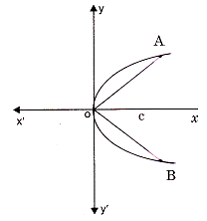
Coordinates of point A are $\left( {x,\frac{b}{2}} \right)$
Since point A lies on the parabola y2 = 4ax
$\therefore {\left( {\frac{b}{2}} \right)^2} = 4ax \Rightarrow x = \frac{{{b^2}}}{{4 \times 4a}} \Rightarrow x = \frac{{{b^2}}}{{16a}}$
In right angled $\Delta {\rm O}{\rm A}{\rm C}$
OA2 = OC2 + AC2
$\therefore {b^2} = {x^2} + {\left( {\frac{b}{2}} \right)^2} \Rightarrow {b^2} = {\left( {\frac{{{b^2}}}{{16a}}} \right)^2} + \frac{{{b^2}}}{4}$
$\Rightarrow {b^2} = \frac{{{b^4}}}{{256{a^2}}} + \frac{{{b^2}}}{4} \Rightarrow 1 = \frac{{{b^2}}}{{256{a^2}}} + \frac{1}{4}$
$\Rightarrow \frac{{{b^2}}}{{256{a^2}}} = 1 - \frac{1}{4}$$\Rightarrow {b^2} = \frac{3}{4} \times 256{a^2} = {b^2} = 192{a^2}$
$\Rightarrow b = \sqrt {192{a^2}} \Rightarrow b = 8\sqrt 3 a$
Thus the side of equilateral triangle is $8\sqrt 3 a$.
View full question & answer→Question 22 Marks
Find the area of the triangle formed by the lines joining the vertex of the parabola x2 = 12y to the ends of its latus rectum.
AnswerThe given equation of parabola is x2 = 12y which is of the form x2 = 4ay
4a = 12 $\Rightarrow$ a = 3
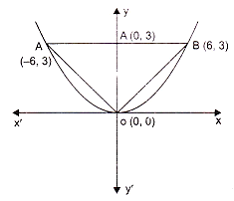
Focus of the parabola is (0, 3) $\Rightarrow$ x = $\pm$6
Let AB be the latus rectum if the parabola then y = 3
$\therefore$ x2 = 4 $\times$ 3 $\times$ 3 = 36
The coordinates of A are (-6, 3) and B are (6, 3)
$\therefore$ Area of $\Delta $AOB$\frac{1}{2}$ [(0 – 0) + (18 + 18) + (0 – 0)]
= $\frac{1}{2}$|36| = 18 sq. units.
View full question & answer→Question 32 Marks
If a parabolic reflector is 20 cm in diameter and 5 cm deep, find the focus.
AnswerA parabolic reflector with diameter PR = 20 cm and OQ = 5 cm.
Vertex of the parabola is (0, 0)
Let focus of the parabola be (a, 0).
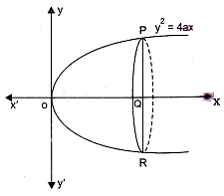
Now PR = 20 cm $\Rightarrow$ PQ = 10 cm
$\therefore$ Coordinate of point P are (5, 10)
Since the point lies on the parabola y2 = 4ax
$\therefore {(10)^2} = 4a \times 5 \Rightarrow a = \frac{{100}}{{20}} \Rightarrow$ a = 5
Thus required focus of the parabola is (5, 0).
View full question & answer→Question 42 Marks
Find the equation of the hyperbola, whose vertices (0, $\pm$3) and foci (0, $\pm$5).
AnswerWe have,
vertices = (0, $\pm$3) = (0, $\pm$a)
$\Rightarrow$ a = 3 and foci = (0, $\pm$c) = (0, $\pm$5)
$\Rightarrow$ c = 5
Also, we know that, c2 = a2 + b2
$\Rightarrow$ 25 = 9 + b2 [$\because$ a = 3]
$\Rightarrow$ b2 = 25 - 9 = 16
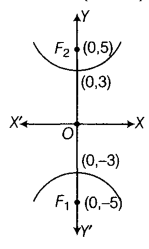
Here, the foci and vertices lie on Y-axis,
Therefore equation of hyperbola is of the form
$\frac { y ^ { 2 } } { a ^ { 2 } } - \frac { x ^ { 2 } } { b ^ { 2 } }$ = 1
i.e., $\frac { y ^ { 2 } } { 9 } - \frac { x ^ { 2 } } { 16 }$ = 1
View full question & answer→Question 52 Marks
Find the equation of hyperbola having Vertices (0, $\pm$5), foci (0, $\pm$8)
AnswerThe vertices are (0, $\pm$5) which lie on y-axis.
So the equation of the hyperbola in standard form is $\frac{{{y^2}}}{{{a^2}}} - \frac{{{x^2}}}{{{b^2}}} = 1$
$\therefore$ the vertices (0, $\pm$a) is (0, $\pm$5)
$\Rightarrow$ a = 5
Foci (0, $\pm$ae) is (0, $\pm$8)
$\Rightarrow$ ae = 8
Now ae = 8
$ \Rightarrow e = \frac{8}{a} \Rightarrow e = \frac{8}{5}$
We know that
$b = a\sqrt {{e^2} - 1} \Rightarrow b = 5\sqrt {\frac{{64}}{{25}} - 1} = 5\frac{{\sqrt {39} }}{5} = \sqrt {39}$
Thus required equation of hyperbola is
$\frac{{{y^2}}}{{{{(5)}^2}}} - \frac{{{x^2}}}{{{{(\sqrt {39} )}^2}}} = 1 \Rightarrow \frac{{{y^2}}}{{25}} - \frac{{{x^2}}}{{39}} = 1$
View full question & answer→Question 62 Marks
Find the equation of hyperbola having Vertices ($\pm$2, 0), foci ($\pm$3, 0)
AnswerThe vertices are ($\pm$2, 0) which lie on x-axis.
So, the equation of hyperbola in standard form is $\frac{{{x^2}}}{{{a^2}}} - \frac{{{y^2}}}{{{b^2}}} = 1$
$\therefore$ the vertices ($\pm$a, 0) is ($\pm$2, 0)
$\Rightarrow$ a = 2
foci ($\pm$ae, 0) is ($\pm$3, 0)
$\Rightarrow$ ae = 3
Now ae = 3
$ \Rightarrow e = \frac{3}{a} \Rightarrow e = \frac{3}{2}$
We know that
$b = a\sqrt {{e^2} - 1} \Rightarrow b = 2\sqrt {\frac{9}{4} - 1} = 2\frac{{\sqrt 5 }}{2} = \sqrt 5$
Thus required equation of hyperbola is
$\frac{{{x^2}}}{{{{(2)}^2}}} - \frac{{{y^2}}}{{{{(\sqrt 5 )}^2}}} = 1 \Rightarrow \frac{{{x^2}}}{4} - \frac{{{y^2}}}{5} = 1$
View full question & answer→Question 72 Marks
Find the coordinates of the foci, and the vertices, the eccentricity and the length of the latus rectum of the hyperbolas. 49y2 - 16x2 = 784
AnswerThe given equation of hyperbola is 49y2 - 16x2 = 784
i.e. $\frac{{49{y^2}}}{{784}} - \frac{{16{x^2}}}{{784}} = 1 \Rightarrow \frac{{{y^2}}}{{16}} - \frac{{{x^2}}}{{49}} = 1$ which is of the form $\frac{{{y^2}}}{{{a^2}}} - \frac{{{x^2}}}{{{a^2}}} = 1$
The foci and vertices of the hyperbola lie on y-axis.
$\therefore$ a2 = 16 $\Rightarrow$ a = 4 and b2 = 49 $\Rightarrow$ b = 7
Now c2 = a2 + b2 = 16 + 49 = 65 $\Rightarrow$ c = $\sqrt{65}$
$\therefore$ Coordinates of foci are $(0, \pm c)$ i.e. $(0, \pm \sqrt {65} )$
Coordinates of vertices are $(0, \pm a)$ i.e $(0, \pm 4)$
Eccentricity $(e) = \frac{c}{a} = \frac{{\sqrt {65} }}{4}$
Length of latus rectum $ = \frac{{2{b^2}}}{a} = \frac{{2 \times 49}}{4} = \frac{{49}}{2}$
View full question & answer→Question 82 Marks
Find the coordinates of the foci, and the vertices, the eccentricity and the length of the latus rectum of the hyperbolas. 5y2 - 9x2 = 36
AnswerThe given equation of hyperbola is 5y2 - 9x2 = 36
i.e. $\frac{{5{y^2}}}{{36}} - \frac{{9{x^2}}}{{36}} = 1 \Rightarrow \frac{{{y^2}}}{{\frac{{36}}{5}}} - \frac{{{x^2}}}{4} = 1$ which is of the form $\frac{{{y^2}}}{{{a^2}}} - \frac{{{x^2}}}{{{b^2}}} = 1$
The foci and vertices of the hyperbola lie on y-axis.
$\therefore$ ${a^2} = \frac{{36}}{5} \Rightarrow a = \frac{6}{{\sqrt 5 }}$ and b2 = 4 $\Rightarrow$ b = 2
Now c2 = a2 + b2 $= \frac{{36}}{5} + 4 = \frac{{56}}{5} \Rightarrow c = \sqrt {\frac{{56}}{5}}$
$\therefore$ Coordinates of foci are $(0, \pm c)$ i.e. $\left( {0, \pm \frac{{\sqrt {56} }}{5}} \right)$
Coordinates of vertices are $(0, \pm a)$ i.e. $\left( {0, \pm \frac{6}{{\sqrt 5 }}} \right)$
Eccentricity (e) $= \frac{c}{a} = \frac{{\sqrt {\frac{{56}}{5}} }}{{\frac{6}{{\sqrt 5 }}}} = \frac{{\sqrt {56} }}{6} = \frac{{2\sqrt {14} }}{6} = \frac{{\sqrt {14} }}{3}$
Length of latus rectum $ = \frac{{2{b^2}}}{a} = \frac{{\frac{{2 \times 4}}{6}}}{{\sqrt 5 }} = \frac{{2 \times 4 \times \sqrt 5 }}{6} = \frac{{4\sqrt 5 }}{3}$
View full question & answer→Question 92 Marks
Find the coordinates of the foci, and the vertices, the eccentricity and the length of the latus rectum of the hyperbolas. 16x2 - 9y2 = 576
AnswerThe given equation of hyperbola is 16x2 - 9y2 = 576
i.e. $\frac{{16{x^2}}}{{576}} - \frac{{9{y^2}}}{{576}} = 1 \Rightarrow \frac{{{x^2}}}{{36}} - \frac{{{y^2}}}{{64}} = 1$ which is of the form $\frac{{{x^2}}}{{{a^2}}} - \frac{{{y^2}}}{{{b^2}}} = 1$
The foci and vertices of the hyperbola lie on x-axis.
$\therefore$ a2 = 36 $\Rightarrow$ a = 6 and b2 = 64 $\Rightarrow$ b = 8
Now c2 = a2 + b2 = 36 + 64 = 100 $\Rightarrow$ c = 10
$\therefore$ Coordinates of foci are $( \pm c,0)$ i.e. $( \pm 10,0)$
Coordinates of vertices are $( \pm a,0)$ i.e. $( \pm 6,0)$
Eccentricity (e) $ = \frac{c}{a} = \frac{{10}}{6} = \frac{5}{3}$
Length of latus rectum $= \frac{{2{b^2}}}{a} = \frac{{2 \times 64}}{6} = \frac{{64}}{3}$
View full question & answer→Question 102 Marks
Find the coordinates of the foci, and the vertices, the eccentricity and the length of the latus rectum of the hyperbolas. 9y2 - 4x2 = 36
AnswerThe given equation of hyperbola is 9y2 - 4x2 = 36
i.e. $\frac{{9{y^2}}}{{36}} - \frac{{4{x^2}}}{{36}} = 1 \Rightarrow \frac{{{y^2}}}{4} - \frac{{{x^2}}}{9} = 1$ which is of the form $\frac{{{y^2}}}{{{a^2}}} - \frac{{{x^2}}}{{{b^2}}} = 1$
The foci and vertices of the hyperbola lie on y-axis.
$\therefore$ a2 = 4 $\Rightarrow$ a = 2 and (b2 = 9 ⇒ b = 3
Now c2 = a2 + b2 = 4 + 9 = 13 $\Rightarrow$ c = $\sqrt{13}$
$\therefore$ Coordinates of foci are (0,±c) i.e. (0,±$\sqrt{13}$)
Coordinates of vertices are (0, ± a) i.e. (0, ± 2)
Eccentricity (e) $\frac{c}{a} = \frac{{\sqrt {13} }}{2}$
Length of latus rectum $= \frac{{2{b^2}}}{a} = \frac{{2 \times 9}}{2} = 9$
View full question & answer→Question 112 Marks
Find the coordinates of the foci, and the vertices, the eccentricity and the length of the latus rectum of the hyperbolas.
$\frac{{{y^2}}}{9} - \frac{{{x^2}}}{{27}} = 1$
AnswerThe equation of given hyperbola is $\frac{{{y^2}}}{9} - \frac{{{x^2}}}{{27}} = 1$ which is of the form $\frac{{{y^2}}}{a^2} - \frac{{{x^2}}}{{b^2}} = 1$
The foci and vertices of the hyperbola lie on x-axis.
a2 = 9 ⇒ a = 3 and b2 = 27 ⇒ b = 3$\sqrt 3$
Now c2 = a2 + b2 = 9 + 27 = 36 ⇒ c = 6
$\therefore$ Coordinates of foci are (0, ± c) i.e. (0, ± 6)
Coordinates of vertices are (0, ± a) i.e. (0, ± 3)
Eccentricity (e) = $= \frac{c}{a} = \frac{6}{3} = 2$
Length of latus rectum $= \frac{{a{b^2}}}{a} = \frac{{2 \times 27}}{3} = 18$
View full question & answer→Question 122 Marks
Find the equation of hyperbola which has Foci $(0, \pm \sqrt {10} )$ and passing through (2, 3)
AnswerHere foci $(0, \pm \sqrt {10} )$ which lie on y-axis
So the equation of hyperbola in standard form is $\frac{{{y^2}}}{{{a^2}}} - \frac{{{x^2}}}{{{b^2}}} = 1$
$\therefore$ foci $(0, \pm a)$ is $(0, \pm \sqrt {10} ) \Rightarrow a = \sqrt {10}$
We know that c2 = a2 + b2
$\therefore {(\sqrt {10} )^2} = {a^2} + {b^2} \Rightarrow$ b2 = 10 - a2
Since the hyperbola passes through (2, 3)
$\therefore \frac{9}{{{a^2}}} - \frac{4}{{{b^2}}} = 1 \Rightarrow \frac{9}{{{a^2}}} - \frac{4}{{10 - {a^2}}} = 1$
$\Rightarrow \frac{{9(10 - {a^2}) - 4{a^2}}}{{{a^2}(10 - {a^2})}} =a^2{(10-a^2)}\Rightarrow$ a4 - 23a2 + 90 = 0
$\Rightarrow$ a4 - 18a2 - 5a2$+$90 = 0 $\Rightarrow$ (a2 - 18)(a2 - 5) = 0 $\Rightarrow a^2=5 ,18$
When a2 = 18 then b2 = 10 - 18 = -8 (which is not possible)
When a2 = 5 then b2 = 10 - 5 = 5
Thus required equation of hyperbola is
$\frac{{{y^2}}}{5} - \frac{{{x^2}}}{5} = 1$
View full question & answer→Question 132 Marks
Find the equation of hyperbola which has Vertices $( \pm 7,0),e = \frac{4}{3}$
AnswerHere vertices are (± 7, 0) which lie on x-axis.
So the equation of hyperbola in standard form is $\frac{{{x^2}}}{{{a^2}}} - \frac{{{y^2}}}{{{b^2}}} = 1$
$\therefore$ Vertices (± a, 0) is (± 7, 0) ⇒ a = 7
Now $e = \frac{4}{3} \Rightarrow \frac{c}{a} = \frac{4}{3} \Rightarrow \frac{c}{7} = \frac{4}{3} \Rightarrow c = \frac{{28}}{3}$
We know that c2 = a2 + b2
$\therefore {\left( {\frac{{28}}{3}} \right)^2} = {(7)^2} + {b^2} \Rightarrow {b^2} = \frac{{784}}{9} - 49 = \frac{{343}}{9}$
Thus required equation of hyperbola is
$\frac{{{x^2}}}{{{{(7)}^2}}} - \frac{{{y^2}}}{{\frac{{343}}{9}}} = 1 \Rightarrow \frac{{{x^2}}}{{49}} - \frac{{{9y^2}}}{{343}} = 1$
View full question & answer→Question 142 Marks
Find the equation of hyperbola having Foci ($\pm$4, 0) and the latus rectum is of length 12.
AnswerHere foci are ($\pm$4, 0) which lie on x-axis.
So the equation of hyperbola in standard form is $\frac{{{x^2}}}{{{a^2}}} - \frac{{{y^2}}}{{{b^2}}} = 1$
∴ foci ($\pm$c, 0) is $\pm$4, 0)
$\Rightarrow$ c = 4
Length of latus rectum $\frac{{2{b^2}}}{a} = 12 \Rightarrow$ b2 = 6a
We know that c2 = a2 + b2
$\therefore$ (4)2 = a2 + 6a
$\Rightarrow$ a2 + 6a – 16 = 0
$\Rightarrow$ (a + 8) (a – 2) = 0
$\Rightarrow$ a = 2 ($\because$ a = -8 is not possible)
$$$\Rightarrow$ a2 = 4
Also b2 = 6 $\times$ 2 = 12
Thus required equation of hyperbola is
$\frac{{{x^2}}}{4} - \frac{{{y^2}}}{{12}} = 1$
View full question & answer→Question 152 Marks
Find the equation of hyperbola having Foci ($\pm$3$\sqrt{5}$, 0), the latus rectum is of length 8.
AnswerHere foci are ($\pm$3$\sqrt{5}$, 0) which lie on x-axis.
So the equation of hyperbola in standard form is $\frac{{{x^2}}}{{{a^2}}} - \frac{{{y^2}}}{{{b^2}}} = 1$
$\therefore$ foci ($\pm$c, 0) is ($\pm$3$\sqrt{5}$, 0)
$\Rightarrow$ c = 3$\sqrt{5}$
Length of latus rectum $\frac{{2{b^2}}}{a} = 8 \Rightarrow$b2 = 4a
We know that c2 = a2 + b2
$\therefore$ (3$\sqrt{5}$)2 = a2 + 4a
$\Rightarrow$ a2 + 4a – 45 = 0
$\Rightarrow$ (a + 9) (a – 5) = 0
$\Rightarrow$ a = 5 ($\because$ a = -9 is not possible)
Also a = 5
$\Rightarrow$ b2 = 4 $\times$ 5 = 20
Thus required equation of hyperbola is
$\frac{{{x^2}}}{{25}} - \frac{{{y^2}}}{{20}} = 1$
View full question & answer→Question 162 Marks
Find the equation of hyperbola having Foci (0, $\pm$13) and the conjugate axis is of length 24.
AnswerHere foci are (0, $\pm$13) which lie on y-axis.
So the equation of hyperbola in standard form is $\frac{{{y^2}}}{{{a^2}}} - \frac{{{x^2}}}{{{b^2}}} = 1$
$\therefore$ (13)2 = a2 + (12)2
$\Rightarrow$ a2 = 169 – 144 = 25
Thus required equation of hyperbola is
$\frac{{{y^2}}}{{25}} - \frac{{{x^2}}}{{{{(12)}^2}}} = 1 \Rightarrow \frac{{{y^2}}}{{25}} - \frac{{{x^2}}}{{144}} = 1$
View full question & answer→Question 172 Marks
Find the equation of hyperbola, when foci are at ($\pm$5, 0) and transverse axis is of length 8.
AnswerHere, foci are at ($\pm$5, 0)
$\therefore$ ($\pm$c, 0) = ($\pm$5,0)
$\Rightarrow$ c = 5
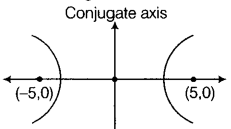
And length of transverse
axis = 2a = 8 $\Rightarrow$ a = 4
Also, we know that, c2 = a2 + b2
$\Rightarrow$ 25 = 16 + b2 [$\because$ a = 4, c = 5]
$\Rightarrow$ b2 = 9
Since, the foci lie on X-axis. Therefore, the equation of hyperbola is of the form
$\frac { x ^ { 2 } } { a ^ { 2 } } - \frac { y ^ { 2 } } { b ^ { 2 } }$ = 1
On putting the values of a2 and b2, we get
$\frac { x ^ { 2 } } { 16 } - \frac { y ^ { 2 } } { 9 }$ = 1
which is the required equation of hyperbola.
View full question & answer→Question 182 Marks
Find the coordinates of the foci, and the vertices, the eccentricity and the length of the latus rectum of the hyperbolas.
$\frac{{{x^2}}}{{16}} - \frac{{{y^2}}}{9} = 1$
AnswerThe equation of given hyperbola is $\frac{{{x^2}}}{{16}} - \frac{{{y^2}}}{9} = 1$ which is of the form $\frac{{{x^2}}}{{{a^2}}} - \frac{{{y^2}}}{{{b^2}}} = 1$
The foci and vertices of the hyperbola lie on x-axis.
$\therefore$ a2 = 16 $\Rightarrow$ a = 4 and b2 = 9 $\Rightarrow$ b = 3
Now c2 = a2 + b2 = 16 + 9 = 25 ⇒ c = 5
$\therefore$ Coordinates of foci are (± c, 0) i.e. (± 5, 0)
Coordinates of vertices are (± a, 0) i.e. (± 4, 0)
Eccentricity $(e) = \frac{c}{a} = \frac{5}{4}$
Length of latus rectum $ = \frac{{2{b^2}}}{a} = \frac{{2 \times 9}}{4} = \frac{9}{2}$
View full question & answer→Question 192 Marks
Find the equation of ellipse having Major axis on the x-axis and passes through the points (4, 3) and (6, 2)
AnswerSince the major axis is along x-axis.
So the equation of ellipse in standard form is $\frac{{{x^2}}}{{{a^2}}} + \frac{{{y^2}}}{{{b^2}}} = 1$
Since the ellipse passes through point (4, 3)
$\therefore \frac{{16}}{{{a^2}}} + \frac{9}{{{b^2}}} = 1$. . . (i)
Also the ellipse passes through point (6, 2)
$\therefore \frac{{36}}{{{a^2}}} + \frac{4}{{{b^2}}} = 1$....(ii)
Solving (i) and (ii), we have
a2 = 52 and b2 = 13
Thus equation of required ellipse is
$\frac{{{x^2}}}{{52}} + \frac{{{y^2}}}{{13}} = 1$
View full question & answer→Question 202 Marks
Find the equation of ellipse having Centre at (0, 0) major axis on the y-axis and passes through the points (3, 2) and (1, 6) .
AnswerSince the major axis is along y-axis
So the equation of ellipse in standard form is $\frac{{{x^2}}}{{{b^2}}} + \frac{{{y^2}}}{{{a^2}}} = 1$
Since the ellipse passes through the point (3, 2)
$\therefore \frac{9}{{{b^2}}} + \frac{4}{{{a^2}}} = 1$
Also the ellipse passes through point (1, 6)
$\therefore \frac{1}{{{b^2}}} + \frac{{36}}{{{a^2}}} = 1$
Solving (i) and (ii), we have
a2 = 40 and b2 = 10
Thus equation of required ellipse is
$\frac{{{x^2}}}{{10}} + \frac{{{y^2}}}{{40}} = 1$
View full question & answer→Question 212 Marks
Find the equation of ellipse having b = 3, c= 4, centre at origin, foci on the x-axis.
AnswerThe foci lie on x-axis
So the equation of ellipse in standard form is $\frac{{{x^2}}}{{{a^2}}} + \frac{{{y^2}}}{{{b^2}}} = 1$
We know that c2 = a2 - b2
$\therefore$ (4)2 = a2 - (3)2 $\Rightarrow$ a2 = 16 + 9 = 25
Thus equation of required ellipse is
$\frac{{{x^2}}}{{25}} + \frac{{{y^2}}}{9} = 1$
View full question & answer→Question 222 Marks
Find the equation of ellipse having Foci ($\pm$3, 0), a = 4.
AnswerThe foci ($\pm$3, 0) lie on x-axis
So the equation of ellipse in standard form is $\frac{{{x^2}}}{{{a^2}}} + \frac{{{y^2}}}{{{b^2}}} = 1$
Now foci ($\pm$c, 0) is ($\pm$3, 0)
$\Rightarrow$ c = 3
We know that c2 = a2 - b2
$\therefore$ (3)2 = (4)2 - b2
$\Rightarrow$ b2 = 16 - 9 = 7
Thus equation of required ellipse is
$\frac{{{x^2}}}{{16}} + \frac{{{y^2}}}{7} = 1$
View full question & answer→Question 232 Marks
Find the equation of ellipse having Length of minor axis 16, foci (0,$\pm$6)
AnswerThe foci (0,$\pm$6) lie on y-axis.
So the equation of ellipse in standard form is $\frac{{{x^2}}}{{{b^2}}} + \frac{{{y^2}}}{{{a^2}}} = 1]$
Now length of minor axis 2b = 16 $\Rightarrow$ b = 8
foci (0, ±c) is (0,± 6) ⇒ c = 6
We know that ${c^2} = {a^2} - {b^2}$
$\therefore$ (6)2 = a2 - (8)2 $\Rightarrow$ a2 = 36 + 64 = 100
Thus equation of required ellipse is
$\frac{{{x^2}}}{{64}} + \frac{{{y^2}}}{{100}} = 1$
View full question & answer→Question 242 Marks
Find the equation of ellipse having Length of major axis 26, foci ($\pm$5, 0)
AnswerThe foci ($\pm$5, 0) lie on x-axis
So the equation of ellipse in standard form is $\frac{{{x^2}}}{{{a^2}}} + \frac{{{y^2}}}{{{b^2}}} = 1$
Now length of major axis 2a = 26
$\Rightarrow$ a = 13
foci ($\pm$c, 0) is ($\pm$5, 0)
$\Rightarrow$ c = 5
We know that c2 = a2 - b2
$\therefore$ (5)2 = (13)2 - b2
$\Rightarrow$ b2 = 169 - 25 = 144
Thus equation of required ellipse is
$\frac{{{x^2}}}{{169}} + \frac{{{y^2}}}{{144}} = 1$
View full question & answer→Question 252 Marks
Find the equation of ellipse having Ends of major axis $(0, \pm \sqrt 5 )$ ,ends of minor axis $( \pm 1,0)$
AnswerEnds of major axis $(0, \pm \sqrt 5 )$ lies on y-axis
So the equation of ellipse in standard form is $\frac{{{x^2}}}{{{b^2}}} + \frac{{{y^2}}}{{{a^2}}} = 1$
Now ends of major axis (0, ± a) is (0, ± $\sqrt 5$) ⇒ a = $\sqrt 5$
Ends of minor axis (± b, 0) is (±1, 0) ⇒ b = 1
Thus equation of required ellipse is
$\frac{{{x^2}}}{1} + \frac{{{y^2}}}{5} = 1$
View full question & answer→Question 262 Marks
Find the equation of ellipse having Ends of major axis $( \pm 3,0)$, ends of minor axis $(0, \pm 2)$
AnswerEnds of major axis $( \pm 3,0)$ lie on x-axis.
So the equation of ellipse in standard form is $\frac{{{x^2}}}{{{a^2}}} + \frac{{{y^2}}}{{{b^2}}} = 1$
Now ends of major axis (± a, 0) is (± 3, 0) ⇒ a = 3
Ends of minor axis $(0, \pm b)$ is $(0, \pm 2) \Rightarrow$ b = 2
Thus equation of required ellipse is
$\frac{{{x^2}}}{9} + \frac{{{y^2}}}{4} = 1$
View full question & answer→Question 272 Marks
Find the equation of ellipse which has Vertices ($\pm$6, 0), foci ($\pm$4, 0)
AnswerThe foci ($\pm$4, 0) lie on x-axis.
So the equation of ellipse in standard form is $\frac{{{x^2}}}{{{a^2}}} + \frac{{{y^2}}}{{{b^2}}} = 1$
Now vertices ($\pm$a, 0) is ($\pm$6, 0)
$\Rightarrow$ a = 6
foci (± c, 0) is ($\pm$4, 0)
$\Rightarrow$ c = 4
We know that c2 = a2 - b2
$\therefore$ (4)2 = (6)2 -b2
$\Rightarrow$ b2 = 36 - 16 = 20
Thus equation of required ellipse is
$\frac{{{x^2}}}{{36}} + \frac{{{y^2}}}{{20}} = 1$
View full question & answer→Question 282 Marks
Find the equation of the ellipse which has Vertices (0, $\pm$13), foci(0, $\pm$5)
AnswerThe foci (0, $\pm$5) lie on y-axis
So the equation of ellipse in standard form is $\frac{{{y^2}}}{{{a^2}}} + \frac{{{x^2}}}{{{b^2}}} = 1$
Now vertices (0, $\pm$a) is (0, $\pm$13)
$\Rightarrow$ a = 13
Foci (0, $\pm$c) is (0, $\pm$5)
$\Rightarrow$ c = 5
We know that c2 = a2 - b2
$\therefore$ (5)2 = (13)2 - b2
$\Rightarrow$ b2 = 169 – 25 = 144
Thus equation of required ellipse is
$\frac{{{x^2}}}{{144}} + \frac{{{y^2}}}{{169}} = 1$
View full question & answer→Question 292 Marks
Find the equation of ellipse which has vertices ($\pm$ 5, 0), foci ($\pm$4, 0)
AnswerVertices ($\pm $5,0) and foci ( $\pm 4,0$)
Here, the vertices are on the x-axis.a
Therefore, the equation of the ellipse will be of form $\frac{x^{2}}{a^{2}}+\frac{y^{2}}{b^{2}}$ =1, where a is the semi-major axis.
Accordingly, a = 5 and c = ae = 4.
It is known that a2 = b2+c2.
$\therefore 5^{2}=b^{2}+4^{2}$
$\Rightarrow$25 = b2 + 16
$\Rightarrow$b2 = 25 – 16
$\Rightarrow$b = $\sqrt{9}$ = 3
Thus, the equation of the ellipse is $\frac{x^{2}}{5^{2}}+\frac{y^{2}}{3^{2}}$ =1 or $\frac{x^{2}}{25}+\frac{y^{2}}{9}$ = 1.
View full question & answer→Question 302 Marks
Find the equation of the parabola that satisfies the given conditions: Vertex (0, 0) Focus (3, 0)
AnswerThe vertex of the parabola is at (0, 0) and focus is at (3, 0),
$\Rightarrow$ y = 0 $\Rightarrow$ The axis of parabola is along x-axis
So the parabola is of the form y2 = 4ax.
The required equation of parabola is
y2 = 4 × 3x $\Rightarrow$ y2 = 12x
View full question & answer→Question 312 Marks
Find the equation of the parabola that satisfies the given conditions: Focus (0, - 3) directrix y = 3
AnswerSince the focus (0, - 3) lies on the y-axis, therefore y-axis is the axis of parabola. Also the directrix is y = 3 i.e. y = a and focus (0, - 3) i.e. (0, -a). So the parabola is of the form x 2 = - 4ay.
The required equation of parabola is
x2 = -4 × 3y $\Rightarrow$ x2 = - 12x
View full question & answer→Question 322 Marks
Find the equation of the parabola that satisfies the given conditions: Focus (6, 0) directrix x = -6
AnswerThe required equation of parabola is
y2 = 4 $\times$ 6x $\Rightarrow$ y2 = 24x
View full question & answer→Question 332 Marks
Find the coordinates of the focus, axis of the parabola, the equation of the directrix and the length of the latus rectum: x2 = - 9y
AnswerThe given equation of parabola is x2 = -9y which is of the form x2 = -4ay
$\therefore$ 4a = 9 $\Rightarrow a = \frac{9}{4}$
$\therefore$ Coordinates of focus are $\left( {0,\;\frac{{ - 9}}{4}} \right)$
Axis of parabola is x = 0
Equation of the directrix is $y = \frac{9}{4} \Rightarrow$ 4y - 9 = 0
Length of latus rectum $= 4 \times \frac{9}{4} = 9$
View full question & answer→Question 342 Marks
Find the coordinates of the focus, axis of the parabola, the equation of the directrix and the length of the latus rectum: y2 = 10x
AnswerThe given equation of parabola is y2 = 10x which is of the form y2 = 4ax
$\therefore$ 4a = 10 $\Rightarrow a = \frac{{10}}{4} \Rightarrow a = \frac{5}{2}$
$\therefore$ Coordinates of focus are $\left( {\frac{5}{2},\;0} \right)$
Axis of parabola is y = 0
Equation of the directrix is $x = \frac{{ - 5}}{2} \Rightarrow$ 2 x + 5 = 0
Length of latus rectum $ = \frac{{4 \times 5}}{2} = 10$
View full question & answer→Question 352 Marks
Find the coordinates of the focus, axis of the parabola, the equation of the directrix and the length of the latus rectum: x2 = -16y
AnswerThe given equation of parabola is x2 = 16y which is of the form x2 = -4ay
$\therefore$ 4a = 16 $\Rightarrow$ a = 4
$\therefore$ Coordinates of focus are (0, -4)
Axis of parabola is x = 0
Equation of the directrix is y = 4 $\Rightarrow$y - 4 = 0
Length of latus rectum = 4 $\times$ 4 = 16
View full question & answer→Question 362 Marks
Find the coordinates of the focus, axis of the parabola, the equation of the directrix and the length of the latus rectum: y2 = -8x
AnswerThe given equation of parabola is y2 = -8x which is of the form y2 = -4 ax
$\therefore$ 4a = 8 $\Rightarrow$ a = 2
$\therefore$ Coordinates of focus are (-2, 0)
Axis of parabola is y = 0
Equation of the directrix is x = 2 $\Rightarrow$ x - 2= 0
Length of latus rectum = 4 $\times$ 2 = 8
View full question & answer→Question 372 Marks
Find the coordinates of the focus, axis of the parabola, the equation of the directrix and the length of the latus rectum: x2 = 6y
AnswerThe given equation of parabola is x2 = 6y which is of the form x2 = 4ay
$\therefore$ 4a = 6 $\Rightarrow a = \frac{6}{4} \Rightarrow a = \frac{3}{2}$
$\therefore$ Coordinates of focus are $\left( {0,\;\frac{3}{2}} \right)$
Axis of parabola is x = 0
Equation of the directrix is $y = \frac{{ - 3}}{2} \Rightarrow$ 2y + 3 =0
Length of latus rectum $= \frac{{4 \times 3}}{2}$ = 6
View full question & answer→Question 382 Marks
Find the equation of the parabola that satisfies the given conditions: Vertex (0, 0) passing through (5, 2) and symmetric with respect to y-axis.
AnswerThe vertex of the parabola is at (0, 0) and it is symmetrical about the y-axis.
$\therefore$ axis of parabola is Y-axis
So the parabola is of the form x2 = 4ay
Since the parabola passes through point (5, 2)
$\therefore {(5)^2} = 4a \times 2 \Rightarrow 25 = 8a \Rightarrow a = \frac{{25}}{8}$
The required equation of parabola is
${x^2} = \frac{{4 \times 25}}{8}y \Rightarrow {x^2} = \frac{{25}}{2}y \Rightarrow 2{x^2} = 25y$
View full question & answer→Question 392 Marks
Find the equation of the parabola that satisfies the given conditions: Vertex (0, 0) passing through (2, 3) and axis is along x-axis.
AnswerThe vertex of the parabola is at (0, 0) and the axis is along x-axis.
So the parabola is of the form y2 = 4ax
Since the parabola passes through point (2, 3)
$\therefore$ (3)2 = 4a × 2 $\Rightarrow$ 9 = 8 a $\Rightarrow a = \frac{9}{8}$
The required equation of parabola is
${y^2} = \frac{{4 \times 9}}{8}x \Rightarrow {y^2} = \frac{9}{2}x \Rightarrow 2{y^2} = 9x$
View full question & answer→Question 402 Marks
Find the equation of the parabola that satisfies the given conditions: Vertex (0, 0) Focus (-2, 0)
AnswerThe vertex of the parabola is at (0, 0) and focus is at (-2, 0)'
$\Rightarrow$ y = 0 $\Rightarrow$ The axis of parabola is along x-axis
So the parabola is of the form y2 = 4ax.
The required equation of parabola is
y2 = 4x - 2x $\Rightarrow$ y2 = -8x.
View full question & answer→Question 412 Marks
Find the coordinates of the focus, axis of the parabola, the equation of the directrix and the length of the latus rectum: y2 = 12x
AnswerThe given equation of parabola is y2 = 12x which is of the form y2 = 4ax.
$\therefore$ 4a = 12 $\Rightarrow$ a = 3
$\therefore$ Coordinates of focus are (3, 0)
Axis of parabola is y = 0
Equation of the directrix is x = -3 $\Rightarrow$ x + 3 = 0
Length of latus rectum = 4$\times$3 = 12
View full question & answer→Question 422 Marks
Find the centre and radius of the circle 2x2 + 2y2 - x = 0.
AnswerThe given equation of circle is
2x2 + 2y2 - x = 0 $\Rightarrow$ x2 + y2 - $\frac { x } { 2 }$ = 0
$\Rightarrow$ $\left( x ^ { 2 } - \frac { x } { 2 } \right)$ + y2 = 0
On adding $\frac { 1 } { 16 }$ to make perfect squares, we get
$\left( x ^ { 2 } - \frac { x } { 2 } + \frac { 1 } { 16 } \right)$ + y2 = $\frac { 1 } { 16 }$
$\Rightarrow$ $\left( x - \frac { 1 } { 4 } \right) ^ { 2 }$ + (y - 0)2 = $\left( \frac { 1 } { 4 } \right) ^ { 2 }$
On comparing with (x - h)2 + (y - k)2 = r2, we get
h = $\frac { 1 } { 4 }$, k = 0 and r = $\frac { 1 } { 4 }$
$\therefore$ Centre = (h, k) = $\left( \frac { 1 } { 4 } , 0 \right)$
and Radius = $\frac { 1 } { 4 }$
View full question & answer→Question 432 Marks
Find the centre and radius of the circle. x 2 + y 2 - 8x - 10y - 12 = 0
AnswerThe given equation of circle is
x 2 +y 2 - 8x - 10y - 12 = 0
$\therefore$ (x 2 - 8x) + (y 2 + 10y) = 12
Completing the square
$\Rightarrow$ [x 2 - 8x + (4) 2] + [y 2 + 10y + (5) 2]
= 12 + (4) 2 + (5) 2
$\Rightarrow$ (x - 4) 2 + (y + 5) 2 = 12 + 16 + 25
$\Rightarrow$ (x - 4) 2 + (y + 5) 2 = 53
$\Rightarrow$ (x - 4) 2 + (y + 5) 2 = $(\sqrt{53})^2$
Comparing it with (x - h) 2 + (y - k) 2 = r 2, we have
h = 4, k = -5 and r = $\sqrt{53}$
Thus coordinates of the centre is (4, -5) and radius is $\sqrt{53}$.
View full question & answer→Question 442 Marks
Find the centre and radius of the circle. x2 + y2 - 4x - 8y - 45 = 0
AnswerThe given equation of circle is
x2 + y2 - 4x - 8y - 45 = 0
$\therefore$ (x2 - 4x) + (y2 - 8y) = 45
$\Rightarrow$ [x2 - 4x + (2)2] + [y2 - 8y + (4)2]
= 45 + (2)2 + (4)2
$\Rightarrow$ (x - 2)2 + (y - 4)2 = 45 + 4 + 16
$\Rightarrow$ (x - 2)2 + (y - 4)2 = 65
$\Rightarrow$ (x - 2)2 + (y - 4)2 = ${(\sqrt {65} )^2}$
Comparing it with (x - h)2 + (y - k)2 = r2, we have
h = 2 , k = 4 and r = $\sqrt{65}$
Thus coordinates of the centre is (2, 4) and radius is $\sqrt{65}$.
View full question & answer→Question 452 Marks
Find the centre and radius of the circle. (x + 5)2 + (y - 3)2 = 36
AnswerThe given equation of circle is
(x + 5)2 + (y - 3)2 = 36 $\Rightarrow$ (x + 5)2 + (y - 3)2 = (16)2
Comparing it with (x - h)2 + (y - k)2 = r2 we have
h = -5, k = 3 and r = 6
Thus the coordinates of the centre is (-5, 3) and radius is 6.
View full question & answer→Question 462 Marks
Find the equation of the circle with centre (-a, -b) and radius $\sqrt {{a^2} - {b^2}}$
AnswerHere h = -a, k = -b and r = $\sqrt {{a^2} - {b^2}}$
The equation of circle is
(x - h)2 + (y - k)2 = r2
$\therefore$ (x + a)2 + (y + b)2 = ${\left( {\sqrt {{a^2} - {b^2}} } \right)^2}$
$\Rightarrow$ x2 + a2 + 2ax + y2 + b2 +2by = a2 - b2
$\Rightarrow$ x2 + y2 + 2ax + 2by + 2b2 = 0
Which is required equation of circle.
View full question & answer→Question 472 Marks
Find the equation of the circle with centre (1, 1) and radius $\sqrt2$
AnswerHere h = 1, k =1 and r = $\sqrt2$
The equation of circle is
(x - h)2 + (y - k)2 = r2
$\therefore$ (x - 1)2 + (y - 1)2 = ${(\sqrt 2 )^2}$
$\Rightarrow$ x2 + 1 - 2x + y2 + 1 - 2y = 2
$\Rightarrow$ x2 + y2 - 2x - 2y = 0
Which is required equation of circle.
View full question & answer→Question 482 Marks
Find the equation of the circle with centre $\left( \frac { 1 } { 2 } , \frac { 1 } { 4 } \right)$ and radius $\frac { 1 } { 12 }$.
AnswerGiven centre is $\left( \frac { 1 } { 2 } , \frac { 1 } { 4 } \right)$
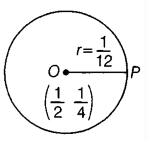
$\therefore$ h = $\frac { 1 } { 2 }$, k = $\frac { 1 } { 4 }$ and radius, r = $\frac { 1 } { 12 }$
On putting these values in equation of circle
(x - h)2 + (y - k)2 = r2, we get
$\left( x - \frac { 1 } { 2 } \right) ^ { 2 } + \left( y - \frac { 1 } { 4 } \right) ^ { 2 } = \left( \frac { 1 } { 12 } \right) ^ { 2 }$
$\Rightarrow$ x2 + $\frac { 1 } { 4 }$ - x + y2 + $\frac { 1 } { 16 }$ - $\frac { y } { 2 }$ = $\frac { 1 } { 144 }$
$\Rightarrow$ x2 + y2 - x - $\frac { y } { 2 } + \frac { 1 } { 4 } + \frac { 1 } { 16 } - \frac { 1 } { 144 }$ = 0
$\Rightarrow$ x2 + y2 - x - $\frac { y } { 2 } + \frac { 11 } { 36 }$ = 0
$\Rightarrow$ 36x2 + 36y2 - 36x - 18y + 11 = 0
which is the required equation of circle.
View full question & answer→Question 492 Marks
Find the equation of the circle with centre (-2, 3) and radius 4
AnswerHere h = -2, k = 3 and r = 4
The equation of circle is
(x - h)2 + (y - k)2 = r2
$\therefore$ (x + 2)2 + (y - 3)2 = (4)2
$\Rightarrow$ x2 + 4 + 4x + y2 + 9 - 6y = 16
$\Rightarrow$ x2 + y2 + 4x - 6y - 3 = 0
Which is required equation of circle.
View full question & answer→Question 502 Marks
Does the point (-2.5, 3.5) lie inside, outside or on the circle x2 + y2 = 25?
AnswerThe equation of given circle is
x2 + y2 = 25
$\Rightarrow$ (x - 0)2 + (y - 0)2 = (5)2
Comparing it with (x - h)2 + (y - k)2 = r2, we have
h = 0 , k = 0 and r = 5
Now distance of the point (-2.5, 3.5) from the centre (0, 0)
$= \sqrt {{{(0 + 2.5)}^2} + {{(0 - 3.5)}^2}} = \sqrt {6.25 + 12.25} = \sqrt {18.5}$ = 4.3 < 5
Thus the point (-2.5, 3.5)lies inside the circle.
View full question & answer→