Questions · Page 2 of 2

2 Marks Questions

Question 512 Marks
Find the equation of a circle with centre (2, 2) and passes through the point (4, 5).
Answer
The equation of circle is
(x - h)2 + (y - k)2 = r2 . . . (i)
Since the circle passes through point (4, 5) and co-ordinates of centre are (2, 2).
$\therefore$ radius of circle $= \sqrt {{{(4 - 2)}^2} + {{(5 - 2)}^2}} = \sqrt {4 + 9} = \sqrt {13}$
Now the equation of required circle is
(x - 2)2  + (y - 2)2 = $(\sqrt{13})^2$ $\Rightarrow$ x2 + 4 - 4x + y2 + 4 - 4y = 13
$\Rightarrow$ x2 + y2 - 4x - 4y - 5 = 0
View full question & answer
Question 522 Marks
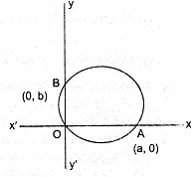
Find the equation of the circle passing through (0, 0) and making intercepts a and b on the coordinate axes.
Answer
The circle makes intercepts a with x-axis and b with y-axis.
$\therefore$ OA = a and OB = b
So the co-ordinates of A are (a, 0) and B are (0, b)
Now the circle passes through three points O(0, 0), A (a, 0) and B(0, b)
Putting the co-ordinates of three points in the equation of circle.
x2 + y2 + 2gx + 2fy + c = 0. . . (i)
c = 0
a2 + 2ga = 0 $\Rightarrow$ a(a + 2 g) = 0 $\Rightarrow g = \frac{{ - 1}}{2}a$
b2 + 2fb = 0 $\Rightarrow$ b (b + 2 f ) = 0 $\Rightarrow f = \frac{{ - 1}}{2}b$
Putting these values of g, f and c in (i) we have
${x^2} + {y^2} + 2 \times \frac{{ - 1}}{2}ax + 2 \times \frac{{ - 1}}{2}by + 0 = 0$
$\Rightarrow$ x2 + y2 - ax - by = 0
which is required equation of circle.

View full question & answer
Question 532 Marks
Find the equation of the circle with centre (0, 2) and radius 2
Answer
Here h = 0, k = 2 and r = 2
The equation of circle is
(x - h)2 + (y - k)2 = r2
$\therefore$ (x - 0)2 + (y - 2)2 = (2)2
$\Rightarrow$ x2 + y2 + 4 - 4y = 4
x2 + y2 - 4y = 0
Which is required equation of circle.
View full question & answer
Question 542 Marks
Find the equation of the parabola which is symmetric about the y-axis, and passes through the point (2, -3).
Answer
Since the parabola is symmetric about the y-axis and has its vertex at the origin, the equation is of the form x2 = 4ay or x2 = -4ay, 
But the parabola passes through (2,–3) which lies in the fourth quadrant, it must open downwards.
Thus the equation is of the form x2 = -4ay
Since the parabola passes through ( 2, -3), we have
$2^{2}=-4 a(-3), \text { i.e., } a=\frac{1}{3}$
Therefore, the equation of the parabola is
$x^{2}=-4\left(\frac{1}{3}\right) y, $ i.e., 3 x2 = -4y
View full question & answer
Question 552 Marks
Find the equation of the parabola with vertex at (0, 0) and focus at (0, 2).
Answer
Given, the vertex is (0, 0) and focus is at (0, 2) which lies on Y-axis.
The Y axis is the axis of parabola.
Therefore, equation of parabola is of the form
x2 = 4ay
x = 4(2)y i.e., x2 = 8y
View full question & answer
Question 562 Marks
Find the equation of the parabola with focus (2, 0) and directrix x = – 2.
Answer
Given that the directrix is x = – 2 and the focus is (2, 0),
Since the focus (2, 0) lies on the x-axis, the x-axis itself is the axis of the parabola.
Hence the equation of the parabola is of the form either y2 = 4ax or y2 = -4ax.
Since the directrix is x = – 2 and the focus is (2, 0),
the parabola is to be of the form y2 = 4ax with a = 2.
Hence the required equation is y2 = 4(2)x = 8x
View full question & answer
Question 572 Marks
Find the coordinates of focus, axis, the equation of directrix and latus rectum of parabola y2 = 8x.
Answer
We have, equation of parabola is y2 = 8x.
The given equation involves y2, so the axis of symmetry is along X-axis. The coefficient of x is positive, so the parabola opens to right.
On comparing with the given equation y2 = 4ax, we get,
a = 2
Thus, focus = (2, 0)
Equation of directrix, x = - 2
Length of latus rectum is 4a = 4 $\times$ 2 = 8.
View full question & answer
Question 582 Marks
Find the equation of the circle which passes through the points (2, - 2) and (3, 4) and whose centre lies on the line x + y = 2.
Answer
Let the equation of circle with centre (h, k) and radius r be (x - h)2 + (y - k)2 = r2 ...(i)
Since, circle passes through the points (2, - 2) and (3, 4), so the points (2, - 2) and (3, 4) will lie on Eq. (i).
$\therefore$ (2 - h)2 + (- 2 - k)2 = r2 ...(ii)
and (3 - h)2 + (4 - k)2 = r2...(iii)
Now, from Eqs. (ii) and (iii), we get
(2 - h)2 + (- 2 - k)2 = (3 - h)2 + (4 - k)2
$\Rightarrow$ 4 + h2 - 4h + 4 + k2 + 4k = 9 + h2 - 6h + 16 + k- 8k
 $\Rightarrow$ 2h + 12k = 17 ...(iv)
Also, given that centre (h, k) lies on x + y = 2. So, it will satisfy it.
$\therefore$ h + k = 2 ...(v)
On solving Eqs. (iv) and (v), we get
h = 0.7, k = 1.3
Now, r2 = (2 - 0.7)2 + (- 2 - 1.3)2 = 1.69 + 10.89 = 12.58
On putting h = 0.7, k = 13 and r2 = 12.58 in Eq. (i), we get
(x - 0.7)2 + (y - 1.3)2 = 12.58
which is the required equation of circle.
View full question & answer
Question 592 Marks
Find the centre and the radius of the circle: x2 + y2 + 8x + 10y – 8 = 0
Answer
The given equation is (x2 + 8x) + (y2 + 10y) = 8
Now, completing the squares within the parenthesis, we get
(x2 + 8x + 16) + (y2 + 10y + 25) = 8 + 16 + 25
i.e. (x + 4)2 + (y + 5)2 = 49
i.e. {x – (– 4)}2 + {y – (–5)}2 = 49     [comparing with {x – (h)}2 + {y – (k)}2 = r2 , centre(-h, -k) and r radius]
Therefore, the given circle has centre at (– 4, –5) and radius 7.
View full question & answer
Question 602 Marks
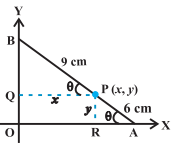
A rod AB of length 15 cm rests in between two coordinate axes in such a way that the end point A lies on x-axis and end point B lies on y-axis. A point P(x, y) is taken on the rod in such a way that AP = 6 cm. Show that the locus of P is an ellipse.
Answer

Let AB be the rod making an angle θ with OX as shown in figure and P (x, y) the point on it such that AP = 6 cm
Since AB = 15 cm, we have

PB = 9 cm.
From P draw PR and PQ perpendiculars on x-axis and y-axis, respectively.
From $\Delta \mathrm{PBQ}, \cos \theta=\frac{x}{9}$
From $\Delta \mathrm{PRA}, \sin \theta=\frac{y}{6}$
Since cos2 θ + sin2 θ = 1
$\left(\frac{x}{9}\right)^{2}+\left(\frac{y}{6}\right)^{2}=1$
or $\frac{x^{2}}{81}+\frac{y^{2}}{36}=1$
Therefore, locus of P is an ellipse.

View full question & answer
Question 612 Marks
Find the equation of the hyperbola with foci (0, $\pm$ 3) and vertices $\left(0, \pm \frac{\sqrt{11}}{2}\right)$
Answer
Since the foci is on the y-axis, the equation of the hyperbola is of the form $\frac{y^{2}}{a^{2}}-\frac{x^{2}}{b^{2}}=1$

given, foci (0, $\pm$ 3) and vertices $\left(0, \pm \frac{\sqrt{11}}{2}\right)$
Since vertices are $\left(0, \pm \frac{\sqrt{11}}{2}\right), \quad a=\frac{\sqrt{11}}{2}$
Also, since foci are (0, ± 3); c= ae = 3 and b2 = c2 – a2 = $\frac{25}{4}$
Therefore, the equation of the hyperbola is $\frac{y^{2}}{\left(\frac{11}{4}\right)}-\frac{x^{2}}{\left(\frac{25}{4}\right)}$ = 1, i.e., 100 y2 – 44 x2 = 275  

View full question & answer
2 Marks Questions - Page 2 - MATHS STD 11 Science Questions - Vidyadip