MCQ
Given below are two statements : one is labelled as Assertion $(A)$ and the other is labelled as Reason $(R)$,

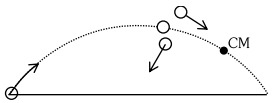
Assertion $(A)$ :When a fire cracker (rocket) explodes in mid air, its fragments fly in such a way that they continue moving in the same path, which the fire cracker would have followed, had it not exploded

Reason $(R)$:Explosion of cracker (rocket) occurs due to internal forces only and no external force acts for this explosion.

In the light of the above statements, choose the most appropriate answer from the options given below :

  • A
    Both $(A)$ and $(R)$ are correct and $(R)$ is the correct explanation of $(A)$
  • B
    Both $(A)$ and $(R)$ are correct but $(R)$ is not the correct explanation of $(A)$
  • C
    $(A)$ is correct but $(R)$ is not correct
  • $(A)$ is not correct but $(R)$ is correct
Answer

Correct option: D.
$(A)$ is not correct but $(R)$ is correct
d
After explosion $C.O.M.$ moving is the same path but particles moving in different direction.

Need a full question paper?

Generate a complete, print-ready paper with questions like this in minutes — across 16+ boards, with answer keys.

Start Generating Free

Similar questions

Two rectangular blocks $A$ and $B$ of different metals have same length and same area of cross-section. They are kept in such a way that their cross-sectional area touch each other. The temperature at one end of $A$ is $100°C$ and that of $B$ at the other end is $0°C$ . If the ratio of their thermal conductivity is $1 : 3$ , then under steady state, the temperature of the junction in contact will be ........ $^oC$
Which one of the following schematic graphs best represents the variation of $p V$ (in Joules) versus $T$ (in Kelvin) of one mole of an ideal gas? (The dotted line represents $p V=T$ )
The range of a projectile when launched at angle $\theta$ is same as when launched at angle $2 \theta$. What is the value of $\theta$ ?
The unit of length, velocity and force are doubled. Which of the following is the correct change in the other units?
In order to determine the Young's Modulus of a wire of radius $0.2\, cm$ (measured using a scale of least count $=0.001\, cm )$ and length $1 \,m$ (measured using a scale of least count $=1\, mm$ ), a weight of mass $1\, kg$ (measured using a scale of least count $=1 \,g$ ) was hanged to get the elongation of $0.5\, cm$ (measured using a scale of least count $0.001\, cm$ ). What will be the fractional error in the value of Young's Modulus determined by this experiment? (in $\%$)
Aboat having a speed of $5\,\, km/hr$. in still water, crosses a river of width $1\,\, km$ along the shortest possible path in $15 \,\,minutes$. The speed of the river in $Km/hr.$
A small hole of area of cross-section $2\; \mathrm{mm}^{2}$ is present near the bottom of a fully filled open tank of height $2\; \mathrm{m} .$ Taking $\mathrm{g}=10 \;\mathrm{m} / \mathrm{s}^{2},$ the rate of flow of water through the open hole would be nearly ......... $\times 10^{-6} \;m^{3} /s$
The contact force exerted by a body A on another body B is equal to the normal force between the bodies. We conclude that:
  1. The surfaces must be frictionless.
  2. The force of friction between the bodies is zero.
  3. The magnitude of normal force equals that of friction.
  4. The bodies may be rough but they don't slip on each other.
When the separation between two charges is increased the electric potential energy of the charges.
  1. Increases.
  2. Decreases.
  3. Remains the same.
  4. May increase or decrease.
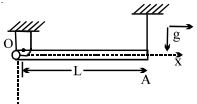
$A$ non uniform rod $OA$ of linear mass density $\lambda = \lambda_0x$ $(\lambda_0 =$ const.) is suspended from ceiling with hinge joint $O$ & light string as shown in figure. Find the angular acceleration of rod just after the string is cut.