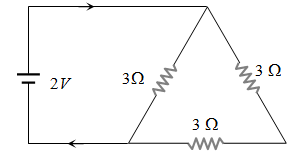
In hydrogen atom, the electron makes $6.6 \times 10^{15}$ revolutions per second around the nucleus in an orbit of radius $0.5 \times 10^{-10} m$. It is equivalent to a current nearly
Two wires of equal diameters, of resistivities $\rho_1 $ and $\rho_2$ and lengths $\mathrm{I}_1$ and $\mathrm{I}_2$, respectively, are joined in series. The equivalent resistivity of the combination is
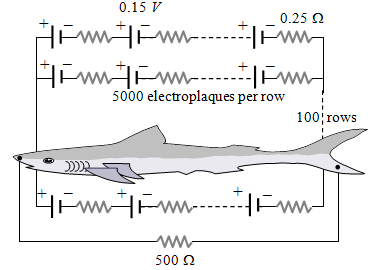
Eels are able to generate current with biological cells called electroplaques. The electroplaques in an eel are arranged in $100$ rows, each row stretching horizontally along the body of the fish containing $5000$ electroplaques. The arrangement is suggestively shown below. Each electroplaques has an emf of $0.15 V$ and internal resistance of $0.25 W$
The water surrounding the eel completes a circuit between the head and its tail. If the water surrounding it has a resistance of $500 W,$ the current an eel can produce in water is about
Equal potentials are applied on an iron and copper wire of same length. In order to have the same current flow in the two wires, the ratio $r\ ($iron$)\ / r\ ($copper$)$ of their radii must be $($Given that specific resistance of iron $=1.0 \times 10^{-7}$ ohm$-m$ and specific resistance of copper $=1.7 \times 10^{-8}$ ohm$-m)$
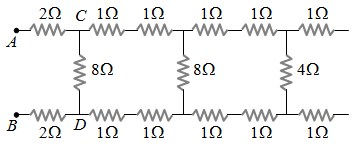
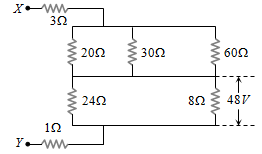
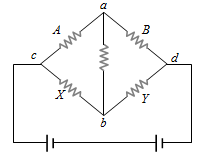
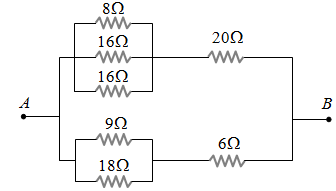
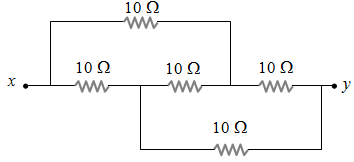
The potential difference across $8$ ohm resistance is $48$ volt as shown in the figure. The value of potential difference across $X$ and $Y$ points will be
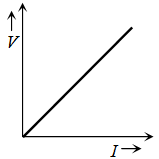
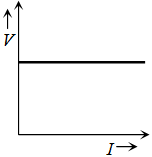
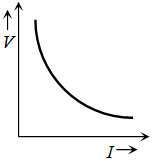
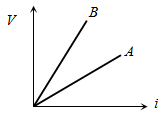
The V-i graph for a conductor makes an angle θ with V-axis. Here V denotes the voltage and i denotes current. The resistance of conductor is given by(a) sin θ(b) cos θ(c) tan θ (d) cot θ
Assertion : A person touching a high power line gets stuck with the line.
Reason : The current carrying wires attract the man towards it.(a) If both assertion and reason are true and the reason is the correct explanation of the assertion.(b) If both assertion and reason are true but reason is not the correct explanation of the assertion.(c) If assertion is true but reason is false.(d) If the assertion and reason both are false.
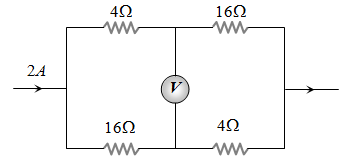
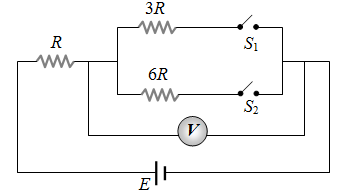
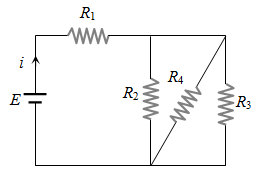
In the circuit shown in figure reading of voltmeter is $V_1$ when only $S_1$ is closed, reading of voltmeter is $V_2$ when only $S_2$ is closed and reading of voltmeter is $V_3$ when both $S_1$ and $S_2$ are closed. Then
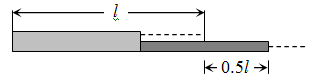
In order to quadruple the resistance of a uniform wire, a part of its length was uniformly stretched till the final length of the entire wire was $1.5$ times the original length, the part of the wire was fraction equal to
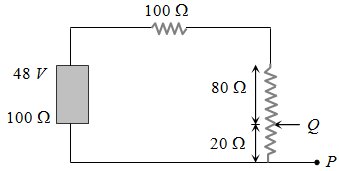
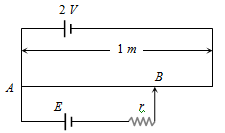
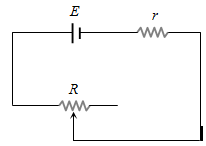
In the given figure, battery $E$ is balanced on $55 \ cm$ length of potentiometer wire but when a resistance of $10\Omega$ is connected in parallel with the battery then it balances on $50 \ cm$ length of the potentiometer wire then internal resistance $r$ of the battery is
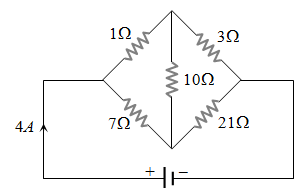
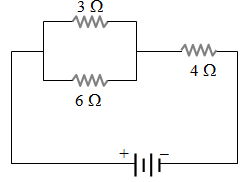
In the circuit shown in figure, the current drawn from the battery is $4A.$ If $10\Omega$ resistor is replaced by $20\Omega$ resistor, then current drawn from the circuit will be
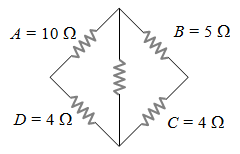
In a typical Wheatstone network, the resistances in cyclic order are $A = 10\Omega, B = 5\Omega, C = 4\Omega$ and $D = 4\Omega$ for the bridge to be balanced
✓
$10\Omega$ should be connected in parallel with $A$
B
$10\Omega$ should be connected in series with $A$
C
$5\Omega$ should be connected in series with $B$
D
$5\Omega$ should be connected in parallel with $B$
Answer
Correct option: A.
$10\Omega$ should be connected in parallel with $A$
$10\Omega$ should be connected in parallel with $A$
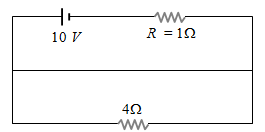
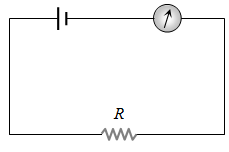
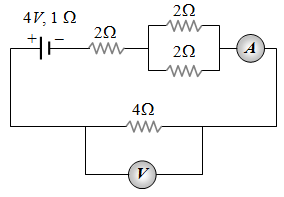
A battery of $emf \ 10 V$ and internal resistance $3 \Omega$ is connected to a resistor as shown in the figure. If the current in the circuit is $0.5 A .$ then the resistance of the resistor will be
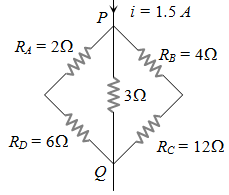
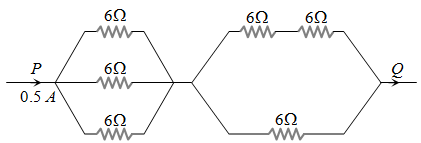
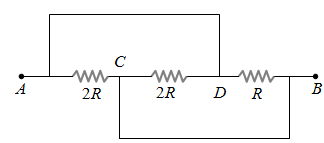
Resistances of $6$ ohm each are connected in the manner shown in adjoining figure. With the current $0.5$ ampere as shown in figure, the potential difference $V_P - V_Q$ is
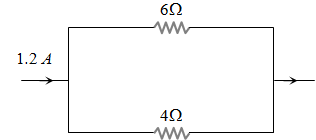
Two resistance wires on joining in parallel the resultant resistance is $\frac{6}{5}$ ohms. One of the wire breaks, the effective resistance is $2$ ohms. The resistance of the broken wire is
The n rows each containing $m$ cells in series are joined in parallel. Maximum current is taken from this combination across an external resistance of $3\Omega$ resistance. If the total number of cells used are $24$ and internal resistance of each cell is $0.5\Omega$ then
An unknown resistance $R_1$ is connected in series with a resistance of $10 W$. This combinations is connected to one gap of a metre bridge while a resistance $R_2$ is connected in the other gap. The balance point is at $50 \ cm$. Now, when the $10 W$ resistance is removed the balance point shifts to $40 \ cm$. The value of $R_1$ is $($in $ohm)$
Masses of 3 wires of same metal are in the ratio 1 : 2 : 3 and their lengths are in the ratio 3 : 2 : 1. The electrical resistances are in ratio(a) 1 : 4 : 9(b) 9 : 4 : 1(c) 1 : 2 : 3(d) 27 : 6 : 1
The electric resistance of a certain wire of iron is R. If its length and radius are both doubled, then(a) The resistance will be doubled and the specific resistance will be halved(b) The resistance will be halved and the specific resistance will remain unchanged(c) The resistance will be halved and the specific resistance will be doubled(d) The resistance and the specific resistance, will both remain unchanged
Answer
(b) The resistance will be halved and the specific resistance will remain unchanged