Questions · Page 4 of 9

M.C.Q (1 Marks)

Question 1511 Mark
The grid in a triode valve is used(a) To increases the thermionic emission(b) To control the plate to cathode current(c) To reduce the inter-electrode capacity(d) To keep cathode at constant potential


Answer
(b) To control the plate to cathode current
View full question & answer
MCQ 1521 Mark
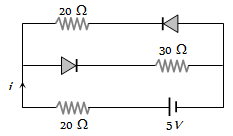
Current in the circuit will be
  • A
    $\frac{5}{40} \mathrm{~A}$
  • $\frac{5}{50} \mathrm{~A}$
  • C
    $\frac{5}{10} \mathrm{~A}$
  • D
    $\frac{5}{20} \mathrm{~A}$
Answer
Correct option: B.
$\frac{5}{50} \mathrm{~A}$
View full question & answer
MCQ 1531 Mark
A P-type semiconductor has acceptor levels $57\ meV$ above the valence band. The maximum wavelength of light required to create a hole is $($Planck’s constant $h = 6.6 \times 10^{-34} J-s)$
  • A
    $57 A^0$
  • B
    $57 \times 10^{-3} A^0$
  • $217100 A^0$
  • D
    $11.61 \times 10^{-33} A^0$
Answer
Correct option: C.
$217100 A^0$
$217100 A^0$
View full question & answer
MCQ 1541 Mark
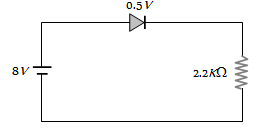
In the circuit, if the forward voltage drop for the diode is $0.5V,$ the current will be
  • $3.4\ mA$
  • B
    $2\ mA$
  • C
    $2.5\ mA$
  • D
    $3\ mA$
Answer
Correct option: A.
$3.4\ mA$
$3.4\ mA$
View full question & answer
Question 1551 Mark
The typical ionisation energy of a donor in silicon is(a) 10.0 eV(b) 1.0eV(c) 0.1 eV(d) 0.001 eV
       
Answer
(c) 0.1 eV
View full question & answer
Question 1561 Mark
The probability of electrons to be found in the conduction band of an intrinsic semiconductor at a finite temperature(a) Decreases exponentially with increasing band gap(b) Increases exponentially with increasing band gap(c) Decreases with increasing temperature (d) Is independent of the temperature and the band gap


Answer
(a) Decreases exponentially with increasing band gap
View full question & answer
MCQ 1571 Mark
A silicon speciman is made into a $P-$type semi-conductor by dopping, on an average, one Indium atom per $5 \times 10^7$ silicon atoms. If the number density of atoms in the silicon specimen is $5 \times 10^{28}$ atoms $/ \mathrm{m}^3$ then the number of acceptor atoms in silicon per cubic centimetre will be
  • A
    $2.5 \times 10^{30}$ atoms $/ \mathrm{cm}^3$
  • B
    $1.0 \times 10^{13}$ atoms $/ \mathrm{cm}^3$
  • $1.0^{\times 10^{15}}$ atom $/ \mathrm{cm}^3$
  • D
    $2.5 \times 10^{36}$ atoms $/ \mathrm{cm}^3$
Answer
Correct option: C.
$1.0^{\times 10^{15}}$ atom $/ \mathrm{cm}^3$
View full question & answer
Question 1581 Mark
Select the correct statement(a) In a full wave rectifier, two diodes work alternately (b) In a full wave rectifier, two diodes work simultaneously(c) The efficiency of full wave and half wave rectifiers is same(d) The full wave rectifier is bi-directional


Answer
(a) In a full wave rectifier, two diodes work alternately
View full question & answer
MCQ 1591 Mark
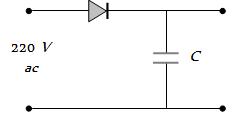
A diode is connected to $220 V ($rms$)$ ac in series with a capacitor as shown in figure. The voltage across the capacitor is
  • A
    $220 V$
  • B
    $110 V$
  • C
    $311.1 V$
  • $\frac{220}{\sqrt{2}} \mathrm{~V}$ 
Answer
Correct option: D.
$\frac{220}{\sqrt{2}} \mathrm{~V}$ 
View full question & answer
MCQ 1601 Mark
The current in a triode at anode potential $100 V$ and grid potential $– 1.2 V$ is $7.5\ mA$. If grid potential is changed to $– 2.2 V,$ the current becomes $5.5\ mA$. the value of trans conductance $(g_m)$ will be
  • $2$ mili mho
  • B
    $3$ mili mho
  • C
    $4$ mili mho
  • D
    $0.2$ mili mho
Answer
Correct option: A.
$2$ mili mho
$2$ mili mho
View full question & answer
Question 1611 Mark
Plate voltage of a triode is increased from 200 V to 225 V. To maintain the plate current, change in grid voltage from 5V to 5.75 V is needed. The amplification factor is (a) 40(b) 45(c) 33.3(d) 25
       
Answer
(c) 33.3
View full question & answer
MCQ 1621 Mark
The plate resistance of a triode is $2.5 \times 10^4 W$ and mutual conductance is $2 \times 10^{–3}$ mho. What will be the value of amplification factor
  • $50$
  • B
    $ 1.25 \times 10^7$
  • C
    $ 75 $
  • D
    $ 2.25 \times 10^7$
Answer
Correct option: A.
$50$
$50$
View full question & answer
Question 1631 Mark
In a diode valve the cathode temperature must be (f = work function)(a) High and ∅  should be high(b) High and ∅ should be low(c) Low and ∅ should be high(d) Low and ∅ should be high
   
   
Answer
(b) High and ∅ should be low
View full question & answer
Question 1641 Mark
The ripple factor in a half wave rectifier is(a) 1.21(b) 0.48(c) 0.6(d) None of these
       
Answer
(a) 1.21
View full question & answer
Question 1651 Mark
The transconductance of a triode amplifier is 2.5 mili mho having plate resistance of 20 KW, amplification 10. Find the load resistance(a) 5 kW  (b) 25 kW(c) 20 kW(d) 50 kW
       
Answer
(a) 5 kW  
View full question & answer
MCQ 1661 Mark
The slope of plate characteristic of a vacuum diode is  $\mathrm{s} 2 \times 10^{-2} \mathrm{~mA} / \mathrm{V}$  The plate resistance of diode will be
  • A
    $50\ W$
  • $50\ kW $
  • C
    $500\ kW$
  • D
    $500\ kW$
Answer
Correct option: B.
$50\ kW $
$50\ kW $
View full question & answer
Question 1671 Mark
The amplification factor of a triode is 50. If the grid potential is decreased by 0.20 V, what increase in plate potential will keep the plate current unchanged(a) 5 V(b) 10 V(c) 0.2 V(d) 50 V
       
Answer
(b) 10 V
View full question & answer
Question 1681 Mark
The thermionic emission of electron is due to(a) Electromagnetic field(b) Electrostatic field(c) High temperature(d) Photoelectric effect
   
   
Answer
(c) High temperature
View full question & answer
MCQ 1691 Mark
In a triode valve the amplification factor is $ 20$ and mutual conductance is $10^{–3}$ mho. The plate resistance is
  • A
    $2 \times 10^3 W$
  • B
    $4 \times 10^3 W$
  • $2 \times 10^4 W$
  • D
    $2 \times 10^4 W$
Answer
Correct option: C.
$2 \times 10^4 W$
$2 \times 10^4 W$
View full question & answer
Question 1701 Mark
The voltage gain of a triode depends upon(a) Filament voltage(b) Plate voltage(c) Plate resistance(d) Plate current
       
Answer
(c) Plate resistance
View full question & answer
Question 1711 Mark
The electrical circuits used to get smooth d.c. output from a rectifier circuit is called(a) Filter(b) Amplifier(c) Full wave rectifier(d) Oscillator
       
Answer
(b) Amplifier
View full question & answer
Question 1721 Mark
For a given triode μ = 20. The load resistance is 1.5 times the anode resistance. The maximum gain will be(a) 16(b) 12(c) 10       (d) None of the above
       
Answer
(b) 12
View full question & answer
Question 1731 Mark
Diode is used as a/an(a) Oscillator(b) Amplifier(c) Rectifier(d) Modulator
       
Answer
(c) Rectifier
View full question & answer
MCQ 1741 Mark
Plate resistance of two triode valves is $2\ KW$ and $4\ KW$, amplification factor of each of the valves is $40.$ The ratio of voltage amplification, when used with $4\ KW$ load resistance, will be
  • A
    $10$
  • B
    $\frac{4}{3}$
  • $\frac{3}{4}$
  • D
    $\frac{16}{3}$
Answer
Correct option: C.
$\frac{3}{4}$
$\frac{3}{4}$
View full question & answer
Question 1751 Mark
In a diode valve, the state of saturation can be obtained easily by(a) High plate voltage and high filament current(b) Low filament current and high plate voltage(c) Low plate voltage and high cathode temperature(d) High filament current and high plate voltage


Answer
(b) Low filament current and high plate voltage
View full question & answer
MCQ 1761 Mark
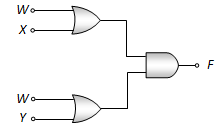
The diagram of a logic circuit is given below. The output $F$ of the circuit is represented by
  • A
    $\ce{W.(X + Y)}$
  • B
    $\ce{W.(X.Y)}$
  • $\ce{W + (X.Y)}$
  • D
    $\ce{W + (X + Y)}$
Answer
Correct option: C.
$\ce{W + (X.Y)}$
$\ce{W + (X.Y)}$
View full question & answer
MCQ 1771 Mark
Which one is correct relation for thermionic emission
  • A
    $\ce{J=A T^{1 / 2} e^{-\emptyset / k T}}$
  • $\mathrm{J}=\mathrm{AT}^2 \mathrm{e}^{-\emptyset / \mathrm{kT}}$
  • C
    $\mathrm{J}=\mathrm{AT}^{3 / 2} \mathrm{e}^{-\emptyset / \mathrm{kT}}$
  • D
    $\ce{J=A T^2 e^{-\emptyset / 2 k T}}$
Answer
Correct option: B.
$\mathrm{J}=\mathrm{AT}^2 \mathrm{e}^{-\emptyset / \mathrm{kT}}$
View full question & answer
Question 1781 Mark
Coating of strontium oxide on Tungsten cathode in a valve is good for thermionic emission because(a) Work function decreases(b) Work function increases(c) Conductivity of cathode increases(d) Cathode can be heated to high temperature


Answer
(a) Work function decreases
View full question & answer
Question 1791 Mark
The introduction of a grid in a triode valve affects plate current by (a) Making the thermionic emission easier at low temperature(b) Releasing more electrons from the plate(c) By increasing plate voltage(d) By neutralising space charge


Answer
(d) By neutralising space charge
View full question & answer
Question 1801 Mark
With a change of load resistance of a triode, used as an amplifier, from 50 kilo ohms to 100 kilo ohms, its voltage amplification changes from 25 to 30. Plate resistance of the triode is(a) 25 kW(b) 75 kW(c) 7.5 kW(d) 2.5 kW
       
Answer
(a) 25 kW
View full question & answer
MCQ 1811 Mark
The unit of mutual conductance of a triode valve is
  • Siemen
  • B
    Ohm 
  • C
    Ohm metre
  • D
    Joule Coulomb$^{–1}$
Answer
Correct option: A.
Siemen
Siemen
View full question & answer
Question 1821 Mark
The triode constant is out of the following(a) Plate resistance(b) Amplification factor(c) Mutual conductance(d) All the above
       
Answer
(d) All the above
View full question & answer
MCQ 1831 Mark
If the amplification factor of a triode $(m)$ is $22$ and its plate resistance is $6600$ ohm, then the mutual conductance of this valve is mho is
  • $\frac{1}{300}$
  • B
    $25 \times 10^{-2}$
  • C
    $2.5 \times 10^{-2}$
  • D
    $0.25 \times 10^{-2}$
Answer
Correct option: A.
$\frac{1}{300}$
$\frac{1}{300}$
View full question & answer
Question 1841 Mark
In the circuit of a triode valve, there is no change in the plate current, when the plate potential is increased from 200 volt to 220 volt and the grid potential is decreased from – 0.5 volt to –1.3 volt. The amplification factor of this valve is(a) 15(b) 20(c) 25 (d) 35
       
Answer
(c) 25 
View full question & answer
MCQ 1851 Mark
$14 \times 10^{15}$ electrons reach the anode per second. If the power consumed is $448$ milliwatts, then the plate $($anode$)$ voltage is
  • A
    $150 V$
  • $200V$
  • C
    $14 \times 448 V$
  • D
    $448/14V$
Answer
Correct option: B.
$200V$
$200V$
View full question & answer
MCQ 1861 Mark
The slope of plate characteristic of a vacuum tube diode for certain operating point on the curve is $10^{-3} \frac{\mathrm{~mA}}{\mathrm{~V}}$  The plate resistance of the diode and its nature respectively
  • A
    $100$ kilo$-$ohms static
  • $1000$ kilo$-$ohms static
  • C
    $1000$ kilo$-$ohms dynamic
  • D
    $100$ kilo$-$ohms dynamic
Answer
Correct option: B.
$1000$ kilo$-$ohms static
View full question & answer
Question 1871 Mark
The amplification factor of a triode valve is 15. If the grid voltage is changed by 0.3 volt the change in plate voltage in order to keep the plate current constant (in volt) is (a) 0.02(b) 0.002(c) 4.5(d) 5.0
       
Answer
(c) 4.5
View full question & answer
Question 1881 Mark
In a triode valve (a) If the grid voltage is zero then plate current will be zero(b) If the temperature of filament is doubled, then the thermionic current will also be doubled(c) If the temperature of filament is doubled, then the thermionic current will nearly be four times(d) At a definite grid voltage the plate current varies with plate voltage according to Ohm’s law


Answer
(c) If the temperature of filament is doubled, then the thermionic current will nearly be four times
View full question & answer
MCQ 1891 Mark
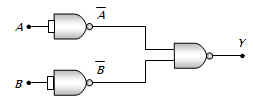
The combination of the gates shown in the figure below produces
  • A
    $\text{NOR}$ gate
  • $\text{OR}$ gate
  • C
    $\text{AND}$ gate
  • D
    $\text{XOR}$ gate
Answer
Correct option: B.
$\text{OR}$ gate
$\text{OR}$ gate
View full question & answer
MCQ 1901 Mark
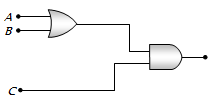
To get an output $1$ from the circuit shown in the figure, the input must be
  • A
    $A = 0, B = 1, C = 0$
  • B
    $A = 1, B = 0,  C = 0$
  • $A = 1, B = 0, C = 1$
  • D
    $A = 1, B = 1, C = 0$
Answer
Correct option: C.
$A = 1, B = 0, C = 1$
View full question & answer
Question 1911 Mark
In a triode amplifier, the value of maximum gain is equal to(a) Half the amplification factor      (b) Amplification factor(c) Twice the amplification factor(d) Infinity
   
   
Answer
(b) Amplification factor
View full question & answer
Question 1921 Mark
In an experiment, the saturation in the plate current in a diode is observed at 240V. But a student still wants to increase the plate current. It can be done, if(a) The plate voltage is increased further(b) The plate voltage is decreased(c) The filament current is decreased(d) The filament current is increased


Answer
(d) The filament current is increased
View full question & answer
Question 1931 Mark
The amplification produced by a triode is due to the action of(a) Filament(b) Cathode(c) Grid   (d) Plate
       
Answer
(c) Grid   
View full question & answer
MCQ 1941 Mark
For a triode $\mathrm{r}_{\mathrm{p}}=10$ kilo ohm and  $\mathrm{g}_{\mathrm{m}}=3$ milli mho. If the load resistance is double of plate resistance, then the value of voltage gain will be
  • A
    $10$
  • $20$
  • C
    $15$
  • D
    $30$
Answer
Correct option: B.
$20$
$20$
View full question & answer
Question 1951 Mark
The amplification factor of a triode is 20. If the grid potential is reduced by 0.2 volt then to keep the plate current constant its plate voltage is to be increased by(a) 10 volt(b) 4 volt(c) 40 volt(d) 100 volt
       
Answer
(b) 4 volt
View full question & answer
MCQ 1961 Mark
In a triode amplifier, $\mu=25, r_p=40$ kilo ohm and load resistance $R_L=10$  kilo ohm. If the input signal voltage is $0.5$ volt, then output signal voltage will be
  • A
    $1.25$ volt
  • B
    $5$ volt
  • $2.5$ volt
  • D
    $10$ volt
Answer
Correct option: C.
$2.5$ volt
$2.5$ volt
View full question & answer
MCQ 1971 Mark
The amplification factor of a triode is $20$ and trans$-$conductance is $3$ milli mho and load resistance $3 \times 10^4 \Omega$  then the voltage gain is
  • $16.36$
  • B
    $28$
  • C
    $78$
  • D
    $108$
Answer
Correct option: A.
$16.36$
$16.36$
View full question & answer
MCQ 1981 Mark
Following is the relation between current and charge
$I=A T^2 e^{q t / V_L}$
then value of $V_L$ will be
  • A
    $\frac{\mathrm{V}}{\mathrm{k} \mathrm{T}}$
  • B
    $\frac{\mathrm{kV}}{\mathrm{T}}$
  • $\frac{\mathrm{kT}}{\mathrm{V}}$
  • D
    $\frac{\mathrm{VT}}{\mathrm{k}}$
Answer
Correct option: C.
$\frac{\mathrm{kT}}{\mathrm{V}}$
View full question & answer
MCQ 1991 Mark
In an amplifier the load resistance $R_l$ is equal to the plate resistance $\left(r_p\right)$. The voltage amplification is equal to
  • A
    $\mu$
  • B
    $2 \mu$
  • $\mu / 2$
  • D
    $\mu / 4$
Answer
Correct option: C.
$\mu / 2$
$\mu / 2$
View full question & answer
Question 2001 Mark
Number of secondary electrons emitted per number of primary electrons depends on(a) Material of target(b) Frequency of primary electrons(c) Intensity(d) None of the above
   
   
Answer
(c) Intensity
View full question & answer