Question 15 Marks
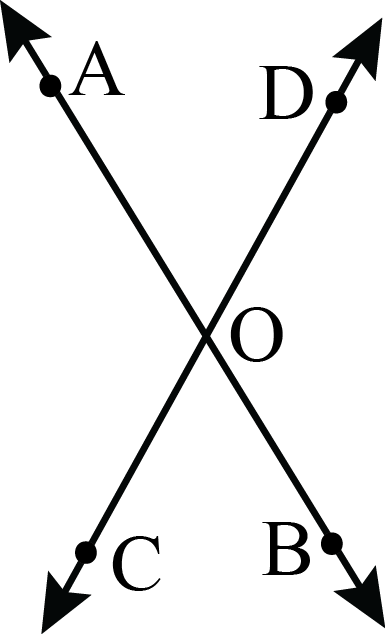
Prove: Two distinct lines cannot have more than one point in common.
Answer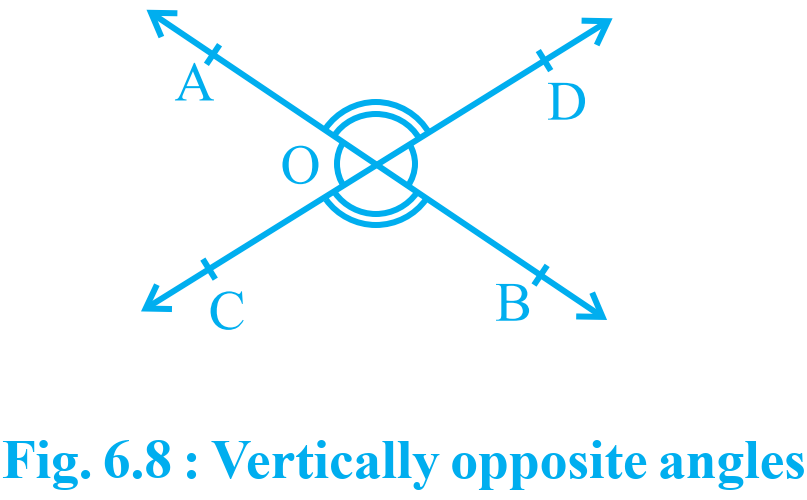
Proof : In the statement above, it is given that 'two lines intersect each other'. So, let $\mathrm{AB}$ and $\mathrm{CD}$ be two lines intersecting at $\mathrm{O}$ as shown in Fig. 6.8. They lead to two pairs of vertically opposite angles, namely,
(i) $\angle \mathrm{AOC}$ and $\angle \mathrm{BOD}$ (ii) $\angle \mathrm{AOD}$ and $\angle \mathrm{BOC}$.
We need to prove that $\angle \mathrm{AOC}=\angle \mathrm{BOD}$ and $\angle \mathrm{AOD}=\angle \mathrm{BOC}$.
Now, ray $\mathrm{OA}$ stands on line $\mathrm{CD}$.
Therefore, $\angle \mathrm{AOC}+\angle \mathrm{AOD}=180^{\circ}$ $\quad$ (Linear pair axiom) (1)
Can we write $\angle \mathrm{AOD}+\angle \mathrm{BOD}=180^{\circ}$ ? Yes! (Why?) $\quad$ (2)
From (1) and (2), we can write
$
\angle \mathrm{AOC}+\angle \mathrm{AOD}=\angle \mathrm{AOD}+\angle \mathrm{BOD}
$
This implies that $\angle \mathrm{AOC}=\angle \mathrm{BOD} \quad$ (Refer Section 5.2, Axiom 3)
Similarly, it can be proved that $\angle \mathrm{AOD}=\angle \mathrm{BOC}$
Now, let us do some examples based on Linear Pair Axiom and Theorem 6.1.
View full question & answer→Proof : In the statement above, it is given that 'two lines intersect each other'. So, let $\mathrm{AB}$ and $\mathrm{CD}$ be two lines intersecting at $\mathrm{O}$ as shown in Fig. 6.8. They lead to two pairs of vertically opposite angles, namely,
(i) $\angle \mathrm{AOC}$ and $\angle \mathrm{BOD}$ (ii) $\angle \mathrm{AOD}$ and $\angle \mathrm{BOC}$.
We need to prove that $\angle \mathrm{AOC}=\angle \mathrm{BOD}$ and $\angle \mathrm{AOD}=\angle \mathrm{BOC}$.
Now, ray $\mathrm{OA}$ stands on line $\mathrm{CD}$.
Therefore, $\angle \mathrm{AOC}+\angle \mathrm{AOD}=180^{\circ}$ $\quad$ (Linear pair axiom) (1)
Can we write $\angle \mathrm{AOD}+\angle \mathrm{BOD}=180^{\circ}$ ? Yes! (Why?) $\quad$ (2)
From (1) and (2), we can write
$
\angle \mathrm{AOC}+\angle \mathrm{AOD}=\angle \mathrm{AOD}+\angle \mathrm{BOD}
$
This implies that $\angle \mathrm{AOC}=\angle \mathrm{BOD} \quad$ (Refer Section 5.2, Axiom 3)
Similarly, it can be proved that $\angle \mathrm{AOD}=\angle \mathrm{BOC}$
Now, let us do some examples based on Linear Pair Axiom and Theorem 6.1.