Questions · Page 1 of 2

Assertion (A) & Reason (B) MCQ

🎯

Test yourself on this topic

50 questions · timed · auto-graded

Question 11 Mark
Directions: In the following questions, the Assertions (A) and Reason(s) (R) have been put forward. Read both the statements carefully and choose the correct alternative from the following:
Assertion: A triangle can have tow obtuse angles.
Reason: Sum of the three angles in a triangle is always 180°.
  1. Both assertion and reason are true and reason is the correct explanation of assertion.
  2. Both assertion and reason are true but reason is not the correct explanation of assertion.
  3. Assertion is true but reason is false.
  4. Assertion is false but reason is true.
Answer
  1. Assertion is false but reason is true.
View full question & answer
Question 21 Mark
Directions: In the following questions, the Assertions (A) and Reason(s) (R) have been put forward. Read both the statements carefully and choose the correct alternative from the following:
Assertion: The angles of a triangle are in the ratio 2 : 3 : 4. The largest angle of the triangle is 80°.
Reason: The sum of all the interior angles of a triangle is 180°.
  1. Both Assertion and Reason are correct and Reason is the correct explanation for Assertion.
  2. Both Assertion and Reason are correct and Reason is not the correct explanation for Assertion.
  3. Assertion is true but the reason is false.
  4. Both assertion and reason are false.
Answer
  1. Both Assertion and Reason are correct and Reason is the correct explanation for Assertion.
View full question & answer
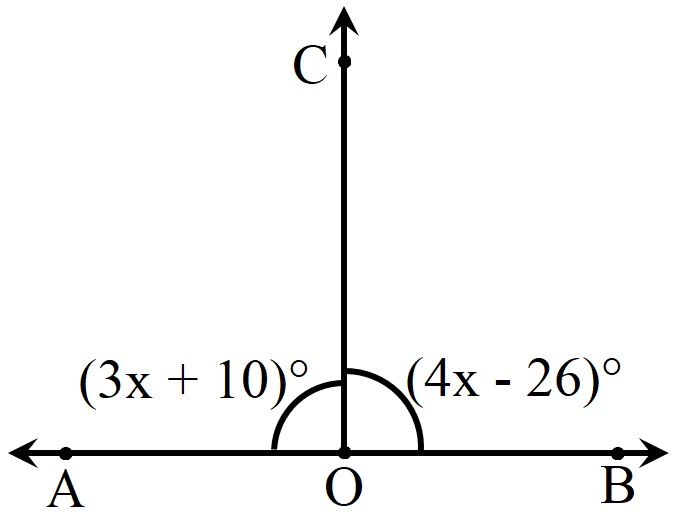
Question 31 Mark
Answer
  1. Both Assertion and Reason are correct and Reason is the correct explanation for Assertion.


  2.  
View full question & answer
Question 41 Mark
Directions: In the following questions, the Assertions (A) and Reason(s) (R) have been put forward. Read both the statements carefully and choose the correct alternative from the following:
Assertion: If the inclination between the arms is less than a right angle, it is called an acute angle.
Reason: 134° is type of acute angle.
  1. Both Assertion and Reason are correct and Reason is the correct explanation for Assertion.
  2. Both Assertion and Reason are correct and Reason is not the correct explanation for Assertion.
  3. Assertion is true but the reason is false.
  4. Both assertion and reason are false.
Answer
  1. Assertion is true but the reason is false.
View full question & answer
Question 51 Mark
Directions: In the following questions, the Assertions (A) and Reason(s) (R) have been put forward. Read both the statements carefully and choose the correct alternative from the following:
Assertion: 183° is a type of reflex angle.
Reason: A reflex angle is smaller than straight angle.
  1. Both Assertion and Reason are correct and Reason is the correct explanation for Assertion.
  2. Both Assertion and Reason are correct and Reason is not the correct explanation for Assertion.
  3. Assertion is true but the reason is false.
  4. Both assertion and reason are false.
Answer
  1. Assertion is true but the reason is false.
View full question & answer
Question 61 Mark
Directions: In the following questions, the Assertions (A) and Reason(s) (R) have been put forward. Read both the statements carefully and choose the correct alternative from the following:
Assertion: Straigth angle > right angle > reflex angle.
Reason: Right angle > obtuse angle > acute angle.
  1. Both Assertion and Reason are correct and Reason is the correct explanation for Assertion.
  2. Both Assertion and Reason are correct and Reason is not the correct explanation for Assertion.
  3. Assertion is true but the reason is false.
  4. Both assertion and reason are false.
Answer
  1. Assertion is true but the reason is false.
View full question & answer
Question 71 Mark
Directions: In the following questions, the Assertions (A) and Reason(s) (R) have been put forward. Read both the statements carefully and choose the correct alternative from the following:
Assertion: If one angle of a triangle is equal to the sum of the other two angles, then the triangle is right angle triangle.
Reason: In $\triangle\text{ABC},$ $∠\text{A}=∠\text{B}+∠\text{C}$ sum of angles $= 180\text{ A}+\angle\text{B}+\angle\text{C}=180 \angle\text{A}+\angle\text{A}=180 \angle\text{A}=90^\circ$ Thus, $\triangle\text{ABC},$ is a right angled triangle.
  1. Both Assertion and Reason are correct and Reason is the correct explanation for Assertion.
  2. Both Assertion and Reason are correct and Reason is not the correct explanation for Assertion.
  3. Assertion is true but the reason is false.
  4. Both assertion and reason are false.
Answer
  1. Both Assertion and Reason are correct and Reason is the correct explanation for Assertion.
View full question & answer
Question 81 Mark
Directions: In the following questions, the Assertions (A) and Reason(s) (R) have been put forward. Read both the statements carefully and choose the correct alternative from the following:
Assertion: If two interior angles on the same side of a transversal intersecting two parallel lines are in the ratio 5 : 4, then the greater of the two angles is 100°
Reason: If a transversal intersects two parallel lines, then the sum of the interior angles on the same side of the transversal is 180°
  1. Both Assertion and Reason are correct and Reason is the correct explanation for Assertion.
  2. Both Assertion and Reason are correct and Reason is not the correct explanation for Assertion.
  3. Assertion is true but the reason is false.
  4. Both assertion and reason are false.
Answer
  1. Both Assertion and Reason are correct and Reason is the correct explanation for Assertion.


  2.  
View full question & answer
Question 91 Mark
Directions: In the following questions, the Assertions (A) and Reason(s) (R) have been put forward. Read both the statements carefully and choose the correct alternative from the following:
Assertion: An exterior angle of triangle is equal to sum of two interior opposite angle.
Reason: If two angles are complementary of each other then each angle is acute angle
  1. Both Assertion and Reason are correct and Reason is the correct explanation for Assertion.
  2. Both Assertion and Reason are correct and Reason is not the correct explanation for Assertion.
  3. Assertion is true but the reason is false.
  4. Both assertion and reason are false.
Answer
  1. Both Assertion and Reason are correct and Reason is not the correct explanation for Assertion.
View full question & answer
Question 101 Mark
Directions: In the following questions, the Assertions (A) and Reason(s) (R) have been put forward. Read both the statements carefully and choose the correct alternative from the following:
Assertion: If two internal opposite angles of a triangle are equal and external angle is given to be 110°, then each of the equal internal angle is 55°.
Reason: A triangle with one of its angle 90°, is called a right triangle.
  1. Both Assertion and Reason are correct and Reason is the correct explanation for Assertion.
  2. Both Assertion and Reason are correct and Reason is not the correct explanation for Assertion.
  3. Assertion is true but the reason is false.
  4. Both assertion and reason are false.
Answer
  1. Both Assertion and Reason are correct and Reason is not the correct explanation for Assertion.

View full question & answer
Question 111 Mark
Directions: In the following questions, the Assertions (A) and Reason(s) (R) have been put forward. Read both the statements carefully and choose the correct alternative from the following:
Assertion: Complementary angle of $72\big(\frac{1}{2}\big)^\circ$ is $17\big(\frac{1}{2}\big)$.
Reason: Sum of two complementary angle is 90°.
  1. Both Assertion and Reason are correct and Reason is the correct explanation for Assertion.
  2. Both Assertion and Reason are correct and Reason is not the correct explanation for Assertion.
  3. Assertion is true but the reason is false.
  4. Both assertion and reason are false.
Answer
  1. Both Assertion and Reason are correct and Reason is not the correct explanation for Assertion.
View full question & answer
Question 121 Mark
Directions: In the following questions, the Assertions (A) and Reason(s) (R) have been put forward. Read both the statements carefully and choose the correct alternative from the following:
Assertion: If the supplement of an angle is three times its complement, then angel is 45°.
Reason: Two complementary angles with a different vertex and a different arm are called adjacent complementary angles.
  1. Both Assertion and Reason are correct and Reason is the correct explanation for Assertion.
  2. Both Assertion and Reason are correct and Reason is not the correct explanation for Assertion.
  3. Assertion is true but the reason is false.
  4. Both assertion and reason are false.
Answer
  1. Assertion is true but the reason is false.
View full question & answer
Question 131 Mark
Directions: In the following questions, the Assertions (A) and Reason(s) (R) have been put forward. Read both the statements carefully and choose the correct alternative from the following:
Assertion: Sum of two adjacent angle is 70°.
Reason: Two angles which have a different vertex, a different arm and same interiors are said to be adjacent angles.
  1. Both Assertion and Reason are correct and Reason is the correct explanation for Assertion.
  2. Both Assertion and Reason are correct and Reason is not the correct explanation for Assertion.
  3. Assertion is true but the reason is false.
  4. Both assertion and reason are false.
Answer
  1. Both assertion and reason are false.
View full question & answer
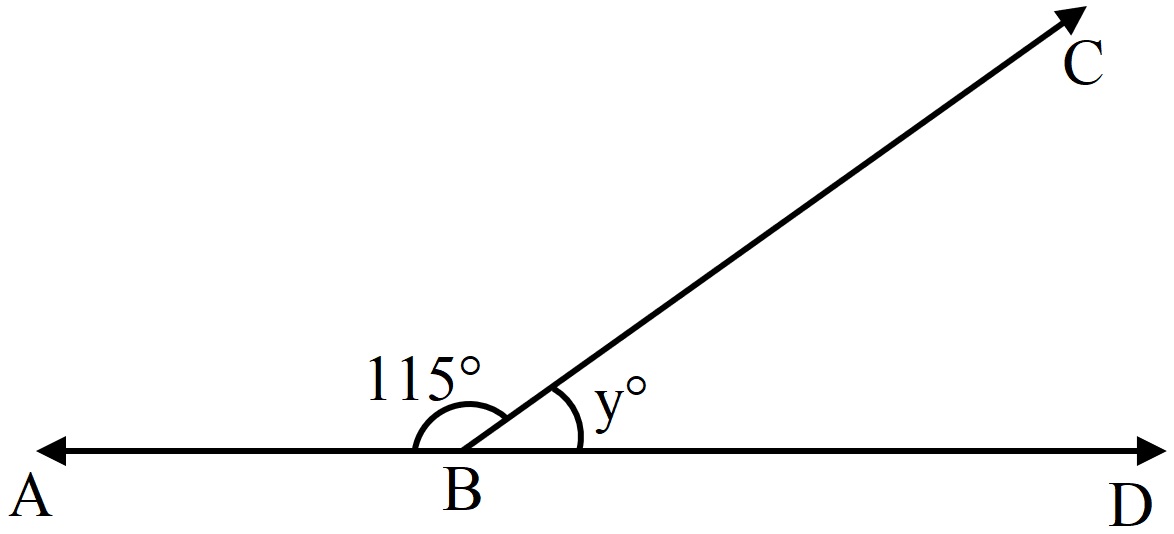
Question 141 Mark
Answer
  1. Both Assertion and Reason are correct and Reason is the correct explanation for Assertion.
View full question & answer
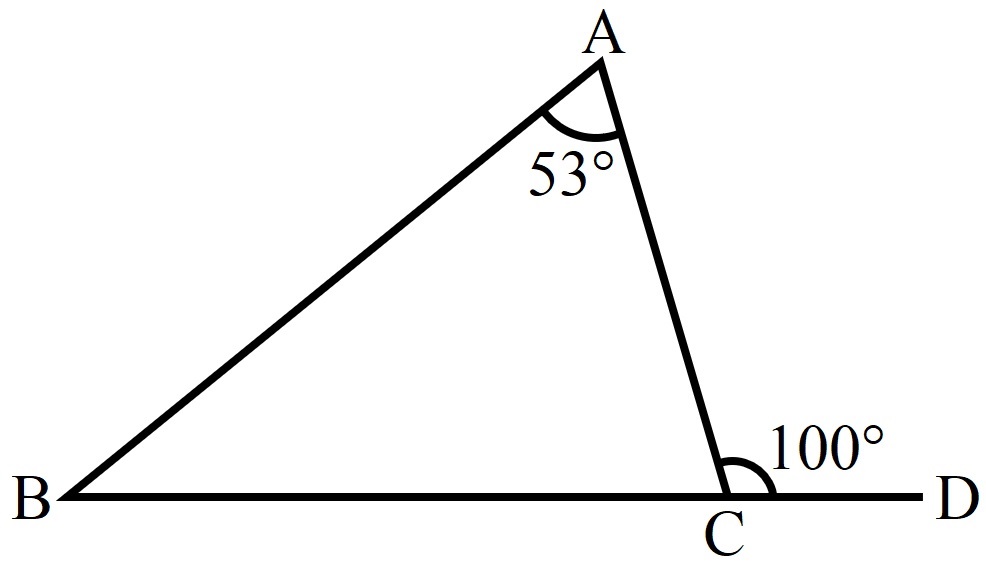
Question 151 Mark
Directions: In the following questions, the Assertions (A) and Reason(s) (R) have been put forward. Read both the statements carefully and choose the correct alternative from the following:
Assertion: If an angle formed by two intersecting lines is 60°, then its vertically opposite angle is 60°.
Reason: If two lines intersect each, then tha vertically opposite angle is 60°.
  1. Both assertion and reason are true and reason is the correct explanation of assertion.
  2. Both assertion and reason are true but reason is not the correct explanation of assertion.
  3. Assertion is true but reason is false.
  4. Assertion is false but reason is true.
Answer
  1. Both assertion and reason are true and reason is the correct explanation of assertion.
View full question & answer
Question 161 Mark
Directions: In the following questions, the Assertions (A) and Reason(s) (R) have been put forward. Read both the statements carefully and choose the correct alternative from the following:
Assertion: A triangle can have two obtuse angles.
Reason: The sum of all the interior angles of a triangle is 150°.
  1. Both Assertion and Reason are correct and Reason is the correct explanation for Assertion.
  2. Both Assertion and Reason are correct and Reason is not the correct explanation for Assertion.
  3. Assertion is true but the reason is false.
  4. Both assertion and reason are false.
Answer
  1. Both assertion and reason are false.
View full question & answer
Question 171 Mark
Directions: In the following questions, the Assertions (A) and Reason(s) (R) have been put forward. Read both the statements carefully and choose the correct alternative from the following:
Assertion: The value of x from the adjoining figure, if $\ell\ \parallel\ \text{m}$ is 15°.
Reason: If two parallel lines are intersected by a transversal, then each pair of corresponding angles so formed is equal.
  1. Both Assertion and Reason are correct and Reason is the correct explanation for Assertion.
  2. Both Assertion and Reason are correct and Reason is not the correct explanation for Assertion.
  3. Assertion is true but the reason is false.
  4. Both assertion and reason are false.
Answer
  1. Both Assertion and Reason are correct and Reason is the correct explanation for Assertion.
View full question & answer
Question 181 Mark
Answer
  1. Both Assertion and Reason are correct and Reason is the correct explanation for Assertion.
View full question & answer
Question 191 Mark
Directions: In the following questions, the Assertions (A) and Reason(s) (R) have been put forward. Read both the statements carefully and choose the correct alternative from the following:
Assertion: A segment has leangth.
Reason: Three lines are concurrent if they have common points.
  1. Both Assertion and Reason are correct and Reason is the correct explanation for Assertion.
  2. Both Assertion and Reason are correct and Reason is not the correct explanation for Assertion.
  3. Assertion is true but the reason is false.
  4. Both assertion and reason are false.
Answer
  1. Both Assertion and Reason are correct and Reason is not the correct explanation for Assertion.
View full question & answer
Question 201 Mark
Directions: In the following questions, the Assertions (A) and Reason(s) (R) have been put forward. Read both the statements carefully and choose the correct alternative from the following:
Assertion: The adjacent angles on a straight line are (5x - 6)° and 7(x + 6)° then the value of x is 12.
Reason: Sum of adjacent angle on straight line is 180°.
  1. Both Assertion and Reason are correct and Reason is the correct explanation for Assertion.
  2. Both Assertion and Reason are correct and Reason is not the correct explanation for Assertion.
  3. Assertion is true but the reason is false.
  4. Both assertion and reason are false.
Answer
  1. Both Assertion and Reason are correct and Reason is the correct explanation for Assertion.
View full question & answer
Question 211 Mark
Directions: In the following questions, the Assertions (A) and Reason(s) (R) have been put forward. Read both the statements carefully and choose the correct alternative from the following:
Assertion: Two adjacent angle always formed a linear lair.
Reason: All linear pairs of angles are adjacent angles and all adjacent angles are linear pairs.
  1. Both Assertion and Reason are correct and Reason is the correct explanation for Assertion.
  2. Both Assertion and Reason are correct and Reason is not the correct explanation for Assertion.
  3. Assertion is true but the reason is false.
  4. Both assertion and reason are false.
Answer
  1. Both assertion and reason are false.
View full question & answer
Question 221 Mark
Directions: In the following questions, the Assertions (A) and Reason(s) (R) have been put forward. Read both the statements carefully and choose the correct alternative from the following:
Assertion: Two angles are called adjacent if they have common vertex.
Reason: The adjacent angle have common interior point.
  1. Both Assertion and Reason are correct and Reason is the correct explanation for Assertion.
  2. Both Assertion and Reason are correct and Reason is not the correct explanation for Assertion.
  3. Assertion is true but the reason is false.
  4. Both assertion and reason are false.
Answer
  1. Assertion is true but the reason is false.
View full question & answer
Question 231 Mark
Directions: In the following questions, the Assertions (A) and Reason(s) (R) have been put forward. Read both the statements carefully and choose the correct alternative from the following:
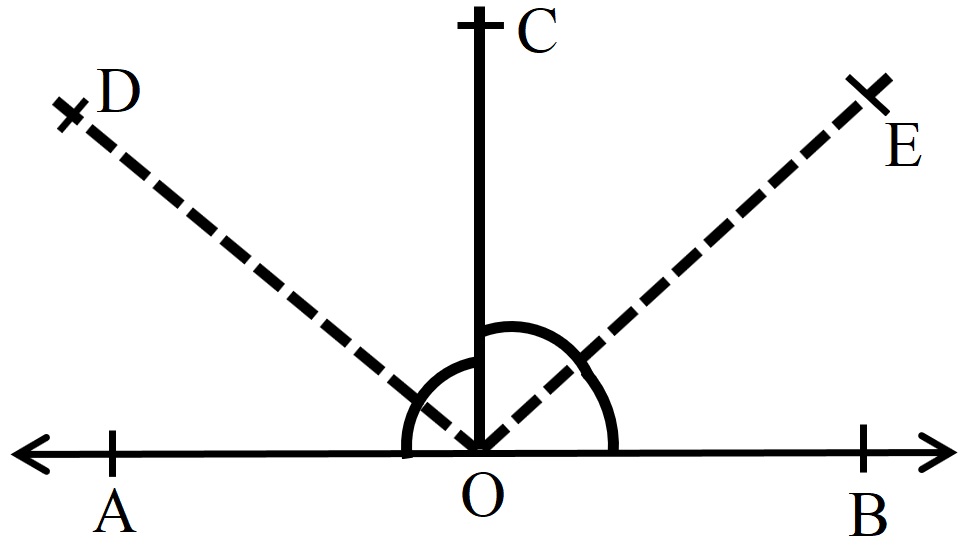
Assertion: If angles ‘a ’ and ‘b’ form a linear pair of angles and a = 40°, then b = 150°.
Reason: Sum of linear pair of angles is always 180°.
  1. Both assertion and reason are true and reason is the correct explanation of assertion.
  2. Both assertion and reason are true but reason is not the correct explanation of assertion.
  3. Assertion is true but reason is false.
  4. Assertion is false but reason is true.
Answer
  1. Assertion is false but reason is true.
View full question & answer
Question 241 Mark
Directions: In the following questions, the Assertions (A) and Reason(s) (R) have been put forward. Read both the statements carefully and choose the correct alternative from the following:
Assertion: Two angles whose sum is equal to 90 degrees are called complementary angles.
Reason: 58° and 32° are the complements of each other.
  1. Both Assertion and Reason are correct and Reason is the correct explanation for Assertion.
  2. Both Assertion and Reason are correct and Reason is not the correct explanation for Assertion.
  3. Assertion is true but the reason is false.
  4. Both assertion and reason are false.
Answer
  1. Both Assertion and Reason are correct and Reason is the correct explanation for Assertion.
View full question & answer
Question 251 Mark
Directions: In the following questions, the Assertions (A) and Reason(s) (R) have been put forward. Read both the statements carefully and choose the correct alternative from the following:
Assertion: 80° is an acute angle type.
Reason: The angle which is less than 90° is known as acute angle.
  1. Both Assertion and Reason are correct and Reason is the correct explanation for Assertion.
  2. Both Assertion and Reason are correct and Reason is not the correct explanation for Assertion.
  3. Assertion is true but the reason is false.
  4. Both assertion and reason are false.
Answer
  1. Both Assertion and Reason are correct and Reason is the correct explanation for Assertion.
View full question & answer
Question 261 Mark
Directions: In the following questions, the Assertions (A) and Reason(s) (R) have been put forward. Read both the statements carefully and choose the correct alternative from the following:
Assertion: The measurment of angle A is 160° and it’s type is obtuse angle.
Reason: The angle which is greater than 90°and smaller than 180° is known as obtuse angle.
  1. Both Assertion and Reason are correct and Reason is the correct explanation for Assertion.
  2. Both Assertion and Reason are correct and Reason is not the correct explanation for Assertion.
  3. Assertion is true but the reason is false.
  4. Both assertion and reason are false.
Answer
  1. Both Assertion and Reason are correct and Reason is the correct explanation for Assertion.
View full question & answer
Question 271 Mark
Directions: In the following questions, the Assertions (A) and Reason(s) (R) have been put forward. Read both the statements carefully and choose the correct alternative from the following:
Assertion: Two angles which are formed, opposite to each other, when two lines intersect at a point or vertex, are called vertically opposite angles.
Reason: A pair of vertically opposite angles are always equal to each other.
  1. Both Assertion and Reason are correct and Reason is the correct explanation for Assertion.
  2. Both Assertion and Reason are correct and Reason is not the correct explanation for Assertion.
  3. Assertion is true but the reason is false.
  4. Both assertion and reason are false.
Answer
  1. Both Assertion and Reason are correct and Reason is not the correct explanation for Assertion.
View full question & answer
Question 281 Mark
Directions: In the following questions, the Assertions (A) and Reason(s) (R) have been put forward. Read both the statements carefully and choose the correct alternative from the following:
Assertion: 70° is an acute angle type.
Reason: The time is 12 : 30 o’clock, the angle formed between the hour hand and the minute hand is an acute angle.
  1. Both Assertion and Reason are correct and Reason is the correct explanation for Assertion.
  2. Both Assertion and Reason are correct and Reason is not the correct explanation for Assertion.
  3. Assertion is true but the reason is false.
  4. Both assertion and reason are false.
Answer
  1. Assertion is true but the reason is false.
View full question & answer
Question 291 Mark
Directions: In the following questions, the Assertions (A) and Reason(s) (R) have been put forward. Read both the statements carefully and choose the correct alternative from the following:
Assertion: $ \Big(110\big(\frac{1}{2}\big)\Big)^\circ$is a acute angle.
Reason: 55° is less than 90 degrees and greater than 0 degrees, so it is called as acute angle.
  1. Both Assertion and Reason are correct and Reason is the correct explanation for Assertion.
  2. Both Assertion and Reason are correct and Reason is not the correct explanation for Assertion.
  3. Assertion is true but the reason is false.
  4. Both assertion and reason are false.
Answer
  1. Both Assertion and Reason are correct and Reason is the correct explanation for Assertion.
View full question & answer
Question 301 Mark
Directions: In the following questions, the Assertions (A) and Reason(s) (R) have been put forward. Read both the statements carefully and choose the correct alternative from the following:
Assertion: 91° is an example of acute angle.
Reason: A triangle which consists of three acute angles. It means that all the angles are less than 90 degrees is known as acute angle triangle.
  1. Both Assertion and Reason are correct and Reason is the correct explanation for Assertion.
  2. Both Assertion and Reason are correct and Reason is not the correct explanation for Assertion.
  3. Assertion is true but the reason is false.
  4. Both assertion and reason are false.
Answer
  1. Both Assertion and Reason are correct and Reason is not the correct explanation for Assertion.
View full question & answer
Question 311 Mark
Directions: In the following questions, the Assertions (A) and Reason(s) (R) have been put forward. Read both the statements carefully and choose the correct alternative from the following:
Assertion: An exterior angle of a triangle is equal to sum of corresponding two interior opposite angle.
Reason: Three pairs of corresponding angles formed by a transversal of two parallel lines.
  1. Both Assertion and Reason are correct and Reason is the correct explanation for Assertion.
  2. Both Assertion and Reason are correct and Reason is not the correct explanation for Assertion.
  3. Assertion is true but the reason is false.
  4. Both assertion and reason are false.
Answer
  1. Assertion is true but the reason is false.

View full question & answer
Question 321 Mark
Directions: In the following questions, the Assertions (A) and Reason(s) (R) have been put forward. Read both the statements carefully and choose the correct alternative from the following:
Assertion: Sum of the pair of angles 120° and 60° is supplementary.
Reason: Two angles, the sum of whose measures is 180°, are called supplementary angles.
  1. Both Assertion and Reason are correct and Reason is the correct explanation for Assertion.
  2. Both Assertion and Reason are correct and Reason is not the correct explanation for Assertion.
  3. Assertion is true but the reason is false.
  4. Both assertion and reason are false.
Answer
  1. Both Assertion and Reason are correct and Reason is the correct explanation for Assertion.

View full question & answer
Question 331 Mark
Directions: In the following questions, the Assertions (A) and Reason(s) (R) have been put forward. Read both the statements carefully and choose the correct alternative from the following:
Assertion: $\angle\text{A}$ and $\angle\text{B}$ are supplementary angles.$ \angle\text{A}=\text{x}+10^\circ$ and $\angle\text{B}=\text{x}−10^\circ$ then ∠A and ∠B are 100° and 80°.
Reason: The angles x - 10° and 190°- x are supplementary.
  1. Both Assertion and Reason are correct and Reason is the correct explanation for Assertion.
  2. Both Assertion and Reason are correct and Reason is not the correct explanation for Assertion.
  3. Assertion is true but the reason is false.
  4. Both assertion and reason are false.
Answer
  1. Both Assertion and Reason are correct and Reason is not the correct explanation for Assertion.
View full question & answer
Question 341 Mark
Directions: In the following questions, the Assertions (A) and Reason(s) (R) have been put forward. Read both the statements carefully and choose the correct alternative from the following:
Assertion: The sum of two adjacent angle is 100° and one of them is 35° then other is 65°.
Reason: Adjacent angle are always supplementary.
  1. Both Assertion and Reason are correct and Reason is the correct explanation for Assertion.
  2. Both Assertion and Reason are correct and Reason is not the correct explanation for Assertion.
  3. Assertion is true but the reason is false.
  4. Both assertion and reason are false.
Answer
  1. Assertion is true but the reason is false.
View full question & answer
Question 351 Mark
Directions: In the following questions, the Assertions (A) and Reason(s) (R) have been put forward. Read both the statements carefully and choose the correct alternative from the following:
Assertion: Two adjacent angle are equal. It is not necessary that each of these angle will be right angle.
Reason: Two adjacent angles are equal. it is necessary that each of these angle will be a right angle.
  1. Both Assertion and Reason are correct and Reason is the correct explanation for Assertion.
  2. Both Assertion and Reason are correct and Reason is not the correct explanation for Assertion.
  3. Assertion is true but the reason is false.
  4. Both assertion and reason are false.
Answer
  1. Assertion is true but the reason is false.
View full question & answer
Question 361 Mark
Directions: In the following questions, the Assertions (A) and Reason(s) (R) have been put forward. Read both the statements carefully and choose the correct alternative from the following:
Assertion: A line segment is a part of a line with two end - points.
Reason: A line can be extended from both side
  1. Both Assertion and Reason are correct and Reason is the correct explanation for Assertion.
  2. Both Assertion and Reason are correct and Reason is not the correct explanation for Assertion.
  3. Assertion is true but the reason is false.
  4. Both assertion and reason are false.
Answer
  1. Both Assertion and Reason are correct and Reason is not the correct explanation for Assertion.
View full question & answer
Question 371 Mark
Directions: In the following questions, the Assertions (A) and Reason(s) (R) have been put forward. Read both the statements carefully and choose the correct alternative from the following:
Assertion: If two internal opposite angles of a triangle are equal and external angle is given to be 110°, then each of the equal internal angle is 55°.
Reason: A triangle with one of its angle 90°, is called a right triangle.
  1. Both assertion and reason are true and reason is the correct explanation of assertion.
  2. Both assertion and reason are true but reason is not the correct explanation of assertion.
  3. Assertion is true but reason is false.
  4. Assertion is false but reason is true.
Answer
  1. Both assertion and reason are true but reason is not the correct explanation of assertion.
View full question & answer
Question 381 Mark
Directions: In the following questions, the Assertions (A) and Reason(s) (R) have been put forward. Read both the statements carefully and choose the correct alternative from the following:
Assertion: The supplement of the angle (120 + a - 2b)° is (60 - a + 2b)°.
Reason: If the sum of two angle is 180° then the angle are supplementary.
  1. Both Assertion and Reason are correct and Reason is the correct explanation for Assertion.
  2. Both Assertion and Reason are correct and Reason is not the correct explanation for Assertion.
  3. Assertion is true but the reason is false.
  4. Both assertion and reason are false.
Answer
  1. Both Assertion and Reason are correct and Reason is the correct explanation for Assertion.
View full question & answer
Question 391 Mark
Directions: In the following questions, the Assertions (A) and Reason(s) (R) have been put forward. Read both the statements carefully and choose the correct alternative from the following:
Assertion: Two adjacent angles always form a linear pair.
Reason: In a linear pair of angles two non - common arms are opposite rays.
  1. Both assertion and reason are true and reason is the correct explanation of assertion.
  2. Both assertion and reason are true but reason is not the correct explanation of assertion.
  3. Assertion is true but reason is false.
  4. Assertion is false but reason is true.
Answer
  1. Assertion is false but reason is true.
    Solution:
    Two adjacent angles do not always form a linear pair.
    In a linear pair of angles two non - common arms are opposite rays.
View full question & answer
Question 401 Mark
Directions: In the following questions, the Assertions (A) and Reason(s) (R) have been put forward. Read both the statements carefully and choose the correct alternative from the following:
Assertion: The bisectors of the angles of a linear pair at right angles.
Reason: If the sum of two adjacent angles is 180°, then the non - common arms of the angles are in a straight line.
  1. Both assertion and reason are true and reason is the correct explanation of assertion.
  2. Both assertion and reason are true but reason is not the correct explanation of assertion.
  3. Assertion is true but reason is false.
  4. Assertion is false but reason is true.
View full question & answer
Question 411 Mark
Directions: In the following questions, the Assertions (A) and Reason(s) (R) have been put forward. Read both the statements carefully and choose the correct alternative from the following:
Assertion: If the arms form an angle of 90 degrees between them, it is called a right angle.
Reason: Two angles whose sum is equal to 90 degrees are called supplementary angles.
  1. Both Assertion and Reason are correct and Reason is the correct explanation for Assertion.
  2. Both Assertion and Reason are correct and Reason is not the correct explanation for Assertion.
  3. Assertion is true but the reason is false.
  4. Both assertion and reason are false.
Answer
  1. Assertion is true but the reason is false.
View full question & answer
Question 421 Mark
Directions: In the following questions, the Assertions (A) and Reason(s) (R) have been put forward. Read both the statements carefully and choose the correct alternative from the following:
Assertion: If angles ‘a’ and ‘b’ form a linear pair of angles and a = 40°, then b = 150°.
Reason: Sum of linear pair of angles is always 250°.
  1. Both Assertion and Reason are correct and Reason is the correct explanation for Assertion.
  2. Both Assertion and Reason are correct and Reason is not the correct explanation for Assertion.
  3. Assertion is true but the reason is false.
  4. Both assertion and reason are false.
Answer
  1. Both assertion and reason are false.
View full question & answer
Question 431 Mark
Directions: In the following questions, the Assertions (A) and Reason(s) (R) have been put forward. Read both the statements carefully and choose the correct alternative from the following:
Assertion: The name Straight - angle comes from straight - line.
Reason: The sum of angles that are formed on a straight line is equal to 180°.
  1. Both Assertion and Reason are correct and Reason is the correct explanation for Assertion.
  2. Both Assertion and Reason are correct and Reason is not the correct explanation for Assertion.
  3. Assertion is true but the reason is false.
  4. Both assertion and reason are false.
Answer
  1. Both Assertion and Reason are correct and Reason is not the correct explanation for Assertion.
View full question & answer
Question 441 Mark
Directions: In the following questions, the Assertions (A) and Reason(s) (R) have been put forward. Read both the statements carefully and choose the correct alternative from the following:
Assertion: In the given figure, if $\text{AB}\parallel\text{CD}$ and $\angle\text{F}=30^\circ,$ then $\angle\text{FCD}$ is 120°.
Reason: If two parallel lines are intersected by a transversal, then co - interior angles are equal.
  1. Both assertion and reason are true and reason is the correct explanation of assertion.
  2. Both assertion and reason are true but reason is not the correct explanation of assertion.
  3. Assertion is true but reason is false.
  4. Assertion is false but reason is true.
Answer
  1. Assertion is true but reason is false.
    Solution:
    In $\triangle\text{AFE},$ by angle sum property.
    $\angle\text{F}+\angle\text{A}+\angle\text{AEF}=180^\circ$
    $30^\circ+90^\circ+\angle\text{AEF}=180^\circ$
    $\angle\text{AEF}=180^\circ-120^\circ$
    $\angle\text{AEF}=60^\circ$
    AB and FC intersect at E (vertically opposite angles)
    $\angle\text{BEC}=60^\circ$
    Now, $\text{AB}\parallel\text{CD}$ and is a transversal
    $\angle\text{BEC}+\angle\text{ECD}=180^\circ$ (Co - interior angles)
    $\angle\text{ECD}=180^\circ-60^\circ$
    $\angle\text{ECD}=120^\circ$
View full question & answer
Question 451 Mark
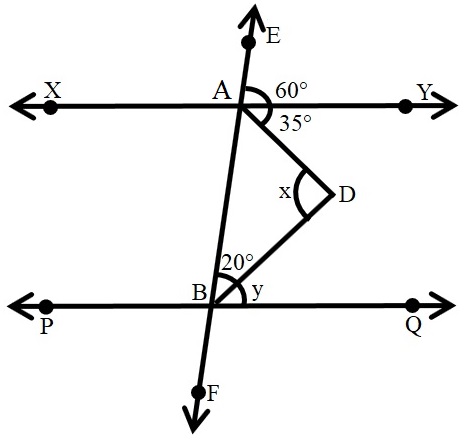
Answer
  1. Assertion is false but reason is true.
    Solution:
    $\text{XY}\parallel\text{PQ}$ and EF is transversal
    $\angle\text{EBQ}=\angle\text{EAY}$ (Corresponding angles)
    20° + y = 60°
    y = 60° - 20°
    y = 40°
    Now, in $\triangle\text{ABD},$
    $\text{x}+20^\circ=\angle\text{EAD}$ (External angle property)
    x + 20° = 60° + 35°
    x = 95° - 20°
    x = 75°
View full question & answer
Question 461 Mark
Directions: In the following questions, the Assertions (A) and Reason(s) (R) have been put forward. Read both the statements carefully and choose the correct alternative from the following:
Assertion: Bisectors of the adjacent angles forming a linear pair form a right angle.
Reason: Angles forming a linear pair can both be acute angles
  1. Both Assertion and Reason are correct and Reason is the correct explanation for Assertion.
  2. Both Assertion and Reason are correct and Reason is not the correct explanation for Assertion.
  3. Assertion is true but the reason is false.
  4. Both assertion and reason are false.
Answer
  1. Assertion is true but the reason is false.

View full question & answer
Question 471 Mark
Directions: In the following questions, the Assertions (A) and Reason(s) (R) have been put forward. Read both the statements carefully and choose the correct alternative from the following:
Assertion: A ray has only one end points.
Reason: A ray is a part of a line, which has a starting point and tends infinitely in both direction.
  1. Both Assertion and Reason are correct and Reason is the correct explanation for Assertion.
  2. Both Assertion and Reason are correct and Reason is not the correct explanation for Assertion.
  3. Assertion is true but the reason is false.
  4. Both assertion and reason are false.
Answer
  1. Assertion is true but the reason is false.
View full question & answer
Question 481 Mark
Directions: In the following questions, the Assertions (A) and Reason(s) (R) have been put forward. Read both the statements carefully and choose the correct alternative from the following:
Assertion: 60° is the complement of 30°.
Reason: The complement angle of 80° is $\frac{\pi}{18}$ radian.
  1. Both Assertion and Reason are correct and Reason is the correct explanation for Assertion.
  2. Both Assertion and Reason are correct and Reason is not the correct explanation for Assertion.
  3. Assertion is true but the reason is false.
  4. Both assertion and reason are false.
Answer
  1. Both Assertion and Reason are correct and Reason is not the correct explanation for Assertion.
View full question & answer
Question 491 Mark
Directions: In the following questions, the Assertions (A) and Reason(s) (R) have been put forward. Read both the statements carefully and choose the correct alternative from the following:
Assertion: Straight angle is an 180°.
Reason: Reflex angle is grater than straight angle and less than complete angle.
  1. Both Assertion and Reason are correct and Reason is the correct explanation for Assertion.
  2. Both Assertion and Reason are correct and Reason is not the correct explanation for Assertion.
  3. Assertion is true but the reason is false.
  4. Both assertion and reason are false.
Answer
  1. Both Assertion and Reason are correct and Reason is not the correct explanation for Assertion.
View full question & answer
Question 501 Mark
Directions: In the following questions, the Assertions (A) and Reason(s) (R) have been put forward. Read both the statements carefully and choose the correct alternative from the following:
Assertion: If two lines are parallel to each other, they don’t intersect each other. They meet each other at infinity.
Reason: Two parallel lines intersect at One point.
  1. Both Assertion and Reason are correct and Reason is the correct explanation for Assertion.
  2. Both Assertion and Reason are correct and Reason is not the correct explanation for Assertion.
  3. Assertion is true but the reason is false.
  4. Both assertion and reason are false.
Answer
  1. Assertion is true but the reason is false.
View full question & answer