MCQ 511 Mark
Let $\text{A}=\{\text{x}\in\text{R}:\text{x}\geq1\}.$ The inverse of the function $f : A \rightarrow A$ given by $\text{f(x)}=2^{\text{x}(\text{x}-1)},$ is:
- A
$\big(\frac{1}{2}\big)^{\text{x}(\text{x}-1)}$
- ✓
$\frac{1}{2}\big\{1+\sqrt{1+4\log_2\text{x}}\big\}$
- C
$\frac{1}{2}\big\{1-\sqrt{1+4\log_2\text{x}}\big\}$
- D
AnswerCorrect option: B. $\frac{1}{2}\big\{1+\sqrt{1+4\log_2\text{x}}\big\}$
Given function is $\text{A}=\{\text{x}\in\text{R}:\text{x}\geq1\}.$
The inverse of the function $f : A \rightarrow A$ given by $\text{f(x)}=2^{\text{x}(\text{x}-1)}$
$\text{f(x)}=\text{y}$
$2^{\text{x}(\text{x}-1)}=\text{y}$
$\text{x}(\text{x}-1)=\log_2\text{y}$
$\text{x}^2+\text{x}=\log_2\text{y}$
$\text{x}^2+\text{x}+\frac{1}{4}=\log_2\text{y}+\frac{1}{4}$
$\Big(\text{x}-\frac{1}{2}\Big)^2=\frac{4\log_2\text{y}+1}{4}$
$\text{x}-\frac{1}{2}=\pm\sqrt{\frac{4\log_2\text{y}+1}{4}}$
$\text{x}=\frac{1}{2}\pm\sqrt{\frac{4\log_2\text{y}+1}{4}}$
$\text{x}=\frac{1}{2}+\sqrt{\frac{4\log_2\text{y}+1}{4}}$
$\text{f}^{-1}(\text{x})=\frac{1+\sqrt{4\log_2\text{y}+1}}{2}$
View full question & answer→MCQ 521 Mark
Total number of equivalence relations defined in the set $S = \{a, b, c\}$ is:
View full question & answer→MCQ 531 Mark
If $f : A \rightarrow B$ is surjective then:
- A
no two elements of $A$ have the same image in $B$
- B
every element of $A$ has an image in $B$
- ✓
every element of $B$ has at least one pre$-$image in $A$
- D
$A$ and $B$ are finite non empty sets
AnswerCorrect option: C. every element of $B$ has at least one pre$-$image in $A$
Surjective means onto function.
$co$ domain $=$ Range
So every element of $B$ has at least one pre$-$image in $A.$
View full question & answer→MCQ 541 Mark
Choose the correct answer from the given four options. Which of the following functions from $Z$ into $Z$ are bijections?
- A
$f(x)=x^3$
- ✓
$f(x)=x+2$
- C
$f(x)=2 x+1$
- D
$f(x)=x^2+1$
AnswerCorrect option: B. $f(x)=x+2$
Consider, the second option i.e., $f(x) = x + 2$
Now, $f \left( x _1\right)= f \left( x _2\right)$
$\Rightarrow x _1+2= x _2+2$
$\Rightarrow x _1= x _2$
Hence, $f(x) = x + 2$ is one$-$one function.
Now, let us suppose, $y = x + 2$
$\text{x}=\text{y}-2\in\text{Z},\ \forall\ \text{y}\in\text{x}$
Hence$, f(x)$ is one$-$one and onto.
View full question & answer→MCQ 551 Mark
If $R$ is a relation on the set $A = \{1, 2, 3\}$ given by $R = \{(1, 1), (2, 2), (3, 3)\},$ then $R$ is:
Answer$R = a, b : a = b$ and $\text{a, b}\in\text{A}$
Reflexivity: Let $\text{a}\in\text{A}$
Then$, a = a$
$\Rightarrow\ \text{a, a}\in\text{R}$ for all $\text{a}\in\text{A}$
So$, R$ is reflexive on $A.$
Symmetry: Let $\text{a, b}\in\text{A}$ such that $\text{a, b}\in\text{R.}$
Then, $\text{a, b}\in\text{R}$
$\Rightarrow a = b \Rightarrow b = a \Rightarrow b, \text{a}\in\text{R}$ for all $\text{a}\in\text{A}$
So$, R$ is symmetric on $A.$
View full question & answer→MCQ 561 Mark
Let us define a relation $R$ in $R$ as $\text{aRb}$ if $a ≥ b.$ Then $R$ is:
- A
- ✓
Reflexive, transitive but not symmetric.
- C
Symmetric, transitive but not reflexive.
- D
Neither transitive nor reflexive but symmetric.
AnswerCorrect option: B. Reflexive, transitive but not symmetric.
View full question & answer→MCQ 571 Mark
Range of $\text{f(x)}=\sqrt{(1-\cos\text{x})\sqrt{(1-\cos\text{x})\sqrt{(1-\cos\text{x}).....\infty}}}$
- A
$[0, 1]$
- B
$(0, 1)$
- ✓
$[0, 2]$
- D
$(0, 2)$
AnswerCorrect option: C. $[0, 2]$
View full question & answer→MCQ 581 Mark
If $f: R \rightarrow R$ be given by $f(\text{x})=(3-\text{x}^3)^{\frac{1}{3}},$ then $\text{fof(x)}$ is:
- A
$\text{x}^{\frac{1}{3}}$
- B
$x^3$
- ✓
$x$
- D
$(3 - x^3)$.
Answer$f: R \rightarrow R$ and $f(\text{x})=(3-\text{x}^3)^{\frac{1}{3}}$$\Rightarrow\ \ f[f(\text{x})]=\Big[3-[f(\text{x})^3\Big]^{\frac{1}{3}}=\left[3-\Big\{(3-\text{x}^3)^{\frac{1}{3}}\Big\}^3\right]^{\frac{1}{3}}$
$=[3-(3-\text{x}^3)]^{\frac{1}{3}}=(3-3+\text{x}^3)^{\frac{1}{3}}=\text{x}$
Therefore, option $(C)$ is correct.
View full question & answer→MCQ 591 Mark
Let $f : [0, \infty) \rightarrow [0, 2]$ be defined by $\text{f(x)}=\frac{2\text{x}}{1+\text{x}},$ then f is:
AnswerCorrect option: A. One$-$one but not onto.
View full question & answer→MCQ 601 Mark
Let $A = \{1, 2, 3, …. n\}$ and $B = \{a, b\}$. Then the number of surjections from $A$ into $B$ is:
- A
$^\text{n}\text{P}_2$
- ✓
$2^n-2$
- C
$2^n-1$
- D
AnswerCorrect option: B. $2^n-2$
View full question & answer→MCQ 611 Mark
If $X$ is brother of the son of $Y\ 's$ son. How is $X$ related to $Y?$
AnswerSon of $Y\ 's$ Son$-$ Grandson, Brother of $Y\ 's$ Grandson$- Y\ 's$ Grandson
Option $D$ is correct.
View full question & answer→MCQ 621 Mark
Which of the following functions form $Z$ to itself are bijections?
- A
$f(x)=x^3$
- ✓
$f(x)=x+2$
- C
$f(x)=2 x+1$
- D
$f(x)=x^2+x$
AnswerCorrect option: B. $f(x)=x+2$
- $f$ is not because for $\text{y}=3\in\text{Co-}$domain $(Z),$ there is no value of $\text{x}\in$Domain $(Z)$
$\text{x}^3=3$
$\Rightarrow\ \text{x}=\sqrt[3]{3}\notin\text{Z}$
$\Rightarrow f$ is not onto.
So$, f$ is not a bijection.
- Injectivity: Let $x$ and $y$ be two elements of the domain $(Z),$ such that
$x + 2 = y + 2$
$\Rightarrow x = y$
So, f is one$-$one.
Surjectivity: Let $y$ be an element in the $co-$domain $(Z),$ such that
$y = f(x)$
$\Rightarrow y = x + 2$
$\Rightarrow\ \text{x}=\text{y}-2\in\text{Z} ($Domain$)$
$\Rightarrow f$ is onto.
So$, f$ is a bijection.
- $f(x) = 2x + 1$ is not onto because if we take $4\in\text{Z} (co$ domain$),$ then $4 = f(x)$
$\Rightarrow4 = 2\text{x} + 1$
$\Rightarrow 2\text{x} = 3$
$\Rightarrow\ \text{x}=\frac{3}{2}\notin\text{Z}$
So$, f$ is not a bijection.
- $f(0) = 0^2 + 0 = 0$
$\Rightarrow $ and $f(-1) = (-1)^2 + (-1) = 1 - 1 = 0$
$\Rightarrow 0$ and $-1$ have the same image.
$\Rightarrow f$ is not one$-$one.
So$, f$ is not a bijection. View full question & answer→MCQ 631 Mark
If the function $f: R \rightarrow R$ be such that $f(x) = x - [x],$ where $[x]$ denotes the greatest integer less than or equal to $x$, then $f^{-2}(x)$ is:
AnswerGiven function is $f(x) = x - [x]$
$[x]$ is a greatest integer function.
Hence, we will have same values of the function for the different values of $x.$
As we are considering integer only not fraction part.
Hence, it is not defined.
View full question & answer→MCQ 641 Mark
If the set $A$ contains $5$ elements and the set $B$ contains $6$ elements, then the number of one$-$one and onto mappings from $A$ to $B$ is:
AnswerAs, the number of bijection from $A$ into $B$ can only be possible when provided $\frac{7}{(\text{A})}>\frac{7}{(\text{B})}$
But here $n(A) < n(B)$
So, the number of bijection.
i.e. one$-$one and onto mapping from $A$ to $B.$
View full question & answer→MCQ 651 Mark
Let $g(x) = 1 + x - [x]$ and $\text{f(x)}=\begin{cases}-1,&\text{x}<0\\0,&\text{x}=0\\1,&\text{x}>0\end{cases}$ where $[x]$ denotes the greatest integer less than or equal to $x.$ Then for all $x, f(g(x))$ is equal to:
AnswerWhen$, -1 < x < 0$
Then$, g(x) = 1 + x - [x]$
$= 1 + x - (-1) = 2 + x$
$\therefore$ $f(g(x)) = 1$
When$, x = 0$
Then$, g(x) = 1 + x - [x]$
$= 1 + x - 0 = 1 + x$
$\therefore f(g(x)) = 1$
When$, x > 1$
Then$, g(x) = 1 + x - [x]$
$= 1 + x - 1 = x$
$\therefore f(g(x)) = 1$
Therefore, for each interval $f(g(x)) = 1$
View full question & answer→MCQ 661 Mark
If $G$ is the set of all matrices of the form $\begin{bmatrix}\text{x}&\text{x}\\\text{x}&\text{x}\end{bmatrix}$, where $\text{x}\in\text{R}-\{0\}$, then the identity element with respect to the multiplication of matrices as binary operation, is:
- A
$\begin{bmatrix}1&1\\1&1\end{bmatrix}$
- B
$\begin{bmatrix}-\frac{1}2&-\frac{1}2\\-\frac{1}2&-\frac{1}2\end{bmatrix}$
- ✓
$\begin{bmatrix}\frac{1}2&\frac{1}2\\\frac{1}2&\frac{1}2\end{bmatrix}$
- D
$\begin{bmatrix}-1&-1\\-1&-1\end{bmatrix}$
AnswerCorrect option: C. $\begin{bmatrix}\frac{1}2&\frac{1}2\\\frac{1}2&\frac{1}2\end{bmatrix}$
Let $\begin{bmatrix}\text{x}&\text{x}\\\text{x}&\text{x}\end{bmatrix}\in\text{G}$ and $\begin{bmatrix}\text{e}&\text{e}\\\text{e}&\text{e}\end{bmatrix}\in\text{G}$ such that
$\begin{bmatrix}\text{x}&\text{x}\\\text{x}&\text{x}\end{bmatrix}\begin{bmatrix}\text{e}&\text{e}\\\text{e}&\text{e}\end{bmatrix}=\begin{bmatrix}\text{x}&\text{x}\\\text{x}&\text{x}\end{bmatrix}$
$\begin{bmatrix}\text{x}&\text{x}\\\text{x}&\text{x}\end{bmatrix}\begin{bmatrix}\text{e}&\text{e}\\\text{e}&\text{e}\end{bmatrix}=\begin{bmatrix}\text{x}&\text{x}\\\text{x}&\text{x}\end{bmatrix}$
$\begin{bmatrix}2\text{ex}&2\text{ex}\\2\text{ex}&2\text{ex}\end{bmatrix}=\begin{bmatrix}\text{x}&\text{x}\\\text{x}&\text{x}\end{bmatrix}$
$2\text{ex}=\text{x}$
$\text{e}=\frac{1}2\in\text{R}-\{0\}$
Thus, $\begin{bmatrix}\frac{1}2&\frac{1}2\\\frac{1}2&\frac{1}2\end{bmatrix}\in\text{G}$, is the identity element in $G.$
View full question & answer→MCQ 671 Mark
If $f: R \rightarrow(-1,1)$ is defined by $f(x)=\frac{-x|x|}{1+x^2}$, then $f^{-1}(x)$ equals,
- A
$\sqrt{\frac{|\text{x}|}{1-|\text{x}|}}$
- ✓
$-\text{Sgn (x)}\sqrt{\frac{|\text{x}|}{1-|\text{x}|}}$
- C
$-\sqrt{\frac{\text{x}}{1-\text{x}}}$
- D
AnswerCorrect option: B. $-\text{Sgn (x)}\sqrt{\frac{|\text{x}|}{1-|\text{x}|}}$
Given function is $f : R \rightarrow (-1, 1)$ is defined by $\text{f(x)}=\frac{-\text{x}|\text{x}|}{1+\text{x}^2}$
Here, for mod function we will have to consider three cases as,
$x < 0, x=0, x > 0$
$x < 0$
$ \Rightarrow|x|=-x$
$\text{f(|x|)}=\frac{-\text{x}(-\text{x})}{1+\text{x}^2}$
$\text{y}=\frac{\text{x}^2}{1+\text{x}^2}$
$\text{y}(1+\text{x}^2)=\text{x}^2$
$\text{y}+\text{yx}^2=\text{x}^2$
$\text{y}=\text{x}^2-\text{yx}^2$
$\text{y}=(1-\text{y})\text{x}^2$
$\text{x}^2=\frac{\text{y}}{1-\text{y}}$
$\text{x}=-\sqrt{\frac{\text{y}}{1-\text{y}}}$
$\Rightarrow\ \text{x}=-\sqrt{\frac{|\text{y}|}{1-|\text{y}|}}\ \text{x} < 0$
Also you can check for the cases $x = 0$ and $x > 0$ that $\text{x}=-\sqrt{\frac{|\text{y}|}{1-|\text{y}|}}$
$-\text{Sgn (x)}\sqrt{\frac{|\text{x}|}{1-|\text{x}|}}$
View full question & answer→MCQ 681 Mark
A constant function $f : A \rightarrow B$ will be one$-$one if:
- A
$n(A) = n(B)$
- ✓
$n(A) = 1$
- C
$n(B) = 1$
- D
$n(A) < n(B)$
AnswerCorrect option: B. $n(A) = 1$
Given $f$ is a constant functions.
$\Rightarrow$ range of $f$ is ${c}($say$)$
Since $f$ is one$-$one
$\Rightarrow$ domain of $A$ should also contain
one element.
$\therefore\text{n(A)}=1$
View full question & answer→MCQ 691 Mark
If $f(x) =1-\frac{1}{\text{x}},$ then $\text{f}(\text{f}(\frac{1}{\text{x}}))$
AnswerCorrect option: C. $\frac{\text{x}}{\text{x}-1}$
View full question & answer→MCQ 701 Mark
Let $R$ be the relation in the set $N$ given by $R = \{(a, b) : a = b – 2, b > 6\}.$ Choose
the correct answer.
- A
$(2,4)\in\text{R}$
- B
$(3,8)\in\text{R}$
- ✓
$(6,8)\in\text{R}$
- D
$(8,7)\in\text{R}.$
AnswerCorrect option: C. $(6,8)\in\text{R}$
Given$: a = b − 2, b > 6$
$(A) a = 2, b = 4 ,$ Here $b > 6$ is not true, therefore, this option is incorrect
| $(B)$ |
$a = 3, b = 8$ and $a = b - 2 \Rightarrow 3 = 8-2$ |
$\Rightarrow$ |
$3 = 6,$ which is false. |
$
$ |
Therefore, this option is incorrect |
|
|
| $(C)$ |
$a = 6, b = 8$ and $b = b - 2 \Rightarrow 6 = 8 - 2$ |
$\Rightarrow$ |
$6 = 6$, which is true. |
$
$ |
Therefore, this option is correct |
|
|
| $(D)$ |
$a = 8, b = 7$ and $a = b - 2 \Rightarrow 8 = 7 - 2$ |
$\Rightarrow$ |
$8 = 5,$ which is false. |
View full question & answer→MCQ 711 Mark
Let f : $\text{R}-\{\frac{3}{5}\}\rightarrow\text{R}$ be defined by $\text{f(x)}=\frac{3\text{x}+2}{5\text{x}-2}.$ Then:
AnswerCorrect option: A. $f^{-1}(x)=f(x)$
a. $f^{-1}(x)=f(x)$
View full question & answer→MCQ 721 Mark
Let $f: R \rightarrow R$ be defined as $f(x) = x^4$. Choose the correct answer.
- A
- B
- C
f is one-one but not onto
- ✓
f is neither one-one nor onto.
AnswerCorrect option: D. f is neither one-one nor onto.
$f: R \rightarrow R$ is defined as $f(x) = x^4$.
Let $x, y \in R$ such that $f(x)=f(y)$.
$\Rightarrow x^4=y^4$
$\Rightarrow x= \pm y$
$\therefore f \left( x _1\right)= f \left( x _2\right)$ does not imply that $x _1= x _2$
For instance,
$f(1)=f(-1)=1$
$\therefore f$ is not one-one.
Consider an element $2$ in co-domain $R$. It is clear that there does not exist any $x$ in domain $R$ such that $f(x)=2$.
$\therefore f$ is not onto.
Hence, function $f$ is neither one-one nor onto.
The correct answer is $D$.
d. $f$ is neither one-one nor onto.
View full question & answer→MCQ 731 Mark
Let $R$ be the relation “is congruent to” on the set of all triangles in a plane is:
View full question & answer→MCQ 741 Mark
If $A = \{a, b, c, d\},$ then a relation $R = \{(a, b), (b, a), (a, a)\}$ on $A$ is:
- ✓
Symmetric and transitive only.
- B
Reflexive and transitive only.
- C
- D
AnswerCorrect option: A. Symmetric and transitive only.
Given that $A = \{a, b, c, d\}$
then $a$ relation $R = \{(a, b), (b, a), (a, a)\}$ on $A.$
$(a, b), (b, a) \in\text{R}$
$\Rightarrow R$ is symmetric.
Also for $(a, a) R$ is symmetric.
View full question & answer→MCQ 751 Mark
If $R$ is the largest equivalence relation on a set $A$ and $S$ is any relation on $A,$ then:
AnswerCorrect option: B. $\text{S}\subset\text{R}$
Given that $R$ is the largest relation on $A$ and $S$ is any relation on $A.$
We know that $R$ is always subset of $A \times A.$
Hence, $\text{S}\subset\text{R}.$
View full question & answer→MCQ 761 Mark
Choose the correct answer from the given four options.Let $f : N \rightarrow R$ be the function defined by $\text{f}(\text{x})=\frac{2\text{x}-1}{2}$ and $g : Q \rightarrow R$ be another function defined by $g(x) = x + 2.$ Then $(\text{gof})\frac{3}{2}$ is:
AnswerWe have $\text{f}(\text{x})=\frac{2\text{x}-1}{2}$ and $g(x) = x + 2$
$\text{gof}\Big(\frac{3}{2}\Big)=\text{g}\Big(\text{f}\Big(\frac{3}{2}\Big)\Big)$
$=\text{g}\bigg(\frac{2\times\frac{3}{2}-1}{2}\bigg)$
$=\text{g}(1)=1+2=3$
View full question & answer→MCQ 771 Mark
Let $\text{f(x)}=\frac{\alpha\text{x}}{\text{x}+1},\ \text{x}\neq-1.$ Then, for what value of $\alpha$ is $f(f(x)) = x?$
- A
$\sqrt{2}$
- B
$-\sqrt{2}$
- C
$1$
- ✓
$-1$
Answer Given function is $\text{f(x)}=\frac{\alpha\text{x}}{\text{x}+1},\ \text{x}\neq-1$
Also $f(f(x)) = x$
$\text{f}\Big(\frac{\alpha\text{x}}{\text{x}+1}\Big)=\text{x}$
$\frac{\alpha\big(\frac{\alpha\text{x}}{\text{x}+1}\big)}{\frac{\alpha\text{x}}{\text{x}+1}+1}=\text{x}$
$\frac{\alpha^2\text{x}}{\alpha\text{x}+\text{x}+1}=\text{x}$
$\alpha^2=\alpha\text{x}+\text{x}+1$
$\alpha^2=(\alpha+1)\text{x}+1$
Comparing on both sides,
$\alpha+1=0$
$\Rightarrow\ \alpha=-1$
View full question & answer→MCQ 781 Mark
Let $\times $ be a binary operation on set $Q$ of rational numbers defined as $\text{a}\times\text{b}=\frac{\text{ab}}{5}.$ Write the identity for $\times .$
View full question & answer→MCQ 791 Mark
For the binary operation $*$ defined on $R − \{1\}$ by the rule $a^ * b = a + b + ab$ for all $a, b \in R − \{1\},$ the inverse of a is:
AnswerCorrect option: B. $-\frac{\text{a}}{\text{a}-1}$
Let $e$ be the identity element in $R - \{1\}$ with respect to $*$ such that
$a^ * e = a = e^ * a, \forall\text{ a}\in\text{R}-\{1\}$
$a^ * e = a$ and $e^ * a = a, \forall\text{ a}\in\text{R}-\{1\}$
Then,
$a + e + ae = a$ and $e + a + ea = a, \forall\text{ a}\in\text{R}-\{1\}$
$e(1 + a) = 0, \forall\text{ a}\in\text{R}-\{1\}$
$\text{e}=0\in\text{R}-\{1\}$
Thus$, 0$ is the identity element in $R - \{1\}$ with respect to $*.$
Let $\text{a}\in\text{R}-\{1\}$ and $\text{b}\in\text{R}-\{1\}$ be the inverse of $a.$ Then,
$a^ * b = e = b^ * a$
$a^ * b = e$ and $b^ * a = e$
$\Rightarrow a + b + ab = 0$ and $b + a + ba = 0$
$\Rightarrow\text{b}(1+\text{a})=-\text{a}\in\text{R}-\{1\}$
$\Rightarrow\text{b}=\frac{-\text{a}}{\text{a}-1}\in\text{R}-\{1\}$
Thus, $\frac{-\text{a}}{\text{a}-1}$ is the inverse of $\text{a}\in\text{R}-\{1\}$.
View full question & answer→MCQ 801 Mark
Let $A = \{1, 2, ......., n\}$ and $B = {a, b}.$ Then the number of subjections from $A$ into $B$ is:
- A
$^{\text{n}}\text{P}_2$
- ✓
$2^\text{n}-2$
- C
$2^\text{n}-1$
- D
$^{\text{n}}\text{C}_2$
AnswerCorrect option: B. $2^\text{n}-2$
The number of functions from a set with n number of elements into a set with $2$ number of elements $= 2^n$
But two functions can be many-one into function.
View full question & answer→MCQ 811 Mark
The function $f: R \rightarrow R$ defined by $f(x)=6^x+6|x|$ is:
- A
One$-$one and onto.
- B
- C
One$-$one and into.
- ✓
AnswerGraph of the given function is as follows:
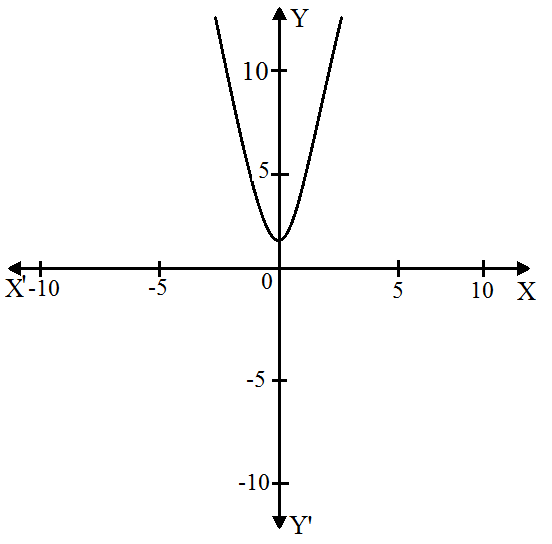
A line parallel to $X-$axis is cutting the graph at two different values.
Therefore, for two different values of $x$ we are getting the same value of $y.$
That means it is many one function.
From the given graph we can see that the range is $[2,\infty)$ and $R$ is the $co-$domain of the given function.
Hence$, Co-$dornain $=$ Range
Therefore, the given function is into. View full question & answer→MCQ 821 Mark
Let $f, g: R \rightarrow R$ be defined by $f(x)=3 x+1$ and $g(x)=x^2-2, \forall x \in R$, respectively. Then, $f \circ g$ is:
- ✓
$3 x^2-5$
- B
$9 x^2+6 x-1$
- C
$3 x^2$
- D
$9 x^2-6 x-3$
AnswerCorrect option: A. $3 x^2-5$
Given,
$f(x)=3 x+1$
$g(x)=x^2-2$
fo $g=f[g(x)]$
$=f\left(x^2-2\right)$
$=3\left(x^2-2\right)+1$
$=3 x^2-6+1$
$=3 x^2-5$
View full question & answer→MCQ 831 Mark
If $N$ be the set of all$-$natural numbers, consider $f : N \rightarrow N$ such that $f(x) = 2x, \forall x \in N,$ then $f$ is:
- A
One$-$one onto.
- ✓
One$-$one into.
- C
Many$-$one onto.
- D
AnswerCorrect option: B. One$-$one into.
View full question & answer→MCQ 841 Mark
Let $f : R \rightarrow R$ be a function defined by $\text{f(x)}=\frac{\text{e}^{|\text{x}|}-\text{e}^{-\text{x}}}{\text{e}^{\text{x}}+\text{e}^{-\text{x}}}.$ Then,
- A
$f$ is a bijection.
- B
$f$ is an injection only.
- C
$f$ is surjection on only.
- ✓
$f$ is neither an injection nor a surjection.
AnswerCorrect option: D. $f$ is neither an injection nor a surjection.
$f : R \rightarrow R$
$\text{f(x)}=\frac{\text{e}^{|\text{x}|}-\text{e}^{-\text{x}}}{\text{e}^{\text{x}}+\text{e}^{-\text{x}}}$
For $x = -2$ and $-3 \in\text{R}$
$\text{f(-2)}=\frac{\text{e}^{|-2|}-\text{e}^2}{\text{e}^{-2}+\text{e}^2}$
$=\frac{\text{e}^2-\text{e}^2}{\text{e}^{-2}+\text{e}^2}$
$=0$
Hence, for different values of $x$ we are getting same values of $f(x)$
That means, the given function is many one.
Therefore, this function is not injective.
For $x < 0$
$f(x) = 0$
For $x > 0$
$\text{f(x)}=\frac{\text{e}^{\text{x}}-\text{e}^{-\text{x}}}{\text{e}^{\text{x}}+\text{e}^{-\text{x}}}$
$=\frac{\text{e}^{\text{x}}+\text{e}^{-\text{x}}}{\text{e}^{\text{x}}+\text{}e^{-\text{x}}}-\frac{2\text{e}^{-\text{x}}}{\text{e}^{\text{x}}+\text{e}^{-\text{x}}}$
$=1-\frac{2\text{e}^{-\text{x}}}{\text{e}^{\text{x}}+\text{e}^{-\text{x}}}$
The value of $\frac{2\text{e}^{-\text{x}}}{\text{e}^{\text{x}}+\text{e}^{-\text{x}}}$ is always positive.
Therefore, the value of $f(x)$ is always less than $1.$
Numbers more than $1$ are not included in the range but they are included in $co-$domain.
As the codomain is $R.$
$\therefore\ \text{Co-domain}\neq\text{Range}$
Hence, the given function is not onto.
Therefore, this function is not surjective.
View full question & answer→MCQ 851 Mark
If a relation $R$ is defined on the set $Z$ of integers as follows$:\ (a, b) \in R \Leftrightarrow a^2+b^2=25$. Then, domain $(R)$ is:
- A
$\{3, 4, 5\}$
- B
$\{0, 3, 4, 5\}$
- ✓
$\{0,\pm3,\pm4,\pm5\}$
- D
AnswerCorrect option: C. $\{0,\pm3,\pm4,\pm5\}$
As $a R b \Leftrightarrow a < b$
does not satisfy reflexive and symmetric relation.
View full question & answer→MCQ 861 Mark
The function $f: A \rightarrow B$ defined by $f(x)=-x^2+6 x-8$ is a bijection if,
- ✓
$\text{A}=(-\infty,3]$ and $\text{B}=(-\infty,1]$
- B
$\text{A}=[-3,\infty)$ and $\text{B}=(-\infty,1]$
- C
$\text{A}=(-\infty,3]$ and $\text{B}=[1,\infty)$
- D
$\text{A}=[3,\infty)$ and $\text{B}=[1,\infty)$
AnswerCorrect option: A. $\text{A}=(-\infty,3]$ and $\text{B}=(-\infty,1]$
$f(x) = -x^2 + 6x - 8$, is a polynomial function and the domain of polynomial function is real number.
$\therefore\ \text{x}\in\text{R}$
$f(x) = -x^2 + 6x - 8$
$= -(x^2 - 6x + 8)$
$= -(x^2 - 6x + 9 - 1)$
$= -(x - 3)^2 + 1$
Maximum value of $-(x - 3)^2$ woud be $0$
$\therefore$ Maximum value of $-(x - 3)^2 + 1$ woud be $1$
$\therefore\ \text{f(x)}\in(-\infty,1]$
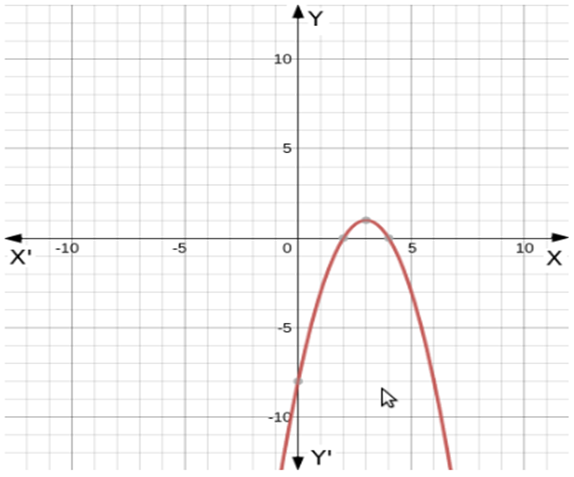
We can see from the given graph that function is symmetrical about $x = 3$ and the given function is bijective.
So$, x$ would be either $(-\infty,3]$ or $[3,\infty)$
The correct option which satisfy $A$ and $B$ both is:
$\text{A}=(-\infty,3]$ and $\text{B}=(-\infty,1]$ View full question & answer→MCQ 871 Mark
Let $*$ be a binary operation on $R$ defined by $a^ * b = ab + 1.$ Then$, *$ is:
- ✓
Commutative but not associative.
- B
Associative but not commutative.
- C
Neither commutative nor associative.
- D
Both commutative and associative.
AnswerCorrect option: A. Commutative but not associative.
Commutativity:
Let $\text{a, b}\in\text{R}$
$a^ * b = ab + 1$
$= ba + 1$
$= b^ * a$
Therefore,
$a^ * b = b^ * a, \forall\text{ a, b}\in\text{R}$
Therefore$, *$ is commutative on $R.$
Associativity:
Let $\text{ a, b, c}\in\text{R}$
$a^ * (b^ * c) = a^ * (bc + 1)$
$= a(bc + 1) + 1$
$= abc + a + 1$
$(a^ * b)^ * c = (ab + 1)^ * c$
$= (ab + 1)c + 1$
$= abc + c + 1$
$\therefore a^ * (b^ * c) \neq (a^ * b)^ * c$
For example$: a = 1, b = 2$ and $c = 3 [$which belong to $R]$
Now,
$1^ * (2^ * 3) = 1^ * (6 + 1)$
$= 1^ * 7$
$= 7 + 1$
$= 8$
$(1^ * 2)^ * 3 = (2 + 1)^ * 3$
$= 3^ * 3$
$= 9 + 1$
$= 10$
$\Rightarrow 1^ * (2^ * 3) \neq (1^ * 2)^ * 3$
Therefore, $\exists a = 1, b = 2$ and $c = 3$ which belong to $R$ such that
$a^ * (b^ * c) \neq (a^ * b)^ * c$
Hence$, *$ is not associative on $R.$
View full question & answer→MCQ 881 Mark
If $A = \{1, 2, 3\}, B = \{1, 4, 6, 9\}$ and $R$ is a relation from $A$ to $B$ defined by $x\ '$ is greater than $y\ '.$ The range of $R$ is:
- A
$\{1, 4, 6, 9\}$
- B
$\{4, 6, 9\}$
- ✓
$\{1\}$
- D
AnswerCorrect option: C. $\{1\}$
Here, $\text{R}=\text{x, y}:\text{x}\in\text{A}$ and $\text{y}\in\text{B}:\text{x}>\text{y}$
$\Rightarrow R = 2, 1, 3, 1$
Thus, Range of $R = \{1\}$
View full question & answer→MCQ 891 Mark
If the binary operation $*$ on $Z$ is defined by $a^ * b=a^2-b^2+a b+4$, then value of $(2^ * 3)^ * 4$ is:
AnswerGiven that $a^ * b=a^2-b^2+a b+4$
So,
$2^ * 3$
$=2^2-3^2+2.3+4$
$=4-9+6+4$
$=5$
Now,
$(2^ * 3)^ * 4$
$=5^ * 4$
$=5^2-4^2+5.4+4$
$=25-16+20+4$
$=33$
View full question & answer→MCQ 901 Mark
$Q ^{+}$is the set of all positive rational numbers with the binary operation * defined by $a^ * b=\frac{ ab }{2} \forall a , b \in Q ^{+}$. The inverse of an element $a \in Q ^{+}$ is:
- A
$\text{a}$
- B
$\frac{1}{\text{a}}$
- C
$\frac{2}{\text{a}}$
- ✓
$\frac{4}{\text{a}}$
AnswerCorrect option: D. $\frac{4}{\text{a}}$
Let e be the identity element in $Q^+$ with respect to $*$ such that
$a^ * e = a = e^ * a, \forall\text{ a}\in\text{Q}^+$
$a^ * e = a$ and $e^ * a = a, \forall\text{ a}\in\text{Q}^+$
$\frac{\text{ae}}2=\text{a}$ and $\frac{\text{ea}}2=\text{a}$, $\forall\text{ a}\in\text{Q}^+$
$\text{e}=2\in\text{Q}^+, \forall\text{ a}\in\text{Q}^+$
Thus$, 2$ is the identity element in $Q^+$ with respect to $*.$
Let $\text{ a}\in\text{Q}^+$ and $\text{ b}\in\text{Q}^+$ be the inverse of $a.$
Then,
$a^ * e = a = e^ * a$
$a^ * b = e$ and $b^ * a = e$
$\frac{\text{ab}}2=2$ and $\frac{\text{ba}}2=2$
$\text{b}=\frac{4}{\text{a}}\in\text{Q}^+$
Thus, $\frac{4}{\text{a}}$ is the inverse of $\text{ a}\in\text{Q}^+$.
View full question & answer→MCQ 911 Mark
Let $f(x)=x^2$ and $g(x)=2^x$. Then, the solution set of the equation fog $(x)=gof(x)$ is:
AnswerCorrect option: C. $\{0, 2\}$
Since $(fog)(x) = (gof)(x),$
$f(g(x)) = g(f(x))$
$\Rightarrow\ \text{f}(2^\text{x})=\text{g}(\text{x}^2)$
$\Rightarrow\ \big(2^{\text{x}}\big)^{2}=2^{\text{x}^2}$
$\Rightarrow\ 2^{2\text{x}}=2^{\text{x}^2}$
$\Rightarrow\ \text{x}^2=2\text{x}$
$\Rightarrow\ \text{x}^2-2\text{x}=0$
$\Rightarrow\ \text{x}(\text{x}-2)=0$
$\Rightarrow\ \text{x}=0, 2$
$\Rightarrow\ \text{x}\in\{0,2\}$
View full question & answer→MCQ 921 Mark
Let $\times $ be a binary operation on set $Q - {1}$ defind by $a \times b = a + b - ab : a, b \in Q - {1}.$ Then $\times $ is:
- A
- B
- ✓
Both $(a)$ and $(b).$
- D
AnswerCorrect option: C. Both $(a)$ and $(b).$
View full question & answer→MCQ 931 Mark
Let $f: R \rightarrow R$ be given by $\text{f(x)}=\tan\text{x}.$ Then,$f^{-1}(1)$ is:
AnswerCorrect option: B. $\big\{\text{n}\pi+\frac{\pi}{4}:\text{n}\in\text{Z}\big\}$
We have,$f: R \rightarrow R$ is given by
$\text{f(x)}=\tan\text{x}$
$\Rightarrow\ \text{f}^{-1}(\text{x})=\tan^{-1}\text{x}$
$\therefore\ \text{f}^{-1}(1)=\tan^{-1}1=\big\{\text{n}\pi+\frac{\pi}{4}:\text{n}\in\text{Z}\big\}$
View full question & answer→MCQ 941 Mark
The maximum number of equivalence relations on the set $A = \{1, 2, 3\}$ is:
AnswerThe maximum number of equivalence relations on the set $A = \{1, 2, 3\}$ is,
$R _1=\{(1,1)\}$
$R _2=\{(2,2)\}$
$R _3=\{(3,3)\}$
$R _4=\{(1,1),(2,2),(3,3),(1,2),(2,1)\}$
$R _5=\{(1,1),(2,2),(3,3),(1,2),(2,1),(1,3),(3,1),(2,3),(3,2)\}$
The maximum number of equivalence relations on the set $A = \{1, 2, 3\}$ is $5$.
View full question & answer→MCQ 951 Mark
Let R be the relation over the set of all straight lines in a plane such that $\text{l}_1\text{Rl}_2\Leftrightarrow\text{l}_1\bot\text{l}_2.$ Then$, R$ is:
AnswerGiven $R$ is the relation over the set of all straight lines in a plane such that $\text{l}_1\text{Rl}_2\Leftrightarrow\text{l}_1\bot\text{l}_2.$
It is symmetric relation as we can say either or $\text{l}_2\bot\text{l}_1.$
View full question & answer→MCQ 961 Mark
An operation $*$ is defined on the set $Z$ of non$-$zero integers by $a^ * b = ab$ for all $a, b \in Z.$ Then the property satisfied is:
Answer$*$ is not clouser because when $a = 1$ and $b = 2,$
$\text{a}^*\text{b}=\frac{\text{a}}{\text{b}}=\frac{1}{2}\in\text{Z}$
$*$ is not commutative because when $a = 1, b = 2$ and $c = 3,$
$1^*(2^*3)=1^*\Big(\frac{2}3\Big)$
$=\frac{1}{\big(\frac{2}{3}\big)}$
$=\frac{3}2$
$(1^*2)^*3=\frac{1}2^*3$
$=\frac{\big(\frac{1}2\big)}{3}$
$=\frac{1}6$
Thus,
$1^*(2^*3)\neq(1^*2)^*3$
View full question & answer→MCQ 971 Mark
Let $f(x)=x^3$ be a function with domain $\{0,1,2,3\}$. Then domain of $f^{-1}$ is:
- A
$\{3, 2, 1, 0\}$
- B
$\{0, -1, -2, -3\}$
- ✓
$\{0, 1, 8, 27\}$
- D
$\{0, -1, -8, -27\}$
AnswerCorrect option: C. $\{0, 1, 8, 27\}$
Given function is $f(x)=x^3$ be a function with domain $\{0,1,2,3\}$
Range $=\left\{0,1^3, 2^3, 3^3\right\}=\{0,1,8,27\}$
$f$ can be written as
$\{(0,0),(1,1),(2,8),(3,27)\}$
Hence, $f^{-1}$ can be written as
$\{(0,0),(1,1),(8,2),(27,3)\}$
Domain of $f^{-1}$ is $\{0,1,8,27\}$
View full question & answer→MCQ 981 Mark
The smallest integer function $f(x) = [x]$ is:
- A
One$-$one.
- ✓
Many$-$one.
- C
Both $(a)$ and $(b).$
- D
AnswerCorrect option: B. Many$-$one.
View full question & answer→MCQ 991 Mark
The number of binary operations that can be defined on a set of $2$ elements is:
View full question & answer→MCQ 1001 Mark
Let $R$ be the relation on the set $A = \{1, 2, 3, 4\}$ given by $R = \{(1, 2), (2, 2), (1, 1), (4, 4), (1, 3), (3, 3), (3, 2)\}.$ Then,
- A
$R$ is reflexive and symmetric but not transitive.
- ✓
$R$ is reflexive and transitive but not symmetric.
- C
$R$ is symmetric and transitive but not reflexive.
- D
$R$ is an equivalence relation.
AnswerCorrect option: B. $R$ is reflexive and transitive but not symmetric.
Reflexivity: Clearly, $(\text{a, a})\in\text{R}\ \forall\ \text{a}\in\text{A}$
So$, R$ is reflexive on $A.$
Symmetry: Since, $1,2\in\text{R},$ but $2,1\notin\text{R,} R$ is not symmetric on $A.$
Transitivity: Since, $1,3,3,2\in\text{R}$ and $1,2\in\text{R}, R$ is transitive on $A.$
View full question & answer→