Questions · Page 1 of 12

M.C.Q (1 Marks)

🎯

Test yourself on this topic

50 questions · timed · auto-graded

MCQ 11 Mark
Assertion : For the scattering of a-particles at a large angles, only the nucleus of the atom is responsible.
Reason : Nucleus is very heavy in comparison to electrons.
  • If both assertion and reason are true and the reason is the correct explanation of the assertion.
  • B
    If both assertion and reason are true but reason is not the correct explanation of the assertion.
  • C
    If assertion is true but reason is false.
  • D
    If the assertion and reason both are false.
Answer
Correct option: A.
If both assertion and reason are true and the reason is the correct explanation of the assertion.
 If both assertion and reason are true and the reason is the correct explanation of the assertion.
View full question & answer
MCQ 21 Mark
Assertion : Electron capture occurs more often than positron emission in heavy elements.
Reason : Heavy elements exhibit radioactivity.
  • A
    If both assertion and reason are true and the reason is the correct explanation of the assertion.
  • If both assertion and reason are true but reason is not the correct explanation of the assertion.
  • C
    If assertion is true but reason is false.
  • D
    If the assertion and reason both are false.
Answer
Correct option: B.
If both assertion and reason are true but reason is not the correct explanation of the assertion.
  If both assertion and reason are true but reason is not the correct explanation of the assertion.
View full question & answer
MCQ 31 Mark
Assertion : Fragments produced in the fission of $\mathrm{U}^{235}$ are radioactive.
Reason : The fragments have abnormally high proton to neutron ratio.
  • A
    If both assertion and reason are true and the reason is the correct explanation of the assertion.
  • B
    If both assertion and reason are true but reason is not the correct explanation of the assertion.
  • If assertion is true but reason is false.
  • D
    If the assertion and reason both are false.
Answer
Correct option: C.
If assertion is true but reason is false.
(c) If assertion is true but reason is false.
View full question & answer
MCQ 41 Mark
Assertion : Radioactivity of $10^8$ undecayed radioactive nuclei of half life of 50 days is equal to that of $1.2 \times 10^8$ number of undecayed nuclei of some other material with half life of 60 days
Reason : Radioactivity is proportional to half-life.
  • A
    If both assertion and reason are true and the reason is the correct explanation of the assertion.
  • B
    If both assertion and reason are true but reason is not the correct explanation of the assertion.
  • If assertion is true but reason is false.
  • D
    If the assertion and reason both are false.
Answer
Correct option: C.
If assertion is true but reason is false.
(c) If assertion is true but reason is false.
View full question & answer
MCQ 51 Mark
Assertion : The mass of b-particles when they are emitted is higher than the mass of electrons obtained by other means.
Reason : b-particle and electron, both are similar particles.
  • A
    If both assertion and reason are true and the reason is the correct explanation of the assertion.
  • If both assertion and reason are true but reason is not the correct explanation of the assertion.
  • C
    If assertion is true but reason is false.
  • D
    If the assertion and reason both are false.
Answer
Correct option: B.
If both assertion and reason are true but reason is not the correct explanation of the assertion.
 If both assertion and reason are true but reason is not the correct explanation of the assertion.
View full question & answer
MCQ 61 Mark
Assertion : The ionising power of b-particle is less compared to a-particles but their penetrating power is more.
Reason : The mass of b-particle is less than the mass of a-particle.
  • A
    If both assertion and reason are true and the reason is the correct explanation of the assertion.
  • If both assertion and reason are true but reason is not the correct explanation of the assertion.
  • C
    If assertion is true but reason is false.
  • D
    If the assertion and reason both are false.
Answer
Correct option: B.
If both assertion and reason are true but reason is not the correct explanation of the assertion.
 If both assertion and reason are true but reason is not the correct explanation of the assertion.
View full question & answer
MCQ 71 Mark
Assertion : Amongst alpha, beta and gamma rays, a-particle has maximum penetrating power.
Reason : The alpha particle is heavier than beta and gamma rays.
  • A
    If both assertion and reason are true and the reason is the correct explanation of the assertion.
  • B
    If both assertion and reason are true but reason is not the correct explanation of the assertion.
  • C
    If assertion is true but reason is false.
  • If the assertion and reason both are false.
Answer
Correct option: D.
If the assertion and reason both are false.
View full question & answer
MCQ 81 Mark
Assertion : All the radioactive elements are ultimately converted in lead.
Reason : All the elements above lead are unstable.
  • A
    If both assertion and reason are true and the reason is the correct explanation of the assertion.
  • B
    If both assertion and reason are true but reason is not the correct explanation of the assertion.
  • If assertion is true but reason is false.
  • D
    If the assertion and reason both are false.
Answer
Correct option: C.
If assertion is true but reason is false.
 If assertion is true but reason is false.
View full question & answer
MCQ 91 Mark
The ratio of radii of nuclei $13^{\mathrm{Al}^{27}}$ and $52^{x^A}$ is 3 : 5. The number of neutrons in the nuclei of X will be
  • A
    52
  • 73
  • C
    125
  • D
    13
Answer
Correct option: B.
73
(b) 73
View full question & answer
MCQ 101 Mark
Assertio : Hydrogen atom consists of only one electron but its emission spectrum has many lines.
Reason : Only Lyman series is found in the absorption spectrum of hydrogen atom whereas in the emission spectrum, all the series are found.
  • A
    If both assertion and reason are true and the reason is the correct explanation of the assertion.
  • If both assertion and reason are true but reason is not the correct explanation of the assertion.
  • C
    If assertion is true but reason is false.
  • D
    If the assertion and reason both are false.
Answer
Correct option: B.
If both assertion and reason are true but reason is not the correct explanation of the assertion.
 If both assertion and reason are true but reason is not the correct explanation of the assertion.
View full question & answer
MCQ 111 Mark
Assertion : The electron in the hydrogen atom passes from energy level n = 4 to the n = 1 level. The maximum and minimum number of photon that can be emitted are six and one respectively.
Reason : The photons are emitted when electron make a transition from the higher energy state to the lower energy state.
  • A
    If both assertion and reason are true and the reason is the correct explanation of the assertion.
  • If both assertion and reason are true but reason is not the correct explanation of the assertion.
  • C
    If assertion is true but reason is false.
  • D
    If the assertion and reason both are false.
Answer
Correct option: B.
If both assertion and reason are true but reason is not the correct explanation of the assertion.
 If both assertion and reason are true but reason is not the correct explanation of the assertion.
View full question & answer
MCQ 121 Mark
Assertion : According to classical theory, the proposed path of an electron in Rutherford atom model will be parabolic.
Reason : According to electromagnetic theory an accelerated particle continuously emits radiation.
  • A
    If both assertion and reason are true and the reason is the correct explanation of the assertion.
  • B
    If both assertion and reason are true but reason is not the correct explanation of the assertion.
  • C
    If assertion is true but reason is false.
  • If assertion is false but reason is true.
Answer
Correct option: D.
If assertion is false but reason is true.
 If assertion is false but reason is true.
View full question & answer
MCQ 131 Mark
Assertion : The positively charged nucleus of an atom has a radius of almost $10^{-15} \mathrm{~m}$.
Reason : In a-particle scattering experiment, the distance of closest approach for a-particles is $\simeq 10^{-15} \mathrm{~m}$
  • If both assertion and reason are true and the reason is the correct explanation of the assertion.
  • B
    If both assertion and reason are true but reason is not the correct explanation of the assertion.
  • C
    If assertion is true but reason is false.
  • D
    If the assertion and reason both are false.
Answer
Correct option: A.
If both assertion and reason are true and the reason is the correct explanation of the assertion.
(a) If both assertion and reason are true and the reason is the correct explanation of the assertion.
View full question & answer
MCQ 141 Mark
Assertion : The force of repulsion between atomic nucleus and a-particle varies with distance according to inverse square law.
Reason : Rutherford did a-particle scattering experiment.
  • A
    If both assertion and reason are true and the reason is the correct explanation of the assertion.
  • If both assertion and reason are true but reason is not the correct explanation of the assertion.
  • C
    If assertion is true but reason is false.
  • D
    If the assertion and reason both are false.
Answer
Correct option: B.
If both assertion and reason are true but reason is not the correct explanation of the assertion.
 If both assertion and reason are true but reason is not the correct explanation of the assertion.
View full question & answer
MCQ 151 Mark
Assertion : Isobars are the element having same mass number but different atomic number.
Reason : Neutrons and protons are present inside nucleus.
  • A
    If both assertion and reason are true and the reason is the correct explanation of the assertion.
  • If both assertion and reason are true but reason is not the correct explanation of the assertion.
  • C
    If assertion is true but reason is false.
  • D
    If the assertion and reason both are false.
Answer
Correct option: B.
If both assertion and reason are true but reason is not the correct explanation of the assertion.
  If both assertion and reason are true but reason is not the correct explanation of the assertion.
View full question & answer
MCQ 161 Mark
Assertion : Density of all the nuclei is same.
Reason : Radius of nucleus is directly proportional to the cube root of mass number.
  • If both assertion and reason are true and the reason is the correct explanation of the assertion.
  • B
    If both assertion and reason are true but reason is not the correct explanation of the assertion.
  • C
    If assertion is true but reason is false.
  • D
    If the assertion and reason both are false.
Answer
Correct option: A.
If both assertion and reason are true and the reason is the correct explanation of the assertion.
 If both assertion and reason are true and the reason is the correct explanation of the assertion.
View full question & answer
MCQ 171 Mark
Assertion : Radioactive nuclei emit $\beta^{-1}$ particles.
Reason : Electrons exist inside the nucleus.
  • A
    If both assertion and reason are true and the reason is the correct explanation of the assertion.
  • B
    If both assertion and reason are true but reason is not the correct explanation of the assertion.
  • If assertion is true but reason is false.
  • D
    If the assertion and reason both are false.
Answer
Correct option: C.
If assertion is true but reason is false.
(c) If assertion is true but reason is false.
View full question & answer
MCQ 181 Mark
Assertion : Bohr had to postulate that the electrons in stationary orbits around the nucleus do not radiate.
Reason : According to classical physics all moving electrons radiate.
  • A
     If both assertion and reason are true and the reason is the correct explanation of the assertion.
  • If both assertion and reason are true but reason is not the correct explanation of the assertion.
  • C
    If assertion is true but reason is false.
  • D
    If the assertion and reason both are false.
Answer
Correct option: B.
If both assertion and reason are true but reason is not the correct explanation of the assertion.
View full question & answer
MCQ 191 Mark
Assertion : Neutrons penetrate matter more readily as compared to protons.
Reason : Neutrons are slightly more massive than protons.
  • A
    If both assertion and reason are true and the reason is the correct explanation of the assertion.
  • If both assertion and reason are true but reason is not the correct explanation of the assertion.
  • C
    If assertion is true but reason is false.
  • D
    If the assertion and reason both are false.
Answer
Correct option: B.
If both assertion and reason are true but reason is not the correct explanation of the assertion.
 If both assertion and reason are true but reason is not the correct explanation of the assertion.
View full question & answer
MCQ 201 Mark
Assertion : $90_{\mathrm{Sr}}$ from the radioactive fall out from a nuclear bomb ends up in the bones of human beings through the milk consumed by them. It causes impairment of the production of red blood cells.
Reason : The energetics b-particles emitted in the decay of $90_{\mathrm{Sr}}$ damage the bone marrow.
  • If both assertion and reason are true and the reason is the correct explanation of the assertion.
  • B
    If both assertion and reason are true but reason is not the correct explanation of the assertion.
  • C
    If assertion is true but reason is false.
  • D
    If the assertion and reason both are false.
Answer
Correct option: A.
If both assertion and reason are true and the reason is the correct explanation of the assertion.
(a) If both assertion and reason are true and the reason is the correct explanation of the assertion.
View full question & answer
MCQ 211 Mark
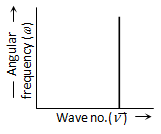
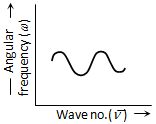
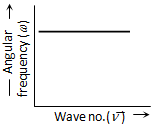
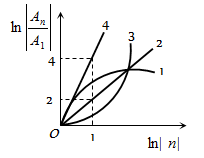
The figure shows a graph between ln$\left|\frac{A_n}{A_1}\right|$ and ln|n|, where $A_n$ is the area enclosed by the nth orbit in a hydrogen like atom. The correct curve is
  • 4
  • B
    3
  • C
    2
  • D
    1
Answer
Correct option: A.
4
(a) 4
View full question & answer
MCQ 221 Mark
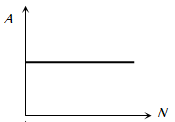
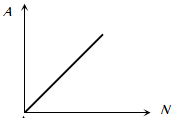
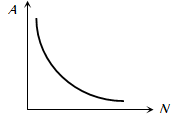
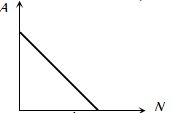
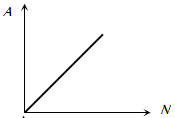
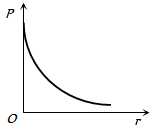
The curve between the activity A of a radioactive sample and the number of active atoms N is
  • A
  • C
  • D
Answer
Correct option: B.
(b)
View full question & answer
MCQ 231 Mark
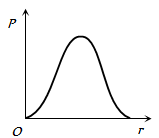
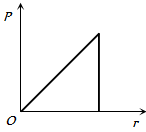
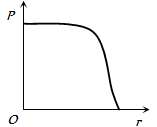
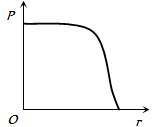
The charge density in a nucleus varies with distance from the centre of the nucleus according to the curve in Fig.
  • A
  • B
  • D
Answer
Correct option: C.
(c)
View full question & answer
MCQ 241 Mark
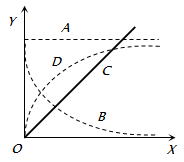
In Fig. X represents time and Y represent activity of a radioactive sample. Then the activity of sample, varies with time according to the curve
  • A
    A
  • B
  • C
    C
  • D
    D
Answer
Correct option: B.
B
(b) B
View full question & answer
MCQ 251 Mark
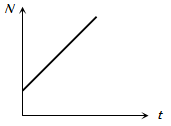
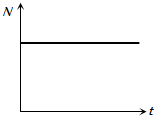
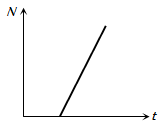
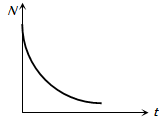
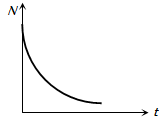
The graph between the instantaneous concentration (N) of a radioactive element and time (t) is
  • A
  • B
  • C
Answer
Correct option: D.
(d)
View full question & answer
MCQ 261 Mark
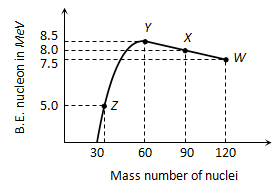
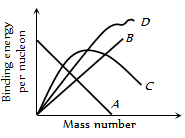
Binding energy per nucleon verses mass number curve for nuclei is shown in the figure. W, X, Y and Z are four nuclei indicated on the curve. The process that would release energy is
  • A
    Y → 2Z
  • B
    W → X + Z
  • W → 2Y
  • D
    X → Y + Z
Answer
Correct option: C.
W → 2Y
(c) W → 2Y
View full question & answer
MCQ 271 Mark
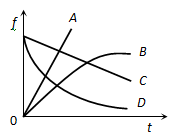
The fraction f of radioactive material that has decayed in time t, varies with time t. The correct variation is given by the curve
  • A
    A
  • B
  • C
    C
  • D
    D
Answer
Correct option: B.
B
(b) B
View full question & answer
MCQ 281 Mark
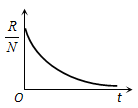
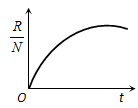
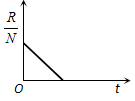
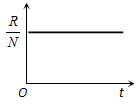
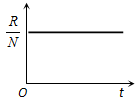
A radioactive sample has $\mathrm{N}_0$ active atoms at t = 0. If the rate of disintegration at any time is R and the number of atoms is N, then the ratio R/N varies with time as
  • A
  • B
  • C
Answer
Correct option: D.
(d)
View full question & answer
MCQ 291 Mark
Binding energy per nucleon plot against the mass number for stable nuclei is shown in the figure. Which curve is correct
  • A
    A
  • B
    B
  • C
  • D
    D
Answer
Correct option: C.
C
(c) C
View full question & answer
MCQ 311 Mark
Rest mass energy of an electron is 0.54 MeV. If velocity of the electron is 0.8 c, then K.E. of the electron is
  • 0.36 MeV
  • B
    0.41 MeV
  • C
    0.48 MeV
  • D
    1.32 MeV
Answer
Correct option: A.
0.36 MeV
0.36 MeV
View full question & answer
MCQ 321 Mark
A radioactive isotope X with a half-life of $1.37\times 10^9$  years decays to Y which is stable. A sample of rock from the moon was found to contain both the elements X and Y which were in the ratio of 1 : 7. The age of the rock is
  • A
    $1.96 \times 10^8$  years
  • B
    $3.85 \times 10^9$  years
  • $4.11 \times 10^9$  years
  • D
    $9.59 \times 10^9$  years
Answer
Correct option: C.
$4.11 \times 10^9$  years
(c) $4.11 \times 10^9$  years
View full question & answer
MCQ 331 Mark
If 10% of a radioactive material decays in 5 days, then the amount of original material left after 20 days is approximately
  • A
    60%
  • 65%
  • C
    70%
  • D
    75%
Answer
Correct option: B.
65%
 65%
View full question & answer
MCQ 341 Mark
A radioactive nucleus is being produced at a constant rate a per second. Its decay constant is l. If $\mathrm{N}_0$ are the number of nuclei at time t = 0, then maximum number of nuclei possible are
  • $\frac{\alpha}{\lambda}$
  • B
    ${N}_0+\frac{\alpha}{\lambda}$
     
  • C
    $\mathrm{N}_0$
  • D
    $\frac{\lambda}{\alpha}+{N}_0$
Answer
Correct option: A.
$\frac{\alpha}{\lambda}$
(a) $\frac{\alpha}{\lambda}$
View full question & answer
MCQ 351 Mark
A radioactive sample is $a-$emitter with half life $138.6$ days is observed by a student to have $2000$ disintegration$/\sec.$ The number of radioactive nuclei for given activity are
  • $ 3.45 \times 10^{10} $
  • B
    $ 1 \times 10^{10} $
  • C
    $ 3.45 \times 10^{15} $
  • D
    $ 2.75 \times 10^{11}$
Answer
Correct option: A.
$ 3.45 \times 10^{10} $
View full question & answer
MCQ 361 Mark
The wavelength $K_a \ X-$rays produced by an $X-$ray tube is $0.76 \mathring A .$ The atomic number of anticathode material is
  • A
    $82$
  • $41$
  • C
    $20$
  • D
    $10$
Answer
Correct option: B.
$41$
$41$
View full question & answer
MCQ 371 Mark
A radioactive sample of $U^{238}$ decay to $Pb$ through a process for which half life is $4.5 \times 10^9$ years. The ratio of number of nuclei of Pb to $\mathrm{U}^{238}$ after a time of $1.5 \times 10^9$ years $($given $2^{1 / 3}=1.26 )$
  • A
    $ 0.12$
  • $ 0.26$
  • C
    $1.2$
  • D
    $0.37$
Answer
Correct option: B.
$ 0.26$
$0.26$
View full question & answer
MCQ 381 Mark
A hydrogen like atom of atomic number Z is in an excited state of quantum number 2n. It can emit a maximum energy photon of 204 eV. If it makes a transition to quantum state n, a photon of energy 40.8 eV is emitted. The value of n will be
  • A
    1
  • 2
  • C
    3
  • D
    4
Answer
Correct option: B.
2
 2
View full question & answer
MCQ 391 Mark
The first excited state of hydrogen atom is 10.2 eV above its ground state. The temperature is needed to excite hydrogen atoms to first excited level, is
  • $7.9 \times 10^4 \mathrm{~K}$
  • B
    $3.5 \times 10^4 \mathrm{~K}$
  • C
    $5.8 \times 10^4 \mathrm{~K}$
  • D
    $14 \times 10^4 \mathrm{~K}$
Answer
Correct option: A.
$7.9 \times 10^4 \mathrm{~K}$
(a) $7.9 \times 10^4 \mathrm{~K}$
View full question & answer
MCQ 401 Mark
An atomic power nuclear reactor can deliver 300 MW. The energy released due to fission of each nucleus of uranium atom $\mathrm{U}^{238}$ is 170 MeV. The number of uranium atoms fissioned per hour will be
  • A
    $30 \times 10^{25}$
  • $4 \times 10^{22}$
  • C
    $10 \times 10^{20}$
  • D
    $5 \times 10^{15}$
Answer
Correct option: B.
$4 \times 10^{22}$
(b) $4 \times 10^{22}$
View full question & answer
MCQ 411 Mark
The rate of disintegration was observed to be $10^{17}$ disintegrations per sec when its half life period is 1445 years. The original number of particles are
  • A
    $8.9 \times 10^{27}$
  • $6.6 \times 10^{27}$
  • C
    $1.4 \times 10^{16}$
  • D
    $1.2 \times 10^{17}$
Answer
Correct option: B.
$6.6 \times 10^{27}$
(b) $6.6 \times 10^{27}$
View full question & answer
MCQ 421 Mark
Excitation energy of a hydrogen like ion in its first excitation state is 40.8 eV. Energy needed to remove the electron from the ion in ground state is
  • 54.4 eV
  • B
    13.6 eV
  • C
    40.8 eV
  • D
    27.2 eV
Answer
Correct option: A.
54.4 eV
(a) 54.4 eV
View full question & answer
MCQ 431 Mark
After 280 days, the activity of a radioactive sample is 6000 dps. The activity reduces to 3000 dps after another 140 days. The initial activity of the sample in dps is
  • A
    6000
  • B
    9000
  • C
    3000
  • 24000
Answer
Correct option: D.
24000
(d) 24000
View full question & answer
MCQ 441 Mark
Half life of a radio-active substance is 20 minutes. The time between 20% and 80% decay will be
  • A
    20 minutes
  • 40 minutes
  • C
    30 minutes
  • D
    25 minutes
Answer
Correct option: B.
40 minutes
(b) 40 minutes
View full question & answer
MCQ 451 Mark
A and B are two radioactive substances whose half lives are 1 and 2 years respectively. Initially 10 gm of A and 1 gm of B is taken. The time (approximate) after which they will have same quantity remaining is
  • 6.62 years
  • B
    5 years
  • C
    3.2 years
  • D
    7 years
Answer
Correct option: A.
6.62 years
(a) 6.62 years
View full question & answer
MCQ 461 Mark
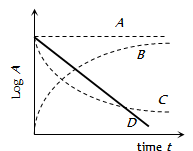
The graph which represents the correct variation of logarithm of activity (log A) versus time, in figure is
  • A
    A
  • B
    B
  • C
    C
  • D
Answer
Correct option: D.
D
(d) D
View full question & answer
MCQ 471 Mark
Two radioactive materials $\mathrm{X}_1$ and $\mathrm{X}_2$ have decay constants 10λ and λ respectively. If initially they have the same number of nuclei, then the ratio of the number of nuclei of $\mathrm{X}_1$ to that of $\mathrm{X}_2$ will be 1/e after a time
  • A
    1/(10 λ)
  • B
    1/(11 λ)
  • C
    11(10 λ)
  • 1(9 λ)
Answer
Correct option: D.
1(9 λ)
(d) 1(9 λ)
View full question & answer
MCQ 481 Mark
Half-life of a radioactive substance is 20 minutes. Difference between points of time when it is 33% disintegrated and 67% disintegrated is approximately
  • A
    10 min
  • 20 min
  • C
    30 min
  • D
    40 min
Answer
Correct option: B.
20 min
(b) 20 min
View full question & answer
MCQ 491 Mark
A radioactive nucleus undergoes a-emission to form a stable element. What will be the recoil velocity of the daughter nucleus if V is the velocity of a-emission and A is the atomic mass of radioactive nucleus
  • $\frac{4 V}{A-4}$
  • B
    $\frac{2 V}{A-4}$
  • C
    $\frac{4 V}{A+4}$
  • D
    $\frac{2V}{A+4}$
Answer
Correct option: A.
$\frac{4 V}{A-4}$
(a) $\frac{4 V}{A-4}$
View full question & answer
MCQ 501 Mark
The half-life of radioactive Polonium (Po) is 138.6 days. For ten lakh Polonium atoms, the number of disintegrations in 24 hours is
  • A
    2000
  • B
    3000
  • C
    4000
  • 5000
Answer
Correct option: D.
5000
(d) 5000
View full question & answer