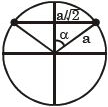
$2$ particles $p$ and $q$ describe $SHM$ of same amplitude $a$ and same frequency $f$ along straight line, the maximum distance between the two particle $a\sqrt 2 $ . The initial phase difference between particle is
Diffcult


Download our appand get started for free
Experience the future of education. Simply download our apps or reach out to us for more information. Let's shape the future of learning together!No signup needed.*
Similar Questions
- 1A heavy small-sized sphere is suspended by a string of length $l$. The sphere rotates uniformly in a horizontal circle with the string making an angle $\theta $ with the vertical. Then the time period of this conical pendulum isView Solution
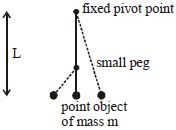
- 2A simple pendulum of length $L$ is constructed from a point object of mass $m$ suspended by a massless string attached to a fixed pivot point. $A$ small peg is placed a distance $2L/3$ directly below the fixed pivot point so that the pendulum would swing as shown in the figure below. The mass is displaced $5$ degrees from the vertical and released. How long does it take to return to its starting position?View Solution
- 3A simple pendulum with length $L$ and mass $m$ of the bob is vibrating with an amplitude $A$. The maximum tension in the string isView Solution
- 4The amplitude of a particle executing $SHM$ about $O$ is $10\, cm.$ Then :View Solution
- 5View SolutionTo make the frequency double of an oscillator, we have to
- 6A plate oscillated with time period $‘T’$. Suddenly, another plate put on the first plate, then time periodView Solution
- 7A weightless spring which has a force constant oscillates with frequency $n$ when a mass $m$ is suspended from it. The spring is cut into two equal halves and a mass $2m $ is suspended from it. The frequency of oscillation will now becomeView Solution
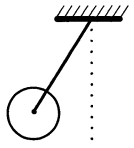
- 8A metal rod of length ' $L$ ' and mass ' $m$ ' is pivoted at one end. A thin disk of mass ' $M$ ' and radius $'R'$ $( < L)$ is attached at its center to the free end of the rod. Consider two ways the disc is attached: (case $A$) The disc is not free to rotate about its center and (case $B$) the disc is free to rotate about its center. The rod-disc system performs $SHM$ in vertical plane after being released from the same displaced position. Which of the following statement$(s)$ is (are) true? $Image$View Solution
$(A)$ Restoring torque in case $A =$ Restoring torque in case $B$
$(B)$ Restoring torque in case $A < $ Restoring torque in case $B$
$(C)$ Angular frequency for case $A > $ Angular frequency for case $B$.
$(D)$ Angular frequency for case $A < $ Angular frequency for case $B$.
- 9A particle executes simple harmonic motion (amplitude $= A$) between $x = - A$ and $x = + A$. The time taken for it to go from $0$ to $A/2$ is ${T_1}$ and to go from $A/2$ to $A$ is ${T_2}$. ThenView Solution
- 10A particle of mass $10\, gm$ is describing $S.H.M.$ along a straight line with period of $2\, sec$ and amplitude of $10, cm$. Its kinetic energy when it is at $5 \,cm$ from its equilibrium position isView Solution