A plate oscillated with time period $‘T’$. Suddenly, another plate put on the first plate, then time period
Easy
Download our app for free and get started
(c)Time period is independent of mass of pendulum.

Download our appand get started for free
Experience the future of education. Simply download our apps or reach out to us for more information. Let's shape the future of learning together!No signup needed.*
Similar Questions
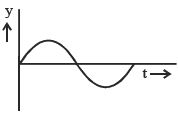
- 1The displacement versus time graph of $SHM$ is Which of the following is its acceleration versus time graph ?View Solution
- 2View SolutionWhich one of the following is a simple harmonic motion
- 3A particle executing $S.H.M.$ of amplitude 4 cm and $T = 4 \,sec.$ The time taken by it to move from positive extreme position to half the amplitude is ..... $\sec$View Solution
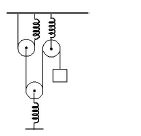
- 4Assuming all pulleys, springs and string massless. Consider all surface smooth. Choose the correct statement $(s)$View Solution
- 5A particle executes simple hormonic motion between $x =\, -A$ and $x = +A$ . It starts from $x = 0$ moves in $+x-$ direction. The time taken for it to move from $x = 0$ to $x = \frac {A}{2}$ is $T_1$ and to move from $\frac {A}{2}$ to $\frac {A}{\sqrt 2}$ is $T_2$ , thenView Solution
- 6A particle execute $S.H.M.$ along a straight line. The amplitude of oscillation is $2 \,cm$. When displacement of particle from the mean position is $1 \,cm$, the magnitude of its acceleration is equal to magnitude of its velocity. The time period of oscillation is ........View Solution
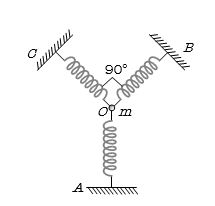
- 7A particle of mass $m$ is attached to three identical springs $A, B$ and $C$ each of force constant $ k$ a shown in figure. If the particle of mass $m$ is pushed slightly against the spring $A$ and released then the time period of oscillations isView Solution
- 8A block of mass $m$ is attached to two springs of spring constants $k_1$ and $k_2$ as shown in figure. The block is displaced by $x$ towards right and released. The velocity of the block when it is at $x/2$ will beView Solution
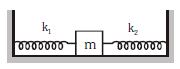
- 9View SolutionWhich of the following statements is not true ? In the case of a simple pendulum for small amplitudes the period of oscillation is
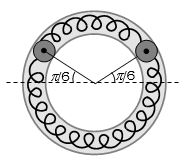
- 10Two identical balls A and B each of mass 0.1 kg are attached to two identical massless springs. The spring mass system is constrained to move inside a rigid smooth pipe bent in the form of a circle as shown in the figure. The pipe is fixed in a horizontal plane. The centres of the balls can move in a circle of radius 0.06 m. Each spring has a natural length of 0.06$\pi$ m and force constant 0.1N/m. Initially both the balls are displaced by an angle $\theta = \pi /6$ radian with respect to the diameter $PQ$ of the circle and released from rest. The frequency of oscillation of the ball B isView Solution