A $10\, m$ long wire of $20\,\Omega$ resistance is connected with a battery of $3\, volt$ $e.m.f.$ (negligible internal resistance) and a $10 \,\Omega$ resistance is joined to it is series. Potential gradient along wire in volt per meter is
Medium
Download our app for free and get started
(c) Potential gradient $x = \frac{e}{{(R + {R_h} + r)}}.\frac{R}{L}$
$ = \frac{3}{{(20 + 10 + 0)}} \times \frac{{20}}{{10}} = 0.2$
$ = \frac{3}{{(20 + 10 + 0)}} \times \frac{{20}}{{10}} = 0.2$

Download our appand get started for free
Experience the future of education. Simply download our apps or reach out to us for more information. Let's shape the future of learning together!No signup needed.*
Similar Questions
- 1Two wires of the same material and equal length are joined in parallel combination. If one of them has half the thickness of the other and the thinner wire has a resistance of $8\, ohms$, the resistance of the combination is equal toView Solution
- 2The resistance of platinum wire at $0^{\circ}\,C$ is $2\,\Omega$ and $6.8\,\Omega$ at $80^{\circ} \,C$. The temperature coefficient of resistance of the wire is :View Solution
- 3Resistance of tungsten wire at $150\,^oC$ is $133\,\Omega $. Its resistance temperature coefficient is $0.0045\,^oC$. The resistance of this wire at $500\,^oC$ will be .............. $\Omega$View Solution
- 4The current through a wire depends on time as $i = (2+3t)\, mA$. The charge crossing through a section of the wire in $1\, min$ is .............. $\mathrm{C}$View Solution
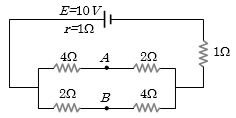
- 5In the circuit shown below, the cell has an $e.m.f.$ of $10\,V$ and internal resistance of $1\, ohm$. The other resistances are shown in the figure. The potential difference ${V_A} - {V_B}$ is ................ $V$View Solution
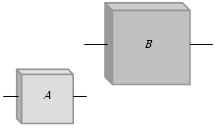
- 6$A$ and $B$ are two square plates of same metal and same thickness but length of $B$ is twice that of $A$. Ratio of resistances of $A$ and $B$ isView Solution
- 7Two conductors have the same resistances at $0^{\circ} \mathrm{C}$ but their temperature coefficients of resistance are $\alpha_1$ and $\alpha_2$. The respective temperature coefficients for their series and parallel combinations are :View Solution
- 8A metal wire has a resistance of $35 \,\Omega$. If its length is increased to double by drawing it, then its new resistance will be (in $\Omega$)View Solution
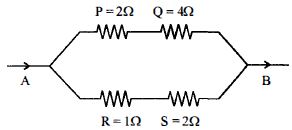
- 9Which of the four resistances $P, Q, R$ and $S$ generate the greatest amount of heat when a current flows from $A$ to $B$ ?View Solution
- 10Two solid conductors are made up of same material, have same length and same resistance. One of them has a circular cross section of area $A_{1}$ and the other one has a square cross section of area $A_{2}$. The ratio $\frac{A _{1}}{A _{2}}$ isView Solution