A $200\,\Omega $ resistor has a certain color code. If one replaces the red color by green in the code, the new resistance will be .............. $\Omega$
JEE MAIN 2019, Medium


Download our appand get started for free
Experience the future of education. Simply download our apps or reach out to us for more information. Let's shape the future of learning together!No signup needed.*
Similar Questions
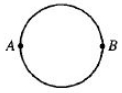
- 1A wire of resistance $12\,ohms$ per meter is bent to form a complete circle of radius $10\, cm.$ The resistance between its two diametrically opposite points, $A$ and $B$ as shown in the figure isView Solution
- 2Four wires of the same diameter are connected in turn between two points, maintained at a constant potential difference. Their resistivities are; $\rho $ and $L$ (wire $1$ )., $1.2\,\rho $ and $1.2\,L$ (wire $2$ ), $0.9\,\rho $ and $0.9\,L$ (wire $3$ ) and $\rho $ and $1.5\,L$ (wire $4$ ). Rank the wires according to the rates at which energy is dissipated as heat, greatest firstView Solution
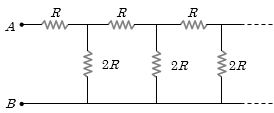
- 3An infinite ladder network is arranged with resistances $R$ and $2 R$ as shown. The effective resistance between terminals $A$ and $B$ isView Solution
- 4One $kg$ of water, at $20\,^oC$, is heated in an electric kettle whose heating element has a mean (temperature averaged) resistance of $20\, \Omega $. The rms voltage in the mains is $200\, V$. Ignoring heat loss from the kettle, time taken for water to evaporate fully, is close to.......... $\min$ [Specific heat of water $= 4200\, J/kg\, ^oC$), Latent heat of water $= 2260\, k\,J/kg$]View Solution
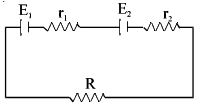
- 5Under what condition current passing through the resistance $R$ can be increased by short circuiting the battery of emf $E_2$. The internal resistances of the two batteries are $r_1$ and $r_2$ respectively.View Solution
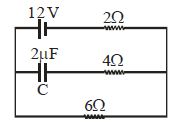
- 6A steady current $I$ flows through a wire of radius $r$, length $L$ and resistivity $\rho$. The current produces heat in the wire. The rate of heat loss in a wire is proportional to its surface area. The steady temperature of the wire is independent ofView Solution
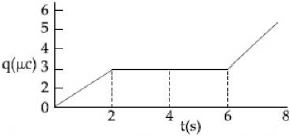
- 7The charge on a capacitor plate in a circuit, as a function of time, is shown in the figureView Solution
What is the value of current at $t = 4\,s$ ? ............... $\mu A$
- 8In $n_e$ and $v_d$ be the number of electrons and drift velocity in a semiconductor. When the temperature is increasedView Solution
- 9If the length of the filament of a heater is reduced by $10\%$, the power of the heater willView Solution
- 10Find the maximum charge on the capacitor $C$ in the following circuit ............ $\mu C$View Solution