The charge on a capacitor plate in a circuit, as a function of time, is shown in the figure
What is the value of current at $t = 4\,s$ ? ............... $\mu A$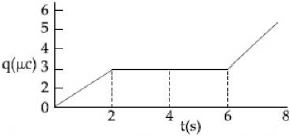
JEE MAIN 2019, Easy


Download our appand get started for free
Experience the future of education. Simply download our apps or reach out to us for more information. Let's shape the future of learning together!No signup needed.*
Similar Questions
- 1The drift velocity of electrons in silver wire with cross-sectional area $3.14 \times 10^{-6}\,m ^2$ carrying a current of $20\,A$ is. Given atomic weight of $Ag =108$ , density of silver $=10.5 \times 10^3\,kg / m ^3..........\times 10^{-4} m / sec$.View Solution
- 2The temperature coefficient of resistance of tungsten is $4.5 \times 10^{-3}{ }^{\circ} C ^{-1}$ and that of germanium is $-5 \times 10^{-2}{ }^{\circ} C ^{-1}$. A tungsten wire of resistance $100 \,\Omega$ is connected in series with a germanium wire of resistance $R$. The value of $R$ for which the resistance of combination does not change with temperature is .......... $\Omega$View Solution
- 3The resistor of resistance '$R$' is connected to $25\, V$ supply and heat produced in it is $25\, J/sec$. The value of $R$ is .......... $\Omega $View Solution
- 4When a current of $2\, A$ flows in a battery from negative to positive terminal, the potential difference across it is $12\, V$. If a current of $3 \,A$ flows in the opposite direction potential difference across the terminals of the battery is $15\, V$, the $emf$ of the battery is ................ $\mathrm{V}$View Solution
- 5In a Wheatstone's bridge, three resistances $P, Q$ and $R$ connected in the three arms and the fourth arm is formed by two resistances $S_1$ and $S_2$ connected in parallel. The condition for the bridge to be balanced will beView Solution
- 6Two identical heaters rated $220\, volt$, $1000\, watt$ are placed in series with each other across $220 \,volt$ lines. If resistance do not change with temperature, then the combined power is ............. $watt$View Solution
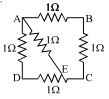
- 7$ABCD$ is a square where each side is a uniform wire of resistance $1\,\Omega$ . $A$ point $E$ lies on $CD$ such that if a uniform wire of resistance $1\,\Omega$ is connected across $AE$ and constant potential difference is applied across $A$ and $C$ then $B$ and $E$ are equipotential.View Solution
- 8You are given three bulbs of $25$, $40$ and $60\, watt$. Which of them has lowest resistanceView Solution
- 9Two wires have resistance of $2$ $\Omega$ and $4$ $\Omega$ connected to same voltage, ratio of heat dissipated at resistance isView Solution
- 10$n$ identical cells are joined in series with two cells $A$ and $B$ with reversed polarities. $emf$ of each cell is $E$ and internal resistance is $r$. Potential difference across cell $A$ and $B$ is : $(n > 4)$View Solution