Question
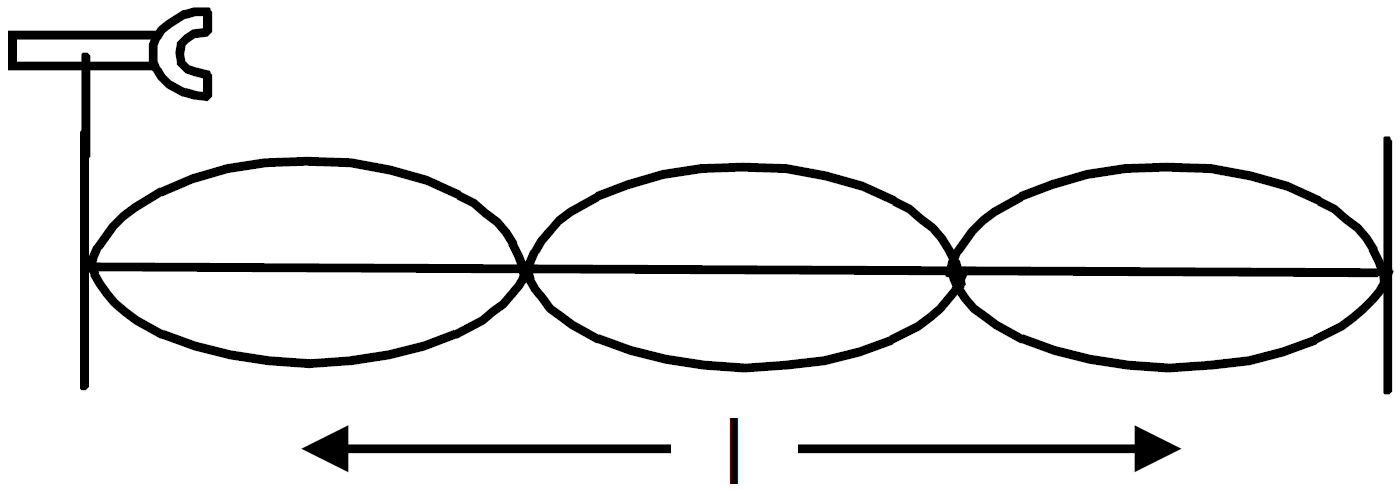
A 660Hz tuning fork sets up vibration in a string clamped at both ends. The wave speed for a transverse wave on this string is 220m/s and the string vibrates in three loops.
  1. Find the length of the string.
  2. If the maximum amplitude of a particle is 0.5cm, write a suitable equation describing the motion.
Answer

Frequency of the tuning fork, $\text{f}=660\text{Hz}$ Wave speed, $\text{v}=220\text{ms}$$\Rightarrow\lambda=\frac{\text{v}}{\text{f}}=\frac{1}{3}\text{m}$
No.of loops = 3
  1. So, $\text{f}=\Big(\frac{3}{2\text{l}}\Big)\text{v}$
$\Rightarrow\text{l}=50\text{cm}$
  1. The equation of resultant stationary wave is given by
$\text{y}=2\text{A}\cos\Big(\frac{2\pi\text{x}}{\text{Ql}}\Big)\sin\Big(\frac{2\pi\text{vt}}{\lambda}\Big)$
$\Rightarrow\text{y}(0.5\text{cm})\cos(0.06\pi\text{cm}^{-1})\sin(1320\pi\text{s}^{-1})$

Need a full question paper?

Generate a complete, print-ready paper with questions like this in minutes — across 16+ boards, with answer keys.

Start Generating Free

Similar questions

Obtain approximately the ratio of the nuclear radii of the gold isotope $^{197}_{79}\text{Au}$ and the silver isotope $^{107}_{47}\text{Ag}.$
The magnetic field due to a long straight wire has been derived in terms of $\mu_0,$ i and d. Express this in terms of $\epsilon_0,$ C, i and d.
A particle of mass ‘m’, with charge ‘q’ moving with a uniform speed ‘v’, normal to a uniform magnetic field ‘B’, describes a circular path of radius ‘r’. Derive expressions for the:
  1. Time period of revolution.
  2. Kinetic energy of the particle.
A heating element using nichrome connected to a 230 V supply draws an initial current of 3.2 A which settles after a few seconds to a steady value of 2.8 A. What is the steady temperature of the heating element if the room temperature is 27${ }^{\circ} C$ ? Temperature coefficient of resistance of nichrome averaged over the temperature range involved is $1.70 \times 10^{-4}{ }^{\circ} C ^{-1}$.
(a) Stars located very far away, which cannot be seen with the eye, can be seen through a telescope. Why?
(b) The magnifying power of two telescopes is the same but the apertures of their objective lenses are different. What will be the change in the final images formed by them?
A swimmer wishes to cross a 500m wide river flowing at 5km/h. His speed with respect to water is 3km/h.
  1. If he heads in a direction making an angle 0 with the flow, find the time he takes to cross the river.
  2. Find the shortest possible time to cross the river.
A wire of length l carries a current i long the x-axis. A magnetic field exists, which is given $\overrightarrow{\text{B}}=\text{B}_0(\overrightarrow{\text{i}}+\overrightarrow{\text{j}}+\overrightarrow{\text{k}})\text{T}.$ Find the magnitude of the magnetic force acting on the wire.
With what considerations in view, a photodiode is fabricated? State its working with the help of a suitable diagram.
Eventhough the current in the forward bias is known to be more than in the reverse bias, yet the photodiode works in reverse bias. What is the reason?
(a) In Example 3.1, the electron drift speed is estimated to be only a few $mm s ^{-1}$ for currents in the range of a few amperes? How then is current established almost the instant a circuit is closed?
(b) The electron drift arises due to the force experienced by electrons in the electric field inside the conductor. But force should cause acceleration. Why then do the electrons acquire a steady average drift speed?
(c) If the electron drift speed is so small, and the electron's charge is small, how can we still obtain large amounts of current in a conductor?
(d) When electrons drift in a metal from lower to higher potential, does it mean that all the 'free' electrons of the metal are moving in the same direction?
(e) Are the paths of electrons straight lines between successive collisions (with the positive ions of the metal) in the (i) absence of electric field, (ii) presence of electric field?
A beam of light consisting of two wavelengths $, 650 nm$ and $520 nm,$ are used to obtain interference fringes in a Young's double slit experiment.
$a$. Find the distance of the third bright fringe on the screen from the central maximum for wavelength $650 nm.$
$b$. What is the least distance from the central maximum where the bright fringes due to both the wavelengths coincide?