Question
$A, B$ and $C$ are all liquids. Liquid $A$ has a comparatively low boiling point. On heating, liquid a vaporizes completely without leaving behind any residue. Liquid $A$ is being used increasingly as a fuel in motor vehicles either alone or by mixing with petrol. Liquid $B$ has a very high boiling point. It also vaporizes completely on heating, without leaving any residue. Liquid $B$ is a conductor of electricity and used in making thermometers. Liquid $c$ has a moderate boiling point. On heating, liquid $C$ vaporises leaving behind a white solid $D$ which is used in cooking vegetables. The condensation of vapours from $C$ give a liquid $E$ which turns anhydrous $CuSO_4$ to blue.
  1. Which liquid could be an element? Name this element.
  2. Which liquid could be a mixture? Name this mixture.
  3. Which liquid could be a compound? Name this compound.
  4. What could the solid $D$ be?
  5. What do you think is liquid $E$?

Answer

  1. Liquid $B$ has a very high boiling point. It also vaporises on heating. It is a conductor of electricity and is used in making thermometers. So, $B$ could be an element. Further, liquid $B$ is mercury as mercury is a liquid metal, which expands on heating and is used extensively in thermometers.
  2. Liquid $C$ has a moderate boiling point. It could be a mixture. It is a salt solution because when $C$ is heated, it vaporises and leaves behind a white solid $($salt$),$ which is used in the process of cooking.
  3. Liquid $A$ is used in motor vehicles as fuel, either alone or after mixing with petrol. It could be a compound because on heating, it does not leave any residue. It is alcohol as alcohol is being used in motor vehicles nowadays.
  4. Solid $D$ is sodium chloride. It is also known as common salt and is added in food.
  5. Liquid $E$ is water as, on heating, liquid $C,$ which is a salt solution, leaves water vapours. On condensing these vapours, we obtain pure water. When water is mixed with anhydrous copper sulphate, we obtain a blue colour solution. This is because of the formation of hydrated copper sulphate solution.
$\text{CuSO}_4+5\text{H}_2\text{O}\xrightarrow{\ \ \ \ \ \ \ \ \ \ \ \ }\text{CuSO}_4\cdot5\text{H}_2\text{O}$
$\ \ \ \ \ \ \ \ \ \ \ \ \ \ \ \ \ \ \ \ \ \ \ \ \ \ \ \ \ \ \ \ \ \ \ \ \ {^\text{hydrated copper sulphate}}$

Need a full question paper?

Generate a complete, print-ready paper with questions like this in minutes — across 16+ boards, with answer keys.

Start Generating Free

Similar questions

Write down the differences between diffusion and osmosis.
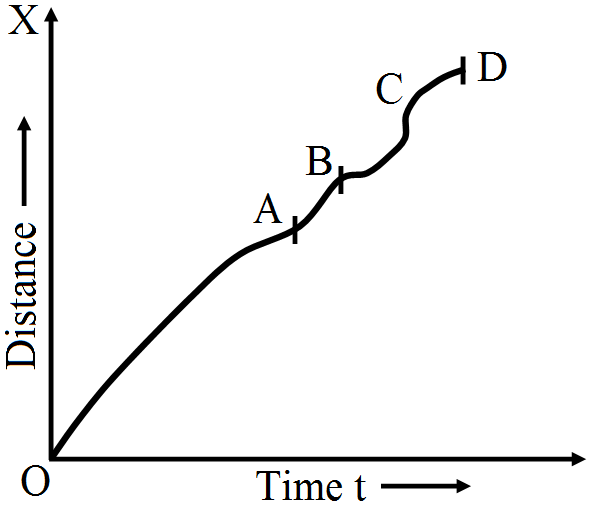
The figure shows an x-t graph of a particle moving along a straight line. What is the sign of the acceleration during the intervals OA, AB, BC, and CD?
What do you understand by the terms “balanced forces” and “unbalanced forces”? Explain with examples.
An object is dropped from rest at a height of $150m$ and simultaneously another object is dropped from rest at a height $100m.$ What is the difference in their heights after $2s$ if both the objects drop with same accelerations? How does the difference in heights vary with time?
The mass of one molecule of a substance is $4.65 \times 10^{-23}g.$ What is its molecular mass? What could this substance be?
State Newton’s third law of motion and give two examples to illustrate the law.
How does the force of attraction between the two bodies depend upon their masses and distance between them? A student thought that two bricks tied together would fall faster than a single one under the action of gravity. Do you agree with his hypothesis or not? Comment.
Give any one advantage of irrigation.
Draw a well labelled diagram of animal cell and mention one function of the main cell organelles.
The atom of an element $X$ contains $17$ protons, $17$ electrons and $18$ neutrons whereas the atom of an element $Y$ contains $11$ protons, $11$ electrons and $12$ neutrons.
  1. What type of ion will be formed by an atom of element $X$? Write the symbol of ion formed.
  2. What will be the number of $(i)$ protons $(ii)$ electrons, and $(iii)$ neutrons, in the ion formed from $X$?
  3. What type of ion will be formed by an atom of element $Y$? Write the symbol of ion formed.
  4. What will be the number of $(i)$ protons $(ii)$ electrons, and $(iii)$ neutrons, in the ion formed from $Y$?
  5. What is the atomic mas of $(i)\  X,$ and $(ii)\ Y$?
  6. What could the elements $X$ and $Y$ be?