Question
What do you understand by the terms “balanced forces” and “unbalanced forces”? Explain with examples.

Answer

  • Balanced forces: If the resultant of all the forces acting on a body is zero, the forces are called balanced forces. These forces do not change the state of rest or of uniform motion of a body but can change the shape of the body.
For example: when a balloon is pressed between hands, then balanced forces (equal and opposite forces) act on the balloon due to which the shape of the balloon changes.
  • Unbalanced forces: If the resultant of all the forces acting on a body is not zero, the forces are called unbalanced forces. These forces change the state of rest or of uniform motion of a body.
For example: if we push a toy car lying on the ground, it starts moving due to the unbalanced force exerted by our hands.

Need a full question paper?

Generate a complete, print-ready paper with questions like this in minutes — across 16+ boards, with answer keys.

Start Generating Free

Similar questions

Define the following:
  1. Sol
  2. Aerosol
  3. Emulsion
  4. Foam
Given one example of each.
Pressure and temperature determine the state of a substance. Explain this in detail.
Explain composite fish culture system with examples. State the major problem associated with this system. Can fish culture be done in any type of combination? If yes, explain.
Give reasons for:
Meristematic cells have a prominent nucleus and dense cytoplasm but they lack vacuole.
Give the main differences between physical changes and chemical changes.
An element $X$ forms the following compounds with hydrogen, carbon and oxygen:
$H_2X, CX_2, XO_2, XO_3$
Describe structure and functions of Golgi apparatus.
How can reverberations in a big hall or auditotium be reduced?`
How will the equations of motion for an object moving with a uniform velocity change?

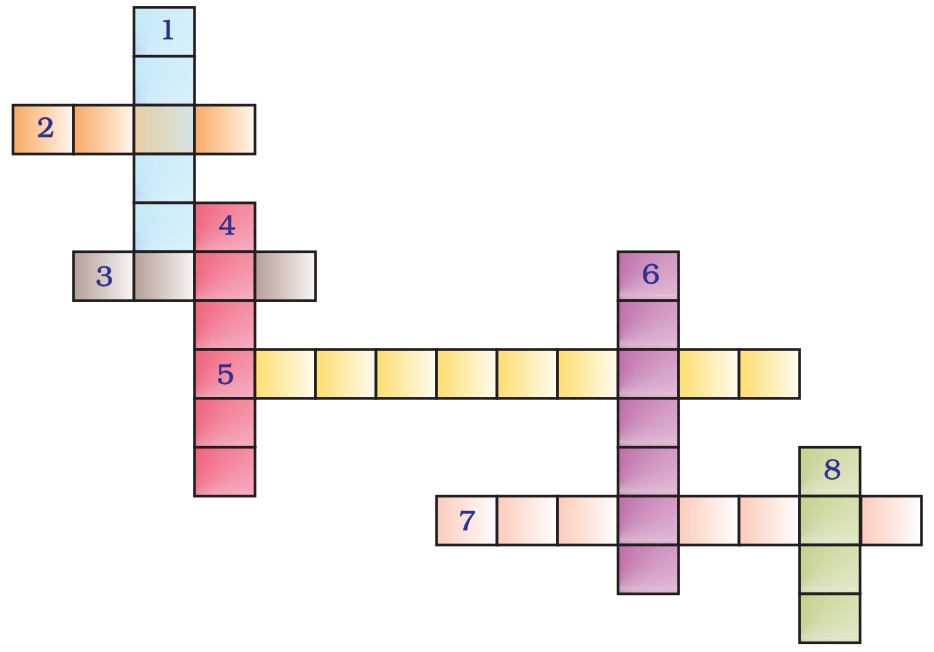
Complete the following crossword puzzle (Figure) by using the name of the chemical elements. Use the data given in the table following.
Across
Down
2.
The element used by Rutherford during his $\alpha$–scattering experiment.
1.
A white lustrous metal used for making ornaments and which tends to get tarnished black in the presence of moist air.
3.
An element which forms rust on exposure to moist air.
4.
Both brass and bronze are alloys of the element.
5.
A very reactive non–metal stored under water.
6.
The metal which exists in the liquid state at room temperature.
7.
Zinc metal when treated with dilute hydrochloric acid produces a gas of this element which when tested with burning splinter produces a pop sound.
8.
An element with symbol Pb.