Question
A bar magnet makes 40 oscillations per minute in an oscillation magnetometer. An identical magnet is demagnetized completely and is placed over the magnet in the magnetometer. Find the time taken for 40 oscillations by this combination. Neglect any induced magnetism.

Answer

$\gamma_1=40$ oscillations/minute

$\text{B}=25\mu\text{T}$

M of second magnet $=1.6\text{A-m}^2$

$\text{d}=20\text{cm}=0.2\text{m}$

  1. For north facing north.

$\gamma=\frac{1}{2\pi}\sqrt{\frac{\text{MB}_\text{H}}{\text{I}}}$

$\gamma=\frac{1}{2\pi}\sqrt{\frac{\text{M}(\text{B}_\text{H}-\text{B})}{\text{I}}}$

$\text{B}=\frac{\mu_0}{4\pi}\frac{\text{m}}{\text{d}^3}=\frac{10^{-7}\times1.6}{8\times10^{-3}}=20\mu\text{T}$

$\frac{\gamma_1}{\gamma_2}=\sqrt{\frac{\text{B}}{\text{B}_\text{H}-\text{B}}}\Rightarrow\frac{40}{\gamma _2}=\sqrt{\frac{25}{5}}$

$\Rightarrow\gamma_2=\frac{40}{\sqrt{5}}=17.88\approx \text{osci/min}$

  1. For north pole facing south.

$\gamma_1 =\frac{1}{2\pi}\sqrt{\frac{\text{MB}_\text{H}}{\text{I}}}$

$\gamma_2=\frac{1}{2\pi}\sqrt{\frac{\text{M} (\text{B} _\text{H}-\text{B}}{\text{I}}}$

$\frac{\gamma_1}{\gamma_2}=\sqrt{\frac{\text{B}}{\text{B}_\text{H}-\text{B}}}\Rightarrow\frac{40}{\gamma_2}=\sqrt{\frac{25}{45}}$

$\Rightarrow\gamma_2=\frac{40}{\sqrt{\big(\frac{25}{45}\big)}}=53.66\approx54\text{ osci/min}$
Need a full question paper?

Generate a complete, print-ready paper with questions like this in minutes — across 16+ boards, with answer keys.

Start Generating Free

Similar questions

A transformer is essentially an a.c. device. It cannot work on d.c. It changes altemating voltages or currents. It does not affect the frequency of a.c. It is based on the phenomenon of mutual induction. A transformer essentially consists of two coils of insulated copper wire having different number of tums and wound on the same soft iron core.
The number of turns in the primary and secondary coils of an ideal transfonner are 2000 and 50 respectively. The primary coil is connected to a main supply of 120V and secondary coil is connected to a bulb of resistance $0.6\Omega.$
  1. The value of voltage across the secondary coil is:
  1. 5V
  2. 2V
  3. 3V
  4. 10V
  1. The value of current in the bulb is:
  1. 7A
  2. 15A
  3. 3A
  4. 5A
  1. The value of current in primary coil is:
  1. 0.125A
  2. 2.52A
  3. 1.51A
  4. 3.52A
  1. Power in primary coil is:
  1. 20W
  2. 5W
  3. 10W
  4. 15W
  1. Power in secondary coil is:
  1. 15W
  2. 20W
  3. 7W
  4. 8W
An elevator is descending with uniform acceleration. To measure the acceleration, a person in the elevator drops a coin at the moment the elevator starts. The coin is 6ft above the floor of the elevator at the time it is dropped. The person observes that the coin strikes the floor in 1 second. Calculate from these data the acceleration of the elevator.
Explain the difference between nuclear fission and nuclear fusion.
When the electron orbiting in hydrogen atom in its ground state moves to the third excited state, show how the de Broglie wavelength associated with it would be affected.
  1. State briefly the processes involved in the formation of p-n junction explaining clearly how the depletion region is formed.
  2. Using the necessary circuit diagrams, show how the V-I characteristics of a p-n junction are obtained in
  1. Forward biasing.
  2. Reverse biasing.

How are these characteristics made use of in rectification?

P-n junction is a single crystal of Ge or Si doped in such a manner that one half portion of it acts asp-type semiconductor and other half functions as n-type semiconductor. As soon as a p-n junction is formed, the holes from the p-region diffuse into then-region, and electron from n region diffuse in top-region. This results in the development of V 8 across the junction which opposes the further diffusion of electrons and holes through the junction.
  1. In an unbiased p-n junction electrons diffuse from n-region top-region because:
  1. Holes in p-region attract them.
  2. Electrons travel across the junction due to potential difference.
  3. Electron concentration inn-region is more as compared to that in p-region.
  4. Only electrons move from n top region and not the vice-versa.
  1. Electron hole recombination in p-n junction may lead to emission of:
  1. Light.
  2. Ultraviolet rays.
  3. Sound.
  4. Radioactive rays.
  1. In an unbiased p-n junction:
  1. Potential at pis equal to that at n.
  2. Potential at pis + ve and that at n is - ve.
  3. Potential at pis more than that at n.
  4. Potential at pis less than that at n.
  1. The potential of depletion layer is due to:
  1. Electrons.
  2. Holes.
  3. Ions.
  4. Forbidden band.
  1. In the depletion layer of unbiased p-n junction,
  1. It is devoid of charge carriers.
  2. Has only electrons.
  3. Has only holes.
  4. P-n junction has a weak electric field.
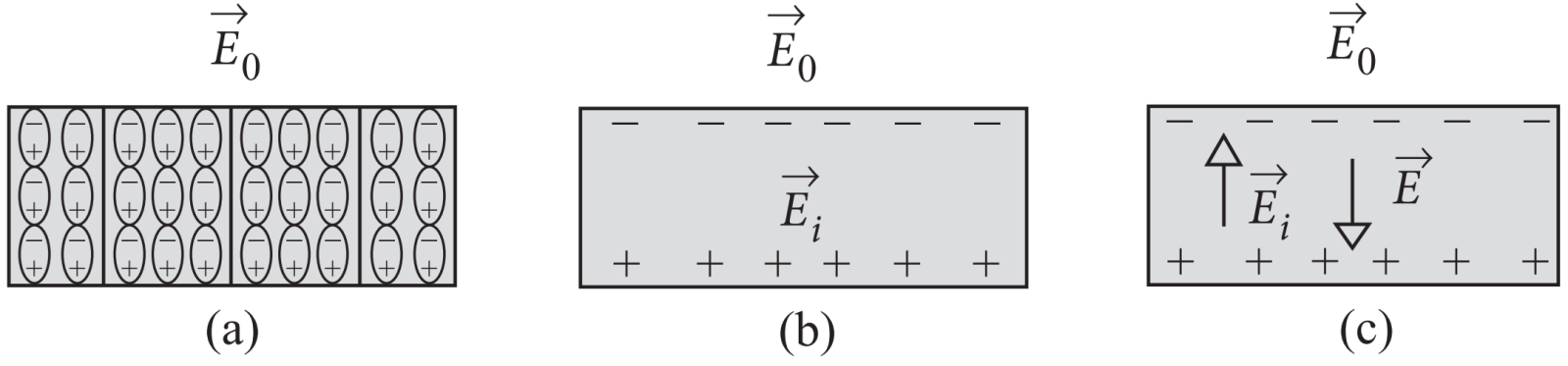
When an insulator is placed in an external field, the dipoles become aligned. Induced surface charges on the insulator establish a polarization field $\vec{\text{E}}_\text{i}$ in its interior. The net field $\vec{\text{E}}$ in the insulator is the vector sum of $\vec{\text{E}}_0$ and $\vec{\text{E}}_\text{i}$ as shown in the figure.

On the application of external electric field, the effect of aligning the electric dipoles in the insulator is called polarisation, and the field $\vec{\text{E}}_\text{i}$ is known as the polarisation field.

The dipole moment per unit volume of the dielectric is known as polarisation $(\vec{\text{P}}).$ For linear isotropic dielectrics, $\vec{\text{P}}=\chi\vec{\text{E}},$ where $\chi=$ electrical susceptibility of the dielectric medium.

  1. Which among the following is an example of polar molecule?
  1. O2
  2. H2
  3. N2
  4. HCI
  1. When air is replaced by a dielectric medium of constant K, the maximum force of attraction between two charges separated by a distance:
  1. Increases K times.
  2. Remains unchanged.
  3. Decreases K times.
  4. Increases 2K times.
  1. Which of the following is a dielectric?
  1. Copper.
  2. Glass.
  3. Antimony (Sb).
  4. None of these.
  1. For a polar molecule, which of the following statements is true?
  1. The centre of gravity of electrons and protons coincide.
  2. The centre of gravity of electrons and protons do not coincide.
  3. The charge distribution is always symmetrical.
  4. The dipole moment is always zero.
  1. When a comb rubbed with dry hair attracts pieces of paper. This is because the?
  1. Comb polarizes the piece of paper.
  2. Comb induces a net dipole moment opposite to the direction of field.
  3. Electric field due to the comb is uniform.
  4. Comb induces a net dipole moment perpendicular to the direction of field.
Establish the expression for equivalent resistance of series combination and parallel combination of resistance separately.
A car starts from rest on a half kilometer long bridge. The coefficient of friction between the tyre and the road is 1.0. Show that one cannot drive through the bridge in less than 10s.
