MCQ
A barometer kept in a stationary elevator reads $76 cm$. If the elevator starts accelerating up the reading will be
  • A
    Zero
  • B
    Equal to $76 cm$
  • C
    More than $76 cm$
  • Less than $76 cm$

Answer

Correct option: D.
Less than $76 cm$
d
(d) $h = \frac{P}{{\rho g}}$

$h \propto \frac{1}{g}$. If lift moves upward with some acceleration then effective g increases. So the value of h decreases i.e. reading will be less than $76 cm.$ 

Need a full question paper?

Generate a complete, print-ready paper with questions like this in minutes — across 16+ boards, with answer keys.
Start Generating Free

Similar questions

A body of mass $4 \mathrm{~kg}$ experiences two forces $\overrightarrow{\mathrm{F}}_1=5 \hat{\mathrm{i}}+8 \hat{\mathrm{j}}+7 \hat{\mathrm{k}}$ and $\overrightarrow{\mathrm{F}}_2=3 \hat{\mathrm{i}}-4 \hat{\mathrm{j}}-3 \hat{\mathrm{k}}$. The acceleration acting on the body is :
The dimension of $\frac{1}{2} \varepsilon_0 E ^2$, where $\varepsilon_0$ is permittivity of free space and $E$ is electric field, is
Which of the diagrams shown in represents variation of total mechanical energy of a pendulum oscillating in air as function of time?
Amount of solar energy received on the earth's surface per unit area per unit time is defined a solar constant. Dimension of solar constant is
Dimensions of $CR$ are those of
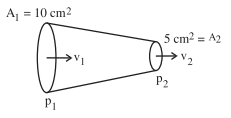
Glycerine of density $1.25 \times 10^3\,kg\,m ^{-3}$ is flowing through the conical section of pipe. The area of cross-section of the pipe at its ends is $10\,cm ^2$ and $5\,cm ^2$ and pressure drop across its length is $3\,Nm ^{-2}$. The rate of flow of glycerine through the pipe is $x \times 10^{-5} m ^3 s ^{-1}$. The value of $x$ is $..............$.
A wound watch spring has $...........$ energy.
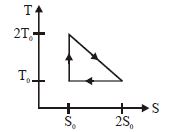
The temperature-entropy diagram of a reversible engine cycle is given in the figure. Its efficiency is
A rod elongates by l when a body of mass $M$ is suspended from it. The work done is:
A particle of unit mass undergoes one­ dimensional motion such that its velocity varies according to $ v(x)= \beta {x^{ - 2n}}$, where $\beta$ and $n$ are constants and $x$ is the position of the particle. The acceleration of the particle as a function of $x$, is given by