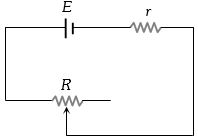
A battery of $e.m.f.$ $E$ and internal resistance $r$ is connected to a variable resistor $R$ as shown here. Which one of the following is true
Easy


Download our appand get started for free
Experience the future of education. Simply download our apps or reach out to us for more information. Let's shape the future of learning together!No signup needed.*
Similar Questions
- 1Wheatstone bridge principle is used to measure the specific resistance $\left(S_1\right)$ of given wire, having length $L$, radius $r$. If $X$ is the resistance of wire, then specific resistance is: $S_1=X\left(\frac{\pi r^2}{L}\right)$. If the length of the wire gets doubled then the value of specific resistance will be :View Solution
- 2In a potentiometer experiment two cells of $e.m.f.$ $E_1$ and $E_2$ are used in series and in conjunction and the balancing length is found to be $58\, cm$ of the wire. If the polarity of $E_2$ is reversed, then the balancing length becomes $29\, cm$. The ratio $\frac{{{E_1}}}{{{E_2}}}$ of the $e.m.f.$ of the two cells isView Solution
- 3There are a large number of cells available, each marked $(6 \,V , 0.5 \,\Omega)$ to be used to supply current to a device of resistance $0.75 \,\Omega$, requiring $24 \,A$ current. How should the cells be arranged, so that power is transmitted to the load using minimum number of cells?View Solution
- 4A uniform wire of resistance $R$ is uniformly compressed along its length, until its radius becomes $n$ times the original radius. Now resistance of the wire becomesView Solution
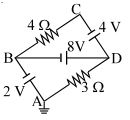
- 5The figure shows a network of resistances in which the point $A$ is earthed. The current through the $3\,\Omega$ resistor isView Solution
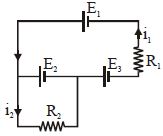
- 6The current $i_1$ and $i_2$ through the resistor $R_1 (= 10\,\Omega )$ and $R_2 (=30 \,\Omega )$ in the circuit diagram with $E_1 = 3\,V, E_2 = 3\,V$ and $E_3 = 2\,V$ are respectively:View Solution
- 7The total momentum of electrons in a straight wire of copper of length $1\, metre$ carrying a current of $16\, A$ isView Solution
- 8Two identical cells each of emf $1.5\,V$ are connected in series across a $10\,\Omega$ resistance. An ideal voltmeter connected across $10\,\Omega$ resistance reads $1.5\,V$. The internal resistance of each cell is $......\Omega$.View Solution
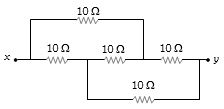
- 9The equivalent resistance between $x$ and $y$ in the circuit shown is ............. $\Omega$View Solution
- 10When three identical bulbs of $60 \;W, 200\;V$ rating are connected in series to a $200 \;V$ supply, the power drawn by them will be ....... $Watt$View Solution