Two particles are executing S.H.M. The equation of their motion are ${y_1} = 10\sin \left( {\omega \,t + \frac{{\pi T}}{4}} \right),$ ${y_2} = 25\sin \,\left( {\omega \,t + \frac{{\sqrt 3 \pi T}}{4}} \right)$. What is the ratio of their amplitude
Easy
Download our app for free and get started
(b) $\frac{{{a_1}}}{{{a_2}}} = \frac{{10}}{{25}} = \frac{2}{5}$

Download our appand get started for free
Experience the future of education. Simply download our apps or reach out to us for more information. Let's shape the future of learning together!No signup needed.*
Similar Questions
- 1An object of mass $0.2\ kg$ executes simple harmonic along $X-$ axis with frequency of $\frac{{25}}{\pi } Hz$ . At the position $x$ = $0.04\ m$ , the object has kinetic energy of $0.5\ J$ and potential energy of $0.4\ J$ amplitude of oscillation in meter is equal toView Solution
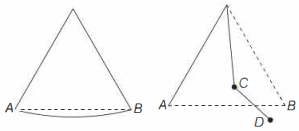
- 2A simple pendulum oscillates freely between points $A$ and $B$. We now put a peg (nail) at the point $C$ as shown in above figure. As the pendulum moves from $A$ to the right, the string will bend at $C$ and the pendulum will go to its extreme point $D$. Ignoring friction, the point $D$View Solution
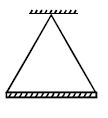
- 3A rod of mass $m$ and length $l$ is suspended from ceiling with two string of length $l$ as shown. When the rod is given a small push in the plane of page and released time period is $T_1$ and when the rod is given a push perpendicular to plane time period of oscillation is $T_2$ . The ratio $\frac{{T_1^2}}{{T_2^2}}$ isView Solution
- 4A mass $m$ attached to a spring oscillates with a period of $3\,s$. If the mass is increased by $1\,kg$ the period increases by $1\,s$. The initial mass $m$ isView Solution
- 5View SolutionA pendulum is swinging in an elevator. Its period will be greatest when the elevator is
- 6The amplitude of a damped oscillator becomes half in one minute. The amplitude after $3$ minute will be $\frac{1}{X}$ times the original, where $X$ isView Solution
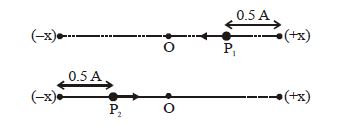
- 7Two bodies performing $S.H.M.$ have same amplitude and frequency. Their phases at a certain instant are as shown in the figure. The phase difference between them isView Solution
- 8An oscillator of mass $M$ is at rest in its equilibrium position in a potential $V\, = \,\frac{1}{2}\,k{(x - X)^2}.$ A particle of mass $m$ comes from right with speed $u$ and collides completely inelastically with $M$ and sticks to it . This process repeats every time the oscillator crosses its equilibrium position .The amplitude of oscillations after $13$ collisions is: $(M = 10,\, m = 5,\, u = 1,\, k = 1 ).$View Solution
- 9Two pendulums begins to swing simultaneously. The first pendulum makes $11$ full oscillations when the other makes $9$. The ratio of length of the two pendulums isView Solution
- 10A pendulum suspended from the ceiling of a train oscillates with a time period $2$ $second$ , when the train is accelerating at $10\,ms^{-2}$. What will be its time period when the train retards at $10\,ms^{-2}$ ? .... $s$View Solution