MCQ
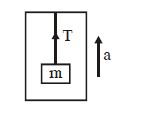
A block of mass $m$ is suspended by a light thread from an elevator. The elevator is accelerating upward with uniform acceleration $a$ . The work done by tension on the block during $t$ seconds is $(u = 0)$
  • $\frac{m}{2}\left( {g + a} \right)a{t^2}$
  • B
    $\frac{m}{2}\left( {g - a} \right)a{t^2}$
  • C
    $\frac{m}{2}g\,a{t^2}$
  • D
    $0$

Answer

Correct option: A.
$\frac{m}{2}\left( {g + a} \right)a{t^2}$
a
$\mathrm{T}=\mathrm{mg}+\mathrm{ma}, \quad \mathrm{S}=\frac{1}{2} \mathrm{at}^{2}$

$\mathrm{W}_{\mathrm{T}}=\mathrm{T} \times \mathrm{S}$

$=\frac{\mathrm{m}(\mathrm{g}+\mathrm{a}) \mathrm{at}^{2}}{2}$

Need a full question paper?

Generate a complete, print-ready paper with questions like this in minutes — across 16+ boards, with answer keys.

Start Generating Free

Similar questions

Two cars $S_1$ and $S_2$ are moving in coplanar concentric circular tracks in the opposite sense with the periods of revolution $3 \,min$ and $24 \,min$, respectively. At time $t=0$, the cars are farthest apart. Then, the two cars will be 
Young's modulus of elasticity of some kind of material is $2 \times 10^{11} N / m ^2$. If the strain produced in it is 0.15 then the force applied will be $\left( N / m ^2\right)$ :
Two pulses having equal and opposite displacements moving in opposite directions overlap at t =t1s. The resultant displacement of the wave at t = t1s is:
A car travels north with a uniform velocity. It goes over a piece of mud which sticks to the tyre. The particles of the mud, as it leaves the ground are thrown
A pendulum bob of mass $50 \,gm$ is suspended from the ceiling of an elevator. The tension in the string if the elevator goes up with uniform velocity is approximately .......... $N$
In adiabatic expansion of a gas
Force acts for $20\,s$ on a body of mass $20\,kg$, starting from rest, after which the force ceases and then body describes $50\,m$ in the next $10\,s$. The value of force will be $..........\,N$
Which of the following orbits is a possible orbit for a planet ?
A body travels uniformly a distance of $ (13.8 \pm 0.2) m$ in a time $(4.0 \pm 0.3)\, s$. The velocity of the body within error limits is
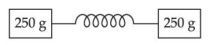
As per the given figure, two blocks each of mass $250\,g$ are connected to a spring of spring constant $2\,Nm ^{-1}$. If both are given velocity $V$ in opposite directions, then maximum elongation of the spring is: