A body is executing simple harmonic motion of amplitude $a$ and period $T$ about the equilibrium position $x=0$. Large numbers of snapshots are taken at random of this body in motion. The probability of the body being found in a very small interval $x$ to $x+|d x|$ is highest at
KVPY 2012, Medium
Download our app for free and get started
(a)
In simple harmonic motion, at positions near extreme positions speed of body is less.
So, more time is spend by the body in extreme positions and less near mean position.
Hence, probability of finding the body at extremes is much higher.
So, correct option is $(a)$.

Download our appand get started for free
Experience the future of education. Simply download our apps or reach out to us for more information. Let's shape the future of learning together!No signup needed.*
Similar Questions
- 1The equation of motion of a particle is $x = a\,cos (\alpha\, t)$ . The motion isView Solution
- 2A particle is executing simple harmonic motion with a period of $T$ seconds and amplitude a metre. The shortest time it takes to reach a point $\frac{a}{{\sqrt 2 }}\,m$ from its mean position in seconds isView Solution
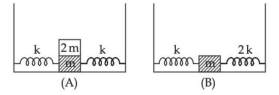
- 3In figure $(A),$ mass ' $2 m$ ' is fixed on mass ' $m$ ' which is attached to two springs of spring constant $k$. In figure $(B),$ mass ' $m$ ' is attached to two spring of spring constant ' $k$ ' and ' $2 k$ '. If mass ' $m$ ' in $(A)$ and $(B)$ are displaced by distance ' $x$ ' horizontally and then released, then time period $T_{1}$ and $T_{2}$ corresponding to $(A)$ and $(B)$ respectively follow the relation.View Solution
- 4View SolutionA chimpanzee swinging on a swing in a sitting position, stands up suddenly, the time period will
- 5For a particle showing motion under the force $F=-5(x-2)$, the motion is ...........View Solution
- 6The periodic time of a body executing simple harmonic motion is $3\, sec$. After how much interval from time $t = 0$, its displacement will be half of its amplitude ..... $\sec$View Solution
- 7The time period of a particle executing $S.H.M.$ is $8 \,s$. At $t=0$ it is at the mean position. The ratio of distance covered by the particle in $1^{\text {st }}$ second to the $2^{\text {nd }}$ second is .............. $s$View Solution
- 8A body executing $S.H.M.$ along a straightline has a velocity of $3 \,ms ^{-1}$ when it is at a distance of $4 \,m$ from its mean position and $4 \,ms ^{-1}$ when it is at a distance of $3 \,m$ from its mean position. Its angular frequency and amplitude areView Solution
- 9At a given point of time the value of displacement of a simple harmonic oscillator is given as $y = A \cos \left(30^{\circ}\right)$. If amplitude is $40\,cm$ and kinetic energy at that time is $200\, J$, the value of force constant is $1.0 \times 10^{ x }\,Nm ^{-1}$. The value of $x$ is ......View Solution
- 10A particle executes $SHM$ of period $1.2\, sec$ and amplitude $8\, cm.$ Find the time it takes to travel $3\,cm$ from the positive extremity of its oscillation. ..... $\sec$View Solution