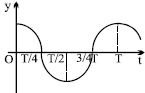
A particle is executing simple harmonic motion with a period of $T$ seconds and amplitude a metre. The shortest time it takes to reach a point $\frac{a}{{\sqrt 2 }}\,m$ from its mean position in seconds is
Medium


Download our appand get started for free
Experience the future of education. Simply download our apps or reach out to us for more information. Let's shape the future of learning together!No signup needed.*
Similar Questions
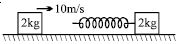
- 1A $2\, Kg$ block moving with $10\, m/s$ strikes a spring of constant $\pi ^2 N/m$ attached to $2\, Kg$ block at rest kept on a smooth floor. The time for which rear moving block remain in contact with spring will be ... $\sec$View Solution
- 2A body executing simple harmonic motion has a maximum acceleration equal to $ 24\,metres/se{c^2} $ and maximum velocity equal to $ 16\;metres/sec $. The amplitude of the simple harmonic motion isView Solution
- 3In an elevator, a spring clock of time period $T_S$ (mass attached to a spring) and a pendulum clock of time period $T_P$ are kept. If the elevator accelerates upwardsView Solution
- 4A particle is vibrating in a simple harmonic motion with an amplitude of $4\, cm.$ At what displacement from the equilibrium position, is its energy half potential and half kineticView Solution
- 5Assume that a tunnel is dug along a chord of the earth, at a perpendicular distance $( R / 2)$ from the earth's centre, where $'R'$ is the radius of the Earth. The wall of the tunnel is frictionless. If a particle is released in this tunnel, it will execute a simple harmonic motion with a time periodView Solution
- 6The equation of a particle executing simple harmonic motion is given by $x =\sin \pi\left( t +\frac{1}{3}\right) m$. At $t =1 \,s$, the speed of particle will be .......... $cm s ^{-1}$ (Given : $\pi=3.14$ )View Solution
- 7An object is attached to the bottom of a light vertical spring and set vibrating. The maximum speed of the object is $15\, cm/sec$ and the period is $628$ milli-seconds. The amplitude of the motion in centimeters isView Solution
- 8The displacement of an oscillating particle varies with time (in seconds) according to the equation $y (cm) = sin \frac{\pi }{2}\left( {\frac{t}{2} + \frac{1}{3}} \right)$. The maximum acceleration of the particle is approximately ..... $cm/s^2$View Solution
- 9A mass $M$ is suspended from a spring of negligible mass. The spring is pulled a little and then released so that the mass executes $S.H.M.$ of time period $T$. If the mass is increased by m, the time period becomes $5T/3$. Then the ratio of $m/M$ isView Solution
- 10The displacement-time graph of a particle executing $SHM$ is shown. Which of the following statements is/are true ?View Solution