A body is moving in a room with a velocity of $20\, m / s$ perpendicular to the two walls separated by $5$ meters. There is no friction and the collisions with the walls are elastic. The motion of the body is
Easy
Download our app for free and get started
(b) Body collides elastically with walls of room. So, there will be no loss in its energy and it will remain colliding with walls of room, so it’s motion will be periodic.
There is no change in energy of the body, hence there is no acceleration, so it’s motion is not $SHM.$
There is no change in energy of the body, hence there is no acceleration, so it’s motion is not $SHM.$

Download our appand get started for free
Experience the future of education. Simply download our apps or reach out to us for more information. Let's shape the future of learning together!No signup needed.*
Similar Questions
- 1An object of mass $m$ is suspended at the end of a massless wire of length $L$ and area of cross$-$section, $A$. Young modulus of the material of the wire is $Y$. If the mass is pulled down slightly its frequency of oscillation along the vertical direction isView Solution
- 2The time period of a mass suspended from a spring is $T$. If the spring is cut into four equal parts and the same mass is suspended from one of the parts, then the new time period will beView Solution
- 3A block of mass $0.1\, kg$ is connected to an elastic spring of spring constant $640\, Nm^{-1}$ and oscillates in a damping medium of damping constant $10^{-2}\, kg\,s^{-1}$ . The system dissipates its energy gradually. The time taken for its mechanical energy of vibration to drop to half of its initial value, is closest to ..... $s$View Solution
- 4View SolutionIdentify correct statement among the following
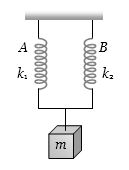
- 5A mass $m$ is suspended by means of two coiled spring which have the same length in unstretched condition as in figure. Their force constant are $k_1$ and $k_2$ respectively. When set into vertical vibrations, the period will beView Solution
- 6View SolutionA simple pendulum is vibrating in an evacuated chamber, it will oscillate with
- 7A cylindrical block of density $\rho$ is partially immersed in a liquid of density $3\rho .$ The plane surface of the block remains parallel to the surface of the liquid. The height of the block is $60\, cm.$ The block performs $SHM$ when displaced from its mean position. [Use $ g = 9.8\, m/s^2$]View Solution
- 8A plank with a small block on top of it is under going vertical $SHM$ . Its period is $2\ sec$ . The minimum amplitude at which the block will separate from plank isView Solution
- 9In forced oscillation of a particle the amplitude is maximum for a frequency $\omega_{1}$ of the force, while the energy is maximum for a frequency $\omega_{2}$ of the force, thenView Solution
- 10A mass $m$ attached to free end of a spring executes SHM with a period of $1\; s$. If the mass is increased by $3\; kg$ the period of oscillation increases by one second, the value of mass $m$ is $..............kg$.View Solution