MCQ
A bullet from a gun is fired on a rectangular wooden block with velocity $u$.When bullet travels $24\,cm$ through the block along its length horizontally, velocity of bullet becomes $\frac{u}{3}$. Then it further penetrates into the block in the same direction before coming to rest exactly at the other end of the block. The total length of the block is $........\,cm$
  • A
    $30$
  • $27$
  • C
    $24$
  • D
    $28$

Answer

Correct option: B.
$27$
b
By $v^2=u^2+2 a s$

$\left(\frac{u}{3}\right)^2=u^2-2 a x$

$2 a x=u^2-\frac{u^2}{9}$

$2 a x=\frac{8 u^2}{9}.........(1)$

Similarly from starting

$v^2=u^2+2 ax$

$0= u ^2-2 ax _2$

$2 ax _2= u ^2..........(2)$

$By (1) /(2)$

$\frac{ x }{ x _2}=\frac{8}{9}$

$\frac{24}{ x _2}=\frac{8}{9}$

$x _2=27\,cm$

Need a full question paper?

Generate a complete, print-ready paper with questions like this in minutes — across 16+ boards, with answer keys.

Start Generating Free

Similar questions

Two stones having different masses $m_1$ and $m_2$ are projected at an angle $\alpha$ and $\left(90^{\circ}-\alpha\right)$ with same speed from same point. The ratio of their maximum heights is
Which of the following is a dimensional constant?
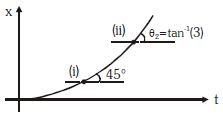
$x-t$ graph for a uniformly accelerated particle is as shown in the figure. Then find the average velocity between points $(i)$ and $(ii)$    ......... $ms^{-1}$
The displacement of the particle varies with time according to the relation $x = \frac{k}{b}\,[1 - {e^{ - bt}}]$. Then the velocity of the particle is
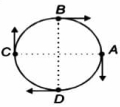
Four particles $A, B, C$ and $D$ are moving with constant speed $v$ each. At the instant shown relative velocity of $A$ with respect to $B, C$ and $D$ are in directions
The K.E. of a body becomes 4 times its initial value. The new linear momentum will be:
After effects of elasticity are maximum for
A ball of mass $4\, kg$, moving with a velocity of $10\, ms ^{-1}$, collides with a spring of length $8\, m$ and force constant $100\, Nm ^{-1}$. The length of the compressed spring is $x\, m$. The value of $x$, to the nearest integer, is ........ .
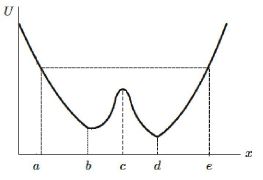
A particle is released from rest at the point $x = a$ and moves along the $x$ axis subject to the potential energy function $U(x)$ shown. The particle:
A free neutron decays to a proton but a free proton does not decay to a neutron. This is because:
  1. Neutron is a composite particle made of a proton and an electron whereas proton is a fundamental particle.
  2. Neutron is an uncharged particle whereas proton is a charged particle.
  3. Neutron has large rest mass than the proton.
  4. Weak forces can operate in a neutron but not in a proton.