A cell, shunted by a $8 \; \Omega$ resistance, is balanced across a potentiometer wire of length $3 \; m$. The balancing length is $2 \; m$ when the cell is shunted by $4 \; \Omega$ resistance. The value of internal resistance of the cell will be $\dots \; \Omega .$
JEE MAIN 2022, Medium


Download our appand get started for free
Experience the future of education. Simply download our apps or reach out to us for more information. Let's shape the future of learning together!No signup needed.*
Similar Questions
- 1Give colors of the ring in sequence marked on a resistance of $56 \ k\Omega$ with tolerance $\pm 5\%$View Solution
- 2$32$ cells, each of $emf$ $3V$, are connected in series and kept in a box. Externally, the combination shows an $emf$ of $84\, V$. The number of cells reversed in the combination isView Solution
- 3At room temperature, copper has free electron density of $8.4 \times {10^{28}}$ per ${m^3}$. The copper conductor has a cross-section of $10^{-6} \,m^2$ and carries a current of $5.4\, A$. The electron drift velocity in copper isView Solution
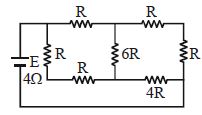
- 4A battery of internal resistance $4\, ohm$ is connected to the network of resistance as hown. In the order that the maximum power can be delivered to the network, the value of $R$ in ohm should be :-View Solution
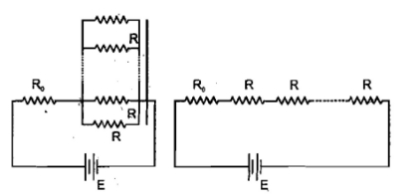
- 5In the circuit shown, $n$-identical resistors $R$ are connected in parallel $(n > 1)$ and the combination is connected in series to another resistor $R_0$. In the adjoining circuit $n$ resistors of resistance $R$ are all connected in series alongwith $R_0$. The batteries in both circuits are identical and net power dissipated in the $n$ resistors in both circuits is same. The ratio $R_0 / R$ isView Solution
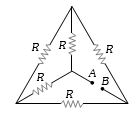
- 6Each of the resistance in the network shown in fig. is equal to $R$. The resistance between the terminals $A$ and $B$ isView Solution
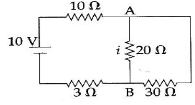
- 7In the electrical circuit shown in the figure, the current $i$ through the side $AB$ isView Solution
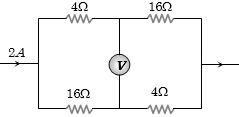
- 8In the circuit shown below, The reading of the voltmeter $V$ is ...........View Solution
- 9To get the maximum current from a parallel combination of $n$ identical cells each of internal resistance $r$ in an external resistance $R$, whenView Solution
- 10Three unequal resistors in parallel are equivalent to a resistance $1\, ohm$. If two of them are in the ratio $1 : 2$ and if no resistance value is fractional, the largest of the three resistances in $ohms$ isView Solution