At room temperature, copper has free electron density of $8.4 \times {10^{28}}$ per ${m^3}$. The copper conductor has a cross-section of $10^{-6} \,m^2$ and carries a current of $5.4\, A$. The electron drift velocity in copper is
Easy


Download our appand get started for free
Experience the future of education. Simply download our apps or reach out to us for more information. Let's shape the future of learning together!No signup needed.*
Similar Questions
- 1By what percentage will the illumination of the lamp decrease if the current drops by $20 \%$ ?View Solution
- 2View SolutionThe maximum current that flows through a fuse wire before it blows out varies with its radius as
- 3Two wires of equal diameters, of resistivities ${\rho _1}$ and ${\rho _2}$ and lengths $l_1$ and $l_2$, respectively, are joined in series. The equivalent resistivity of the combination isView Solution
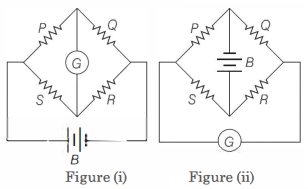
- 4Figure $(i)$ below shows a Wheatstone's bridge in which $P, Q, R$ and $S$ are fixed resistances, $G$ is a galvanometer and $B$ is a battery. For this particular case, the galvanometer shows zero deflection. Now, only the positions of $B$ and $G$ are interchanged, as shown in figure $(ii)$. The new deflection of the galvanometerView Solution
- 5Two cells of same emf but different internal resistances $I_{1}$ and $I_{2}$ are connected in series with a resistance $R$. The value of resistance $R$, for which the potential difference across second cell is zero, isView Solution
- 6A $d.c.$ main supply of $e.m.f.\, 220\, V$ is connected across a storage battery of $e.m.f.\, 200\, V$ through a resistance of $1\,\Omega $. The battery terminals are connected to an external resistance $'R'$ . The minimum value of $'R'$, so that a current passes through the battery to charge it is ............... $\Omega$View Solution
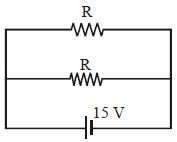
- 7If power dissipated in the circuit is $150\,W,$ then value of $R$ is ............... $\Omega$View Solution
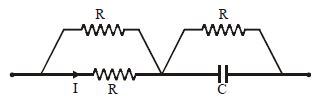
- 8View SolutionThe capacitor shown in fig. is in steady state. The energy stored in the capacitor is
- 9View SolutionIn meter bridge or Wheatstone bridge for measurement of resistance, the known and the unknown resistances are interchanged. The error so removed is
- 10Three light bulbs of $40\, W$, $60\, W$ and $100\, W$ are connected in series with $220\, V$ source. Which one of the bulbs will glow brightest ............ $W$View Solution