MCQ
A cone of base radius $R$ and height $h$ is located in a uniform electric field $\vec E$ parallel to its base. The electric flux entering the cone is
  • A
    $\frac{1}{2}\,EhR$
  • $E h R$
  • C
    $2\, E h R$
  • D
    $4\, E h R$

Answer

Correct option: B.
$E h R$
b
Electric flux, $\phi \, = E \,(ds)\, cos\, \theta$

$= E \,(hR)\, cos\, 0^o\, = EhR$

Need a full question paper?

Generate a complete, print-ready paper with questions like this in minutes — across 16+ boards, with answer keys.
Start Generating Free

Similar questions

When connected across the terminals of a cell, a voltmeter measures 5V and a connected ammeter measures 10 A of current. A resistance of 2 ohms is connected across the terminals of the cell. The current flowing through this resistance will be
Which of the following is wrong for interference fringes?
A radioactive nucleus decays by two different process. The half life of the first process is $5$ minutes and that of the second process is $30\,s$. The effective half-life of the nucleus is calculated to be $\frac{\alpha}{11}\,s$. The value of $\alpha$ is $..............$
A sphere of radius R has a uniform distribution of electric charge in its volume. At a distance x from its centre, for x < R, the electric field is directly proportional to
In a photon$-$particle collision, the quantity that does not remain conserved is:
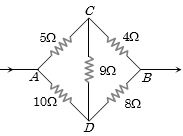
Five resistors are connected as shown in the diagram. The equivalent resistance between $A$ and $B$ is .............. $ohm$
Assertion : If three capacitors of capacitances $C_1 < C_2 < C_3$ are connected in parallel then their equivalent capacitance $C_P > C_S$.

Reason : $\frac{1}{{{C_p}}} = \frac{1}{{{C_1}}} + \frac{1}{{{C_2}}} + \frac{1}{{{C_3}}}$

For skywave propagation of a $10\, MHz$ signal, what should be the minimum electron density in ionosphere
The frequency and intensity of a light source are both doubled. Consider the following statements.
  1. The saturation photocurrent remains almost the same.
  2. The maximum kinetic energy of the photoelectrons is doubled.
What happens to fringe width in the Young's double slit experiment, if it is performed in glycerine instead of air?