Question
A convex lens is put $10\, cm$ from a light source and it makes a sharp image on a screen, kept $10\, cm$ from the lens. Now a glass block (refractive index $1.5$) of $1.5\, cm$ thickness is placed in contact with the light source. To get the sharp image again, the screen is shifted by a distance $d$. Then $d$ is
Answer

If $u=-10 \,\mathrm{cm}$

$v=+10\, \mathrm{cm}$

$\Rightarrow \mathrm{f}=5\,\mathrm{cm}$

Glass plate shift $=\mathrm{t}\left(1-\frac{1}{\mu}\right)=1.5\left(1-\frac{2}{3}\right)=0.5\,\mathrm{cm}$

So, new $u=10-0.5=9.5\,\mathrm{cm}$

$\frac{1}{v}-\frac{1}{u}=\frac{1}{f}$

$\frac{1}{v}-\frac{1}{-9.5}=\frac{1}{5}$

After solving we get,

$v=\frac{47.5}{4.5}$.  Hence, shift $\frac{47.5}{4.5}-10=\left(\frac{2.5}{4.5}\right)=0.55\, \mathrm{cm}$

Need a full question paper?

Generate a complete, print-ready paper with questions like this in minutes — across 16+ boards, with answer keys.

Start Generating Free

Similar questions

A particle $A$ has charge $ + q$ and a particle $B$ has charge $ + \,4q$ with each of them having the same mass $m$. When allowed to fall from rest through the same electric potential difference, the ratio of their speed $\frac{{{v_A}}}{{{v_B}}}$ will become
Vector$\overrightarrow A $ makes equal angles with $x, y$ and $z$ axis. Value of its components (in terms of magnitude of $\overrightarrow A $) will be
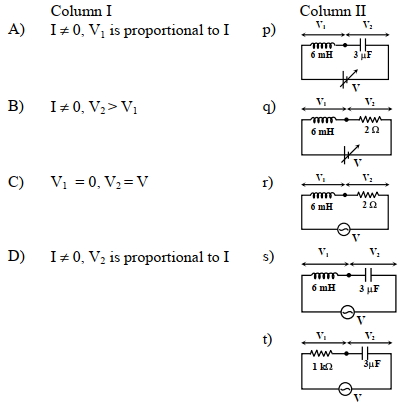
You are given many resistances, capacitors and inductors. These are connected to a variable $DC$ voltage source (the first two circuits) or an $\mathrm{AC}$ voltage source of $50 \mathrm{~Hz}$ frequency (the next three circuits) in different ways as shown in Column $II$. When a current $I$ (steady state for $DC$ or rms for $AC$) flows through the circuit, the corresponding voltage $\mathrm{V}_1$ and $\mathrm{V}_2$. (indicated in circuits) are related as shown in Column $\mathrm{I}$. Match the two

$Image$

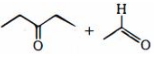
Consider the following sequence of reactions.

The ketone. $(A)$ is

Ketone $A\,\xrightarrow[2\,.\,{{H}_{2}}O]{1.\,{{C}_{2}}{{H}_{5}}MgBr}B$  $\xrightarrow[-\,{{H}_{2}}O]{{{H}_{2}}S{{O}_{4}},\,Heat}C$ $\xrightarrow[2.\,Zn\,,\,{{H}_{2}}O]{1.{{O}_{3}}}$ Figure

Indium impurity in germanium makes
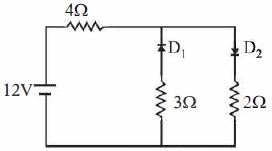
The circuit has two oppositively connected ideal diodes in parallel. What is the current flowing in the circuit?......$A$
Latent heat of ice is $80 \,cal/gm$. A man melts $60\, g$ of ice by chewing in $1$ minute. His power is ........ $W$
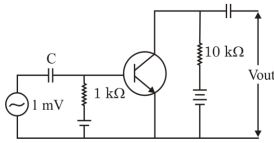
An $n.p.n$ transistor with current gain $\beta=100$ in common emitter configuration is shown in figure. The output voltage of the amplifier will be$.....V$
Which one of the following compounds is the best choice for being prepared by an efficient mixed aldol addition reaction?
The relation between $\lambda $ and $({T_{1/2}})$ is (${T_{1/2}}=$ half life, $\lambda=$ decay constant)