A current of $10\, A$ exists in a wire of crosssectional area of $5\, mm ^{2}$ with a drift velocity of $2 \times 10^{-3}\, ms ^{-1}$. The number of free electrons in each cubic meter of the wire is ..........
JEE MAIN 2021, Medium
Download our app for free and get started
$i =10 A , A =5 mm ^{2}=5 \times 10^{-6} m ^{2}$
and $v _{ d }=2 \times 10^{-3} m / s$
We know, $i= neAvd$
$\therefore 10= n \times 1.6 \times 10^{-19} \times 5 \times 10^{-6} \times 2 \times 10^{-3}$
$\Rightarrow n =0.625 \times 10^{28}=625 \times 10^{25}$

Download our appand get started for free
Experience the future of education. Simply download our apps or reach out to us for more information. Let's shape the future of learning together!No signup needed.*
Similar Questions
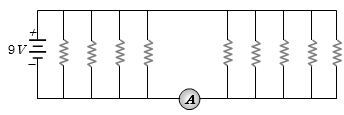
- 1If each resistance in the figure is of $9\,\Omega$ then reading of ammeter is ............ $A$View Solution
- 2In a potentiometer circuit there is a cell of $e.m.f.$ $2\, volt$, a resistance of $5\, ohm$ and a wire of uniform thickness of length $1000\, cm$ and resistance $15\, ohm$. The potential gradient in the wire isView Solution
- 3When a potential difference $V$ is applied across a wire of resistance $R$, it dissipates energy at a rate $W$. If the wire is cut into two halves and these halves are connected mutually parallel across the same supply, the same supply, the energy dissipation rate will become:View Solution
- 4A potentiometer wire is $100\,\, cm$ long and a constant potential difference is maintained across it. Two cells are connected in series first to support one another and then in opposite direction. The balance points are obtained at $50\,\, cm$ and $10\,\, cm$ from the positive end of the wire in the two cases. The ratio of emf's isView Solution
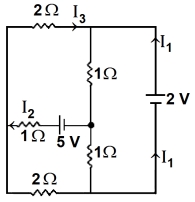
- 5In the following circuit, the magnitude of current $I _{ l }$, is $............A$.View Solution
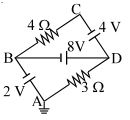
- 6The figure shows a network of resistances in which the point $A$ is earthed. The current through the $3\,\Omega$ resistor isView Solution
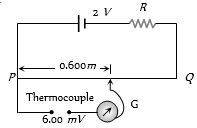
- 7Figure shows a simple potentiometer circuit for measuring a small $e.m.f$. produced by a thermocouple. The meter wire $PQ$ has a resistance $5 \,\Omega$ and the driver cell has an e.m.f. of $2\, V$. If a balance point is obtained $0.600\, m$ along $PQ$ when measuring an e.m.f. of $6.00\, mV$, what is the value of resistance $R$ ............... $\Omega$View Solution
- 8The current in a wire varies with time according to relation $I = 4 + 2t$. The quantity of charge which has passed through a crosssectionn of the wire during the time $t = 2\, s$ to $t = 6\, s$ will be .............. $\mathrm{C}$View Solution
- 9In a meter bridge experiment, initially the jockey is at null point. Now resistance $R_1$ $\&$ $R_2$ is interchanged. Shift in the position of jockey is ................ $cm$View Solution
- 10A battery is charged at a potential of $15\, V$ for $8$ hours when the current flowing is $10\, A$. The battery on discharge supplies a current of $5\, A$ for $15$ hours. The mean terminal voltage during discharge is $14\, V$. The "Watt-hour" efficiency of the battery is .............. $\%$View Solution