The current in a wire varies with time according to relation $I = 4 + 2t$. The quantity of charge which has passed through a crosssectionn of the wire during the time $t = 2\, s$ to $t = 6\, s$ will be .............. $\mathrm{C}$
Medium


Download our appand get started for free
Experience the future of education. Simply download our apps or reach out to us for more information. Let's shape the future of learning together!No signup needed.*
Similar Questions
- 1The terminal voltage across a battery of $\mathrm{emf}$ $E$ can beView Solution
- 2The resistors of resistances $2$ $\Omega$, $4$ $\Omega$ and $8$ $\Omega$ are connected in parallel, then the equivalent resistance of the combination will beView Solution
- 3In a hydrogen discharge tube it is observed that through a given cross-section $3.13 \times {10^{15}}$ electrons are moving from right to left and $3.12 \times {10^{15}}$ protons are moving from left to right. What is the electric current in the discharge tube and what is its directionView Solution
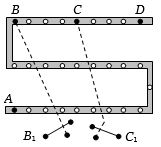
- 4View SolutionFor the post office box arrangement to determine the value of unknown resistance the unknown resistance should be connected between
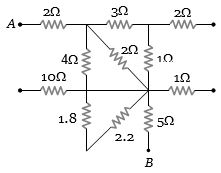
- 5What is the equivalent resistance between the points $A$ and $B$ of the network .................. $\Omega$View Solution
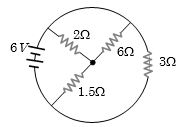
- 6The total current supplied to the circuit by the battery is ............. $A$View Solution
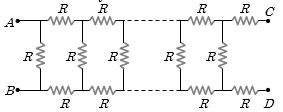
- 7In the figure, the value of resistors to be connected between $C$ and $D$ so that the resistance of the entire circuit between $A$ and $B$ does not change with the number of elementary sets used isView Solution
- 8View SolutionFor measurement of potential difference, potentiometer is preferred in comparison to voltmeter because
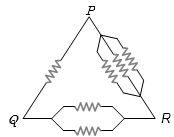
- 9Six equal resistances are connected between points $P$, $Q$ and $R$ as shown in the figure. Then the net resistance will be maximum betweenView Solution
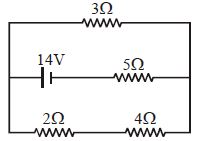
- 10Find out current in $3\,\Omega $ resistance in given circuitView Solution