MCQ
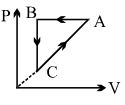
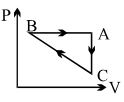
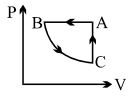
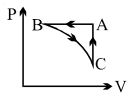
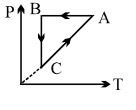
A cyclic process $ABCA$ is shown in $PT$ diagram. When presented on $PV$, it would
  • A

  • B


  • D

Answer

Correct option: C.

c
In the given cyclic process, From $A$ to $B$, the pressure is constant.

From $C$ to $A, P \propto T$

Hence, the volume is constant.

From $B$ to $C$, the temperature is constant.

Hence, $P \propto \frac{1}{V}$

From $C$ to $A,$ volume is constant.

Hence, when presented on $P V,$ it would be represented by option $\mathrm{C}$.

Need a full question paper?

Generate a complete, print-ready paper with questions like this in minutes — across 16+ boards, with answer keys.
Start Generating Free

Similar questions

A body welghs $200 \;\mathrm{N}$ on the surface of the earth. ......$N$ will it weigh half way down to the centre of the earth?
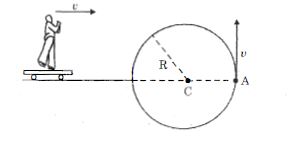
A boy is moving with a constant speed $v$ on a small trolley towards a distant circle as shown in the figure. A point mass is moving on the circle with a constant speed $v$, what is the frequency of change in magnitude of relative velocity of the point mass, as observed by the boy.
At the highest point of the path of a projectile, its
$A$ block of mass $m$ moving with a velocity $v_0$ on a smooth horizontal surface strikes and compresses a spring of stiffness $k$ till mass comes to rest as shown in the figure. This phenomenon is observed by two observers:

$A$: standing on the horizontal surface

$B$: standing on the block 

To an observer $B$, when the block is compressing the spring
Consider two containers $A$ and $B$ containing identical gases at the same pressure, volume and temperature. The gas in container $A$ is compressed to half of its original volume isothermally while the gas in container $B$ is compressed to half of its original value adiabatically. The ratio of final pressure of gas in $B$ to that of gas in $A$ is
Hail storms are observed to strike the surface of the frozen lake at $30^o$ with the vertical and rebound at $60^o$ with the vertical. Assume contact to be smooth, the coefficient of restitution is
The value of $(\overrightarrow A + \overrightarrow B )\, \times (\overrightarrow A - \overrightarrow B )$ is
A particle is moving along a curve. Then
The ratio of two specific heats of gas ${C_p}/{C_v}$ for argon is $1.6$ and for hydrogen is $1.4$. Adiabatic elasticity of argon at pressure $P$ is $E.$ Adiabatic elasticity of hydrogen will also be equal to $E$ at the pressure
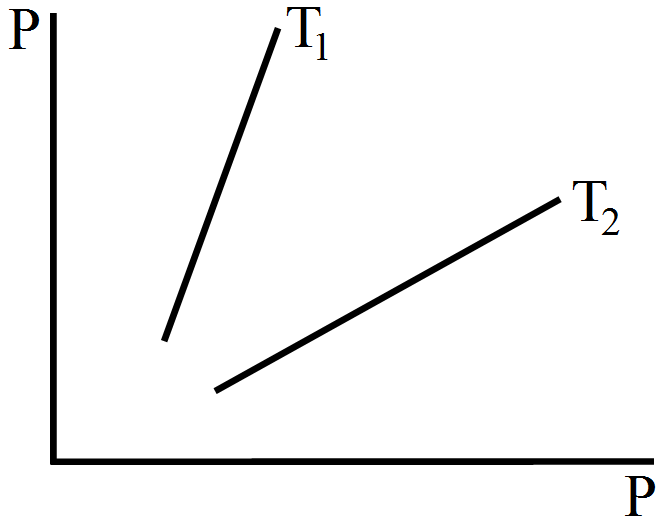
Figure. shows graphs of pressure vs density for an ideal gas at two temperatures T1 and T2.
  1. T1 > T2
  2. T1 = T2
  3. T1 < T2
  4. Any of the three is possible.