A fuse wire with radius $1\, mm$ blows at $1.5\, amp$. The radius of the fuse wire of the same material to blow at $3\,A$ will be
Diffcult
Download our app for free and get started
(a) $i \propto {r^{3/2}} \Rightarrow $ $\frac{{{r_2}}}{{{r_1}}} = {\left( {\frac{{{i_2}}}{{{i_1}}}} \right)^{3/2}} = {\left( {\frac{3}{{1.5}}} \right)^{2/3}} = {(4)^{1/3}}$
$ \Rightarrow {r_2} = {(4)^{1/3}} \times {r_1} = {4^{1/3}}$ ( $r_1 = 1\, mm$)
$ \Rightarrow {r_2} = {(4)^{1/3}} \times {r_1} = {4^{1/3}}$ ( $r_1 = 1\, mm$)

Download our appand get started for free
Experience the future of education. Simply download our apps or reach out to us for more information. Let's shape the future of learning together!No signup needed.*
Similar Questions
- 1The heat produced by a $100\, watt$ heater in $2$ minute will be equal toView Solution
- 2A railway compartment is lit up by thirteen lamps each taking $2.1\, amp$ at $15\, volts$. The heat generated per second in each lamp will be ............ $cal$View Solution
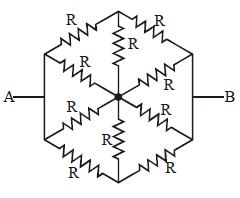
- 3The effective resistance between $A$ and $B$ of the shown network, where resistance of each resistor is $R$ , isView Solution
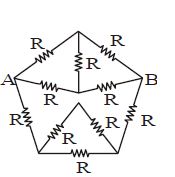
- 4Find out equivalent resistance between $A$ and $B$View Solution
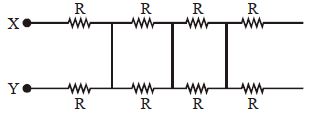
- 5Net resistance between $X$ and $Y$ isView Solution
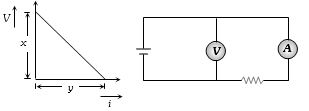
- 6In an experiment, a graph was plotted of the potential difference $V$ between the terminals of a cell against the circuit current $i$ by varying load rheostat. Internal conductance of the cell is given byView Solution
- 7Two $220\; V , 100 \;W$ bulbs are connected first in series and then in parallel. Each time the combination is connected to a $220 \;V \;AC$ supply line. The power drawn by the combination in each case respectively will beView Solution
- 8An electric wire of length ‘$I$’ and area of cross-section $a$ has a resistance $R\, ohms$. Another wire of the same material having same length and area of cross-section $4a$ has a resistance ofView Solution
- 9View SolutionFor which of the following the resistance decreases on increasing the temperature
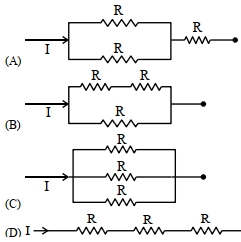
- 10Different combination of $3$ resistors of equal resistance $R$ are shown in the figures.View Solution
The increasing order for power dissipation is: