Question
A given galvanometer is to be converted into (i) an ammeter (ii) a milliammeter (iii) a voltmeter. In which case will the required resistance be (i) least (ii) highest and why?

Answer

The required resistance has least value in the case of an ammeter and maximum value in the case of a voltmeter.
This is due to the reason that the shunt resistance required to convert a galvanometer into ammeter or milliammeter has the value.
$\text{S}=\frac{\text{I}_g}{\text{I}-\text{I}_\text{g}}\times\text{R}_\text{g}$
Thus, the shunt required in the case of milliammeter has higher value.
Similarly, since the voltmeter should have a high resistance, the value of required resistance should be highest in the case of a voltmeter. This is connected in series with the coil of the galvanometer.

Need a full question paper?

Generate a complete, print-ready paper with questions like this in minutes — across 16+ boards, with answer keys.
Start Generating Free

Similar questions

An electric bulb is designed to operate at 12 volts DC. If this bulb is connected to an AC source and gives normal brightness, what would be the peak voltage of the source?
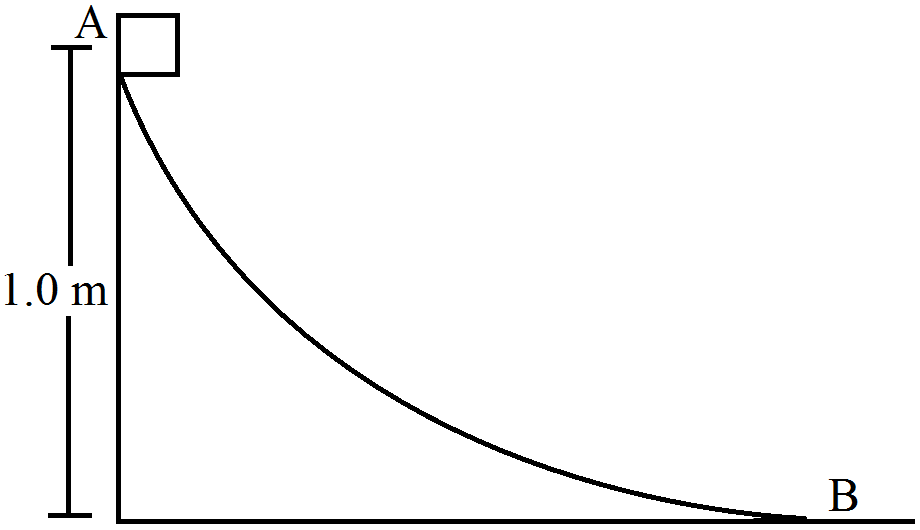
A block weighing 10N travels down a smooth curved track AB joined to a rough horizontal surface (figure). The rough surface has a friction coefficient of 0.20 with the block. If the block starts slipping on the track from a point 1.0m above the horizontal surface, how far will it move on the rough surface?

Use Huygens's principle to explain the formation of diffraction pattern due to a single slit illuminated by a monochromatic source of light.
When the width of the slit is made double the original width, how would this affect the size and intensity of the central diffraction band?
Obtain essential expression for balanced position of Wheatstone Bridge.###Explain the principle of Wheatstone Bridge. How can we find the resistance of any resistor using this principle?
In a Coolidge tube, electrons strike the target and stop inside it. Does the target get more and more negatively charged as time passes?
Draw the intensity distributions for (i) the fringes produced in interference, and (ii) the diffraction bands produced due to single slit. Write two points of difference between the phenomena of interference and diffraction.
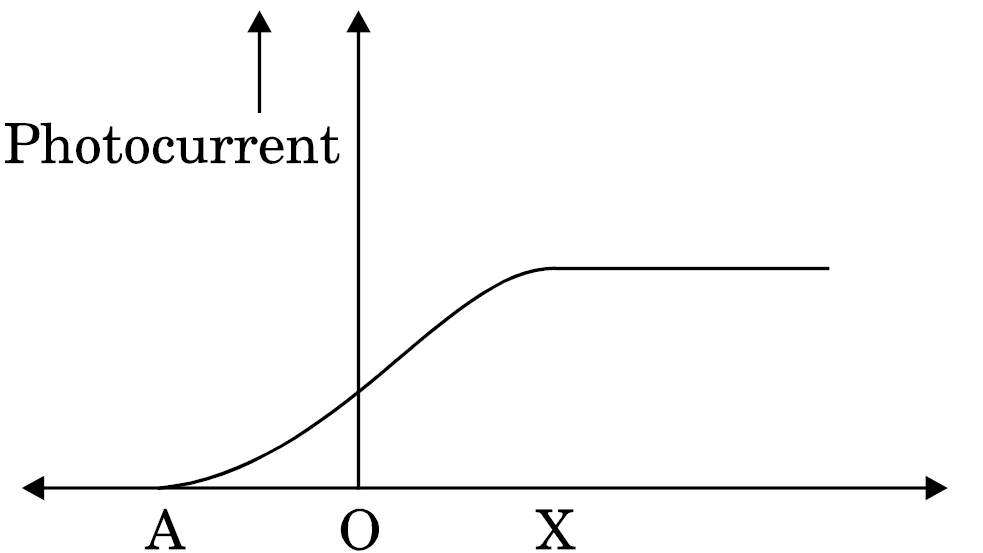
The following graph shows the variation of photocurrent for a photosensitive metal:

  1. Identify the variable X on the horizontal axis.
  2. What does the point A on the horizontal axis represent?
  3. Draw this graph for three different values of frequencies of incident radiation v1, v2 and v3 (v1 > v2 > v3) for same intensity. 
  4. Draw this graph for three different values of intensities of incident radiation I1, I2, and I3 (I1 > I2 > I3) having same frequency.
It is said that any charge given to a conductor comes to its surface. Should all the protons come to the surface? Should all the electrons come to the surface? Should all the free electrons come to the surface?
In a photodiode, the conductivity increases when the material is exposed to light. It is found that the conductivity changes only if the wavelength is less than 620nm. What is the band gap?
Comment on the following :(i) Electric conductivity.(ii) Dependence of resistivity and resistance on temperature.