MCQ
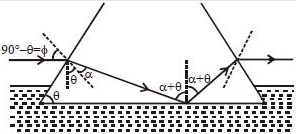
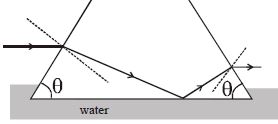
A glass prism whose cross-section is an isosceles  triangle stands with its (horizontal) base in water; the angles that its two equal sides make with the base are each $\theta$. An incident ray of light, above and parallel to the water surface is totally internally reflected at the glass-water interface and subsequently re-emerges into the air. Take the refractive indices of glass and water to be $\frac{3}{2}$ and $\frac{4}{3} $ , respectively. Maximum value of $cos\theta$ is.        
  • A
    $\sqrt {\frac{{20}}{{21}}}$
  • $\sqrt {\frac{{17}}{{21}}}$
  • C
    $\sqrt {\frac{{7}}{{10}}}$
  • D
    $\sqrt {\frac{{4}}{{9}}}$

Answer

Correct option: B.
$\sqrt {\frac{{17}}{{21}}}$
b
$\alpha  + \theta  > {i_C}$

Where ${i_C}$ is critical angle for glass-water interface 

$\theta  > {i_C} - \alpha $              .........$(i)$

For air glass interface

$\sin \left( {{{90}^o} - \theta } \right) = {\mu _g}\sin \alpha $               .............$(ii)$

Need a full question paper?

Generate a complete, print-ready paper with questions like this in minutes — across 16+ boards, with answer keys.

Start Generating Free

Similar questions

The electric field in a region is radially outward and at a point is given by $E=250 \,r V / m$ (where $r$ is the distance of the point from origin). Calculate the charge contained in a sphere of radius $20 \,cm$ centred at the origin ......... $C$
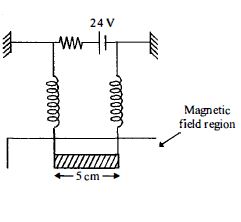
The circuit in figure consists of wires at the top and bottom and identical springs as the left and right sides. The wire at the bottom has a mass of $10\, g$ and is $5\, cm$ long. The wire is hanging as shown in the figure. The springs stretch $0.5\, cm$ under the weight of the wire and the circuit has a total resistance of $12\, \Omega $. When the lower wire is subjected to a static magnetic field, the springs, stretch an additional $0.3\, cm$. The magnetic field is
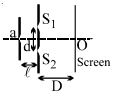
The figure shows a schematic diagram showing the arrangement of Young's Double Slit Experiment Choose the correct statement $(s)$ related to the wavelength of light used
In a compound microscope, the intermediate image is
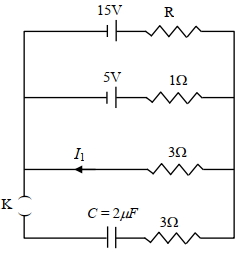
In a circuit shown in the figure, the capacitor $C$ is initially uncharged and the key $K$ is open. In this condition, a current of $1 \mathrm{~A}$ flows through the $1 \Omega$ resistor. The key is closed at time $t=t_0$. Which of the following statement($s$) is(are) correct?

[Given: $\mathrm{e}^{-1}=0.36$ ]

($A$) The value of the resistance $R$ is $3 \Omega$.

($B$) For $t$

($C$) At $t=t_0+7.2 \mu \mathrm{s}$, the current in the capacitor is $0.6 \mathrm{~A}$.

($D$) For $t \rightarrow \infty$, the charge on the capacitor is $12 \mu C$.

The average e.m.f. induced in a coil in which the current changes from 2 ampere to 4 ampere in 0.05 second is 8 volt. What is the self inductance of the coil ?
A conducting ring is placed around the core of an electromagnet as shown in fig. When key $K$ is pressed, the ring
If 200 MeV energy is released in the fission of a single $U^{235}$ nucleus, the number of fissions required per second to produce 1 kilowatt power shall be (Given $1eV = 1.6 \times 10^{-19}J$)
How did de $–$ Broglie modify Bohr’s postulate?
Light is incident normally on a completely absorbing surface with an energy flux of $25\,W\,cm^{-2}.$ If the surface has an area of $25\,cm^2,$ the maximum momentum transferred to the surface in $40\,min$ time duration will be