MCQ
In a compound microscope, the intermediate image is
  • A
    Virtual, erect and magnified
  • B
    Real, erect and magnified
  • Real, inverted and magnified
  • D
    Virtual, erect and reduced

Answer

Correct option: C.
Real, inverted and magnified
c
( c)Intermediate image means the image formed by objective, which is real, inverted and enlarged.

Need a full question paper?

Generate a complete, print-ready paper with questions like this in minutes — across 16+ boards, with answer keys.
Start Generating Free

Similar questions

In a potentiometer circuit a cell of $EMF$ $1.5\, {V}$ gives balance point at $36\, {cm}$ length of wire. If another cell of $EMF$ $2.5\, {V}$ replaces the first cell, then at what length of the wire, the balance point occurs ? (in $cm$)
An AC voltage $\mathrm{V}=20 \sin 200 \pi t$ is applied to a series $LCR$ circuit which drives a current $I=10 \sin \left(200 \pi t+\frac{\pi}{3}\right)$. The average power dissipated is:
Which of the following statements is correct in case of Thomson’s atomic model?
When subjected to a transverse electric field, cathode rays move
A wire of length $10 \mathrm{~cm}$ and radius $\sqrt{7} \times 10^{-4} \mathrm{~m}$ connected across the right gap of a meter bridge. When a resistance of $4.5 \ \Omega$ is connected on the left gap by using a resistance box, the balance length is found to be at $60 \mathrm{~cm}$ from the left end. If the resistivity of the wire is $\mathrm{R} \times 10^{-7} \Omega \mathrm{m}$, then value of $\mathrm{R}$ is :
An electron moving towards the east enters a magnetic field directed towards the north. The force on the electron will be directed
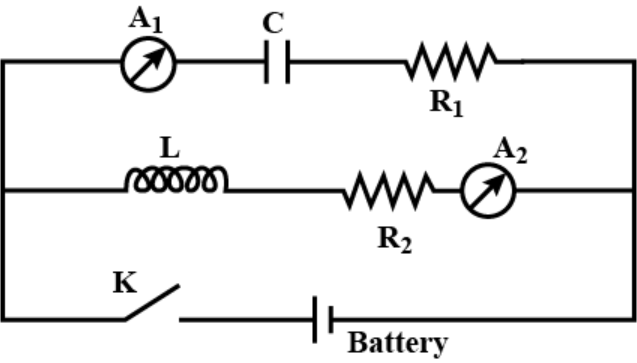
In a circuit inductance $L$ and capacitance $C$ are connected as shown in figure. $A_1$ and $A_2$ are ammeters. When key $K$ is pressed to complete the circuit, then just after closing key $(K)$, the readings of $A_1$ and $A_2$ will be.
Image
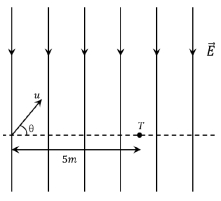
A uniform electric field, $\vec{E}=-400 \sqrt{3} \hat{y} NC ^{-1}$ is applied in a region. A charged particle of mass $m$ carrying positive charge $q$ is projected in this region with an initial speed of $2 \sqrt{10} \times 10^6 ms ^{-1}$. This particle is aimed to hit a target $T$, which is $5 m$ away from its entry point into the field as shown schematically in the figure. Take $\frac{ q }{ m }=10^{10} Ckg ^{-1}$. Then-

$(A)$ the particle will hit $T$ if projected at an angle $45^{\circ}$ from the horizontal

$(B)$ the particle will hit $T$ if projected either at an angle $30^{\circ}$ or $60^{\circ}$ from the horizontal

$(C)$ time taken by the particle to hit $T$ could be $\sqrt{\frac{5}{6}} \mu s$ as well as $\sqrt{\frac{5}{2}} \mu s$

$(D)$ time taken by the particle to hit $T$ is $\sqrt{\frac{5}{3}} \mu s$
Assertion : X-rays can penetrate through the flesh but not through the bones.
Reason : The penetrating power of X-rays depends on voltage.
A telescope of aperture $3 \times 10^{-2}\,m$ diameter is focused on a window at $80\, m$ distance fitted with a wire mesh of spacing $2\times10^{-3}\, m$. Given: $\lambda \, = 5.5\times10^{-7}\, m$ , which of the following is true for observing the mesh through the telescope?