MCQ
A light and a heavy body have equal momenta. Which one has greater K.E
  • The light body
  • B
    The heavy body
  • C
    The K.E. are equal
  • D
    Data is incomplete

Answer

Correct option: A.
The light body
a
(a)$E = \frac{{{P^2}}}{{2m}}$ if $ P = $ constant then$E \propto \frac{1}{m}$

Need a full question paper?

Generate a complete, print-ready paper with questions like this in minutes — across 16+ boards, with answer keys.
Start Generating Free

Similar questions

An electron, a proton, a deuteron and an alpha particle, each having the same speed are in a region of constant magnetic field perpendicular to the direction of the velocities of the particles. The radius of the circular orbits of these particles are respectively $R_e, R_p, R_d \,$ and $\, R_\alpha$. It follows that
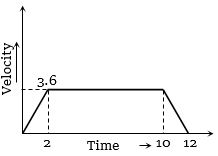
A lift is going up. The variation in the speed of the lift is as given in the graph. What is the height to which the lift takes the passengers..........$m$
A solid cylinder is rolling down on an inclined plane of angle $\theta $. The coefficient of static friction between the plane and the cylinder is $\mu _s$. The condition for the cylinder not to slip is
Given below are two statements$:$

Statement $I:$ Biot-Savart's law gives us the expression for the magnetic field strength of an infinitesimal current element (IdI) of a current carrying conductor only.

Statement $II :$ Biot-Savart's law is analogous to Coulomb's inverse square law of charge $q$, with the former being related to the field produced by a scalar source, Idl while the latter being produced by a vector source, $q$. In light of above statements choose the most appropriate answer from the options given below:

If some charge is given to a solid metallic sphere, the field inside remains zero and by Gauss's law all the charge resides on the surface. Now, suppose that Coulomb's force between two charges varies as $1 / r^{3}$. Then, for a charged solid metallic sphere
Assertion : A helium filled balloon does not rise indefinately in air but halts after a certain height.

Reason : Viscosity opposes the motion of balloon. Choose any one of the following four responses:
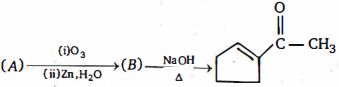
the reactant $(A)$ will be
The electric field due to a uniformly charged sphere of radius $R$ as a function of the distance $r$ from its centre is represented graphically by
The minimum force required to start pushing a body up a rough (frictional coefficient $\mu$) inclined plane is $F _{1}$ while the minimum force needed to prevent it from sliding down is $F _{2}$. If the inclined plane makes an angle $\theta$ from the horizontal such that $\tan \theta=2 \mu$, then the ratio $\frac{F_{1}}{F_{2}}$ is
A lift is moving down with acceleration $a$. A man in the lift drops a ball inside the lift. The acceleration of the ball as observed by the man in the lift and a man standing stationary on the ground are respectively