Question
A long, straight wire carries a current. Is Ampere's law valid for a loop that does not enclose the wire? That encloses the wire but is not circular?

Answer

Ampere's law is valid for a loop that is not circular. However, it should have some charge distribution in the area enclosed so as to have a constant electric field in the region and a non-zero magnetic field. Even if the loop defined does not have its own charge distribution but has electric influence of some other charge distribution, it can have some constant magnetic field $\big(\oint\overrightarrow{\text{B}}.\text{d}\overrightarrow{\text{l}}=\mu_0\text{i}\ \text{enclosed}\big).$

Need a full question paper?

Generate a complete, print-ready paper with questions like this in minutes — across 16+ boards, with answer keys.
Start Generating Free

Similar questions

A nonconducting sheet of large surface area and thickness d contains uniform charge distribution of density $\rho.$ Find the electric field at a point P inside the plate, at a distance x from the central plane. Draw a qualitative graph of E against x for 0 < x < d.
A rod is inserted as the core in the current-carrying solenoid of the previous problem.
  1. What is the magnetic intensity H at the centre?
  2. If the magnetization I of the core is found to be 0.12Nm, find the susceptibility of the material of the rod.
  3. Is the material paramagnetic, diamagnetic or ferromagnetic?
Should the energy of a photon be called its kinetic energy or its internal energy?
A large conducting plane has a surface charge density $1.0\times10^{-4}\text{Cm}^{-2}.$ Find the electrostatic energy stored in a cubical volume of edge 1.0cm in front of the plane.
In Young’s double slit experiment, explain with reason in each case, how the interference pattern changes, when :
  1. Width of the slits is doubled.
  2. Separation between the slits is increased.
  3. Screen is moved away from the plane of slits.
A water particle of mass 10.0mg and having a charge of 1.50 × 10-6C stays suspended in a room. What is the magnitude of electric field in the room? What is its direction?
In a Quincke's experiment, the sound intensity has a minimum value I at a particular position. As the sliding tube is pulled out by a distance of 16.5mm, the intensity increases to a maximum of 9I. Take the speed of sound in air to be 330m/s.
  1. Find the frequency of the sound source.
  2. Find the ratio of the amplitudes of the two waves arriving at the detector assuming that it does not change much between the positions of minimum intensity and maximum intensity.
Derive $\frac{n_1}{-u}+\frac{n_2}{v}=\frac{n_2-n_1}{ R }$ for refraction at a spherical surface.
What should be the distance between the object in Exercise 9.30 and the magnifying glass if the virtual image of each square in the figure is to have an area of 6.25 mm2. Would you be able to see the squares distinctly with your eyes very close to the magnifier?
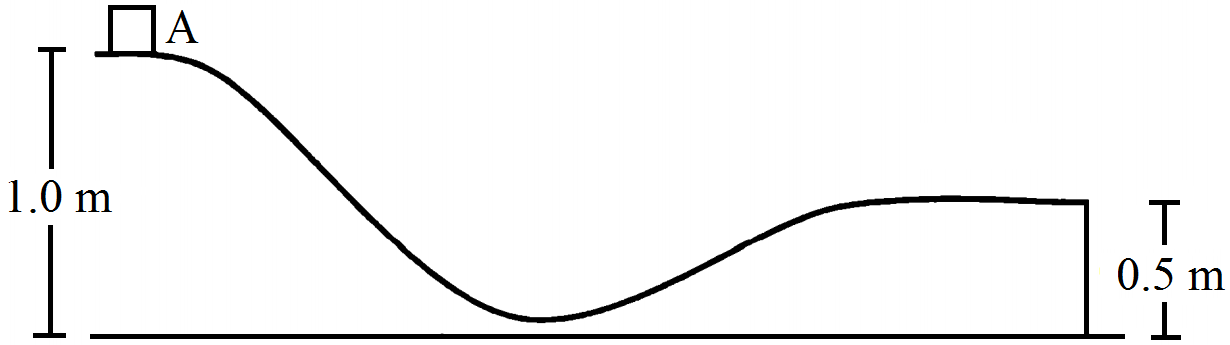
Figure shows a particle sliding on a frictionless track which terminates in a straight horizontal section. If the particle starts slipping from the point A, how far away from the track will the particle hit the ground?