Question
 A magnetic field can be produced by moving, charges or electric currents. The basic equation governing the magnetic field due to a current distribution is the Biot-Savart law. Finding the magnetic field resulting from a current distribution involves the vector product, and is inherently a calculas problem when the distance from the current to the field point is continuously changing. According to this law, the magnetic field at a point due to a current element of length $\text{d}\vec{\text{I}}$ carrying current I, at a distance r from the element is $\text{dB}=\frac{\mu_0}{4\pi}\frac{\text{I}(\text{d}{\vec{\text{I}}\times\vec{\text{r}}})}{\text{r}^3}$

Biot-Savart law has certain similarities as well as difference with Coloumb's law for electrostatic field e.g., there is an angle dependence in Biot-Savart law which is not present in electrostatic case.

  1. The direction of magnetic field $\text{d}\vec{\text{B}}$ due to a current element $\text{Id}\vec{\text{l}}$ at a point of distance $\vec{\text{r}}$ from it, when a current I passes through a long conductor is in the direction
  1. Of position vector $\vec{\text{r}}$ of the point.
  2. Of current element $\text{Id}\vec{\text{l}}$
  3. Perpendicular to both $\text{d}\vec{\text{l}}$ and $\vec{\text{r}}$
  4. Perpendicular to $\text{d}\vec{\text{l}}$ only.
  1. The magnetic field due to a current in a straight wire segment of length Lat a point on its perpendicular bisector at a distance r (r >> L)
  1. Decreases as $\frac{1}{\text{r}}$

  2. Decreases as $\frac{1}{\text{r}^2}$

  3. Decreases as $\frac{1}{\text{r}^3}$

  4. approaches a finite limit as $\text{r}\rightarrow\infty$
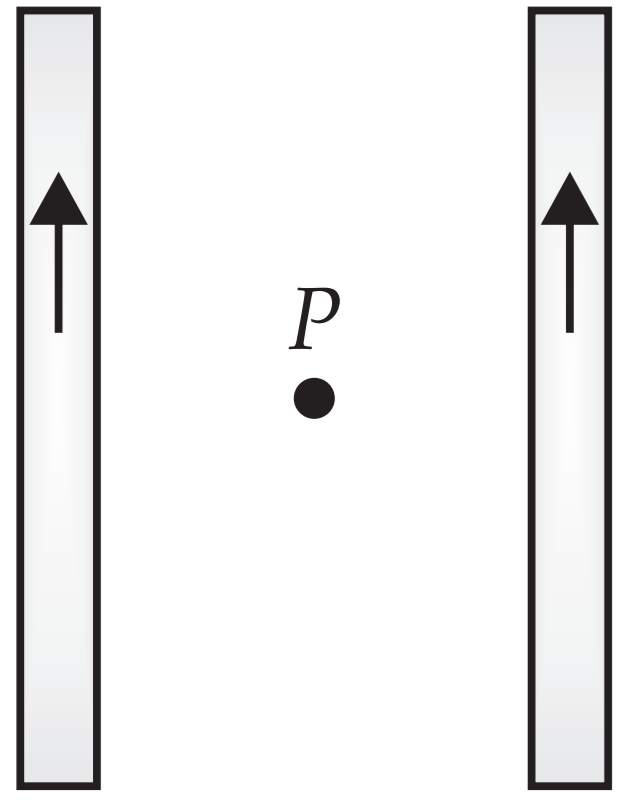
  1. Two long straight wires are set parallel to each other. Each carries a current i in the same direction and the separation between them is 2r. The intensity of the magnetic field midway between them is:
  1. $\mu_0\frac{\text{i}}{\text{r}}$

  2. $4\mu_0\frac{\text{i}}{\text{r}}$

  3. $\text{Zero}$

  4. $\mu_0\frac{\text{i}}{\text{4r}}$

  1. A long straight wire carries a current along the z-axis for any two points in the x - y plane. Which of the following is always false?
  1. The magnetic fields are equal.
  2. The directions of the magnetic fields are the same.
  3. The magnitudes of the magnetic fields are equal.
  4. The field at one point is opposite to that at the other point.
  1. Biot-Savart law can be expressed alternatively as:
  1. Coulomb's Law.
  2. Ampere's circuital law.
  3. Ohm's Law.
  4. Gauss's Law. 

Answer

  1. (c) Perpendicular to both $\text{d}\vec{\text{l}}$ and $\vec{\text{r}}$

Explanation:

According to Biot-Savart's law, the magnetic induction due to a current element is given by,

$\text{d}\vec{\text{B}}=\frac{\mu_0}{4\pi}\frac{\text{Id}\vec{\text{l}\times\text{r}}}{\text{r}^3}$

This is perpendicular to both $\text{d}\vec{\text{l}}$ and $\vec{\text{r}}.$

  1. (b) Decreases as

Explanation:

From Biot-savart's law, $\text{dB}=\frac{\mu_0}{4\pi}\frac{\text{Idl}}{\text{r}^2}\text{i.e. dB}\propto\frac{1}{\text{r}^2}$

  1. (c) $\text{Zero}$

Explanation:

$\text{B}=\frac{\mu_0}{2\pi}.\frac{\text{i}}{\text{r}}-\frac{\mu_0}{2\pi}.\frac{\text{i}}{\text{r}}=0$

  1. (a) The magnetic fields are equal.
  1. (b) Ampere's circuital law.

Explanation:

Biot-Savart law can be expressed alternatively as Ampere circuital law.

Need a full question paper?

Generate a complete, print-ready paper with questions like this in minutes — across 16+ boards, with answer keys.

Start Generating Free

Similar questions

A metallic loop is placed in a nonuniform magnetic field. Will an emf be induced in the loop?

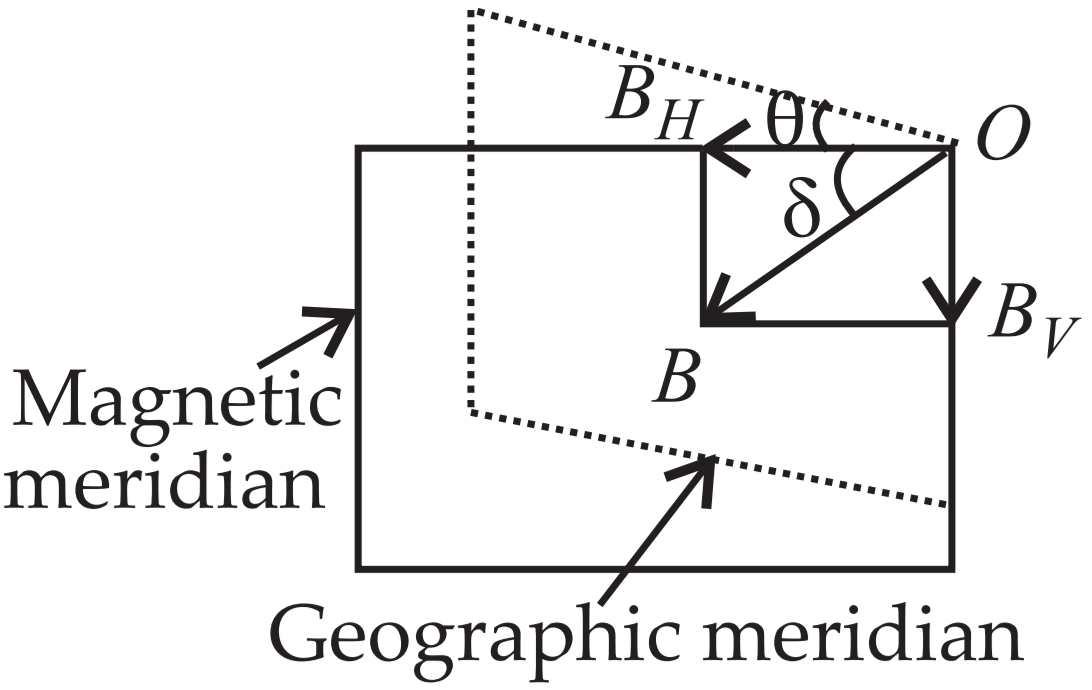
'Tile earth's magnetic field at a point on its surface is usually characterised by three quantities: (a) declination (bl inclination or dip and (cl horizontal component of the field. These are known as the elements of the earth's magnetic field. At a place, angle between geographic meridian and magnetic meridian is defined as magnetic declination, whereas angle made by the earth's magnetic field with the horizontal in magnetic meridian is known as magnetic dip.

  1. In a certain place, the horizontal component of magnetic field is $\frac{1}{\sqrt{3}}$ times the vertical component. 'Tile angle of dip at this place is:
  1. $\text{Zero}$

  2. $\frac{\pi}{3}$

  3. $\frac{\pi}{2}$

  4. $\frac{\pi}{6}$

  1. The angle between the true geographic north and the north shown by a compass needle is called as:
  1. Inclination.
  2. Magnetic declination.
  3. Angle of meridian.
  4. Magnetic pole.
  1. Tile angles of dip at the poles and the equator respectively are
  1. 30º, 30º
  2. 0º, 90º
  3. 45º, 90º
  4. 90º, 0º 
  1. A compass needle which is allowed to move in a horizontal plane is taken to a geomagnetic pole. It
  1. Will become rigid showing no movement.
  2. Will stay in any position.
  3. Will stay in north-south direction only.
  4. Will stay in east-west direction only. 
  1. Select the correct statement from the following.
  1. The magnetic dip is zero at the centre of the earth.
  2. Magnetic dip decreases as we move away from the equator towards the magnetic pole.
  3. Magnetic dip increases as we move away from the equator towards the magnetic pole.
  4. Magnetic dip does not vary from place to place. 
A uniform magnetic field of 0.20 × 10-3 T exists in the space. Find the change in the magnetic scalar potential as one moves through 50cm along the field.
A wire is stretched to reduce its diameter to half. What will be the magnitude of its new resistance?
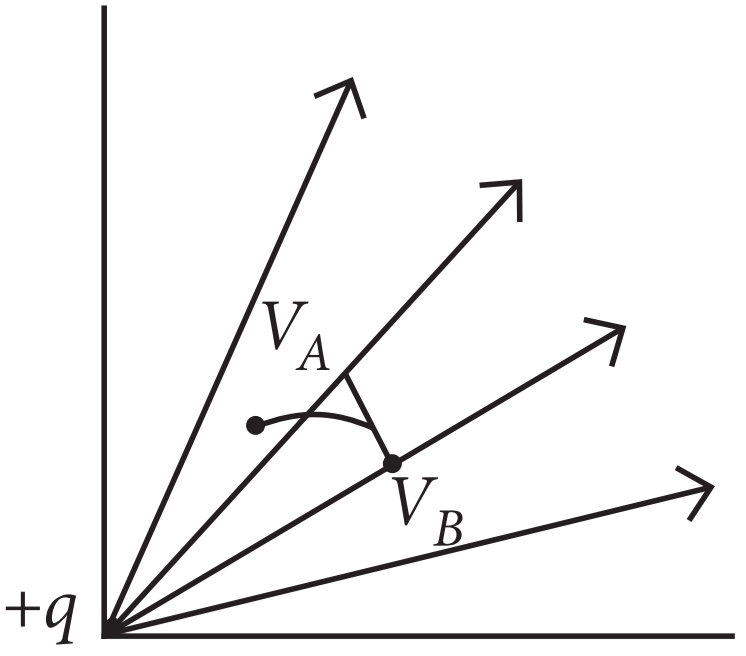
Electrostatic potential energy of a system of point charges is defined as the total amount of work done in bringing the different charges to their respective positions from infinitely charge mutual separations. The work is stored in the system of two point charges in the form of electrostatic potential energy U of the system. Electric potential difference between any points A and B in an electric field is the amount of work done in moving a unit positive test charge from A to B along any path agents the electrostatic force $\text{V}_\text{B}-\text{V}_\text{A}=\frac{\text{W}_\text{AB}}{\text{q}_\text{o}}=\int\vec{\text{E}}.\text{dl}.$

  1. A test charge is moved from lower potential point to a higher potential point. The potential energy of test charge wiII.
  1. Remain the same.
  2. Increase.
  3. Decrease.
  4. Become zero.
  1. Which of the following statement is not true?
  1. Electrostatic force is a conservative force.
  2. Potential energy of charge q at a point is the work done per unit charge in bringing a charge from any point to infinity.
  3. Spring force and gravitational force are conservative force.
  4. Both (a) and (c).
  1. Work done in moving a charge from one point to another inside a uniformly charged conducting sphere is:
  1. Always zero.
  2. Non-zero.
  3. May be zero.
  4. None of these.
  1. The work done in bringing a unit positive charge from infinite distance to a point at distance x from a positive charge Q is W. Then the potential $\phi$ at that point is:
  1. $\frac{\text{WQ}}{\text{x}}$

  2. W

  3. $\frac{\text{W}}{\text{x}}$

  4. WQ

  1. If $1\mu\text{C}$ charge is shifted from A to B and it is found that work done by an external force is $40\mu\text{J}.$ ln doing so against electrostatics force, the potential difference VA - VB is:
  1. 40V
  2. -40V
  3. 20V
  4. -60V
The combination of two bar magnets makes 10 oscillations per second in an oscillation magnetometer when like poles are tied together and 2 oscillations per second when unlike poles are tied together. Find the ratio of the magnetic moments of the magnets. Neglect any induced magnetism.
The photon picture of electromagnetic radiations and the characteristic properties of photons are as follows: ln the interaction ofradiation with matter, radiation behaves as ifit is made of particles like photons. 
Each photon has energy $\text{E}\Big(=\text{h}\upsilon=\frac{\text{hc}}{\lambda}\Big)$ and momentum $\text{p}\Big(=\frac{\text{h}\upsilon}{\text{c}}=\frac{\text{h}}{\lambda}\Big),$ where h is Planck's constant, $\upsilon$ and $\lambda$ are the frequency and wavelength of radiation and c is the velocity of light.
The photon energy is independent of the intensity of radiations.
All the photons emitted from a source of radiations travel through space with the same speed c. The frequency of photon gives the radiation, a definite energy (or colour) which does not change when photon travels through different media.
Photons are not deflected by electric and magnetic fields. This shows that photons are electrically neutral.
  1. Which one among the following shows particle nature of tight?
  1. Photoelectric effect
  2. Interference
  3. Refraction
  4. Polarization
  1. Which of the following statements about photon is incorrect?
  1. Photons exert no pressure.
  2. Momentum of photon is $\frac{\text{h}\upsilon}{\text{c}}$.
  3. Rest mass of photon is zero.
  4. Energy of photon is $\text{h}\upsilon$.
  1. The rest mass of photon is:
  1. $\frac{\text{h}\upsilon}{\text{c}}$
  2. $\frac{\text{h}\upsilon}{\text{c}^2}$
  3. $\frac{\text{h}\upsilon}{\lambda}$
  4. Zero
  1. ln a photon-particle collision (such as photon-electron collision), which of the following may not be conserved?
  1. Total energy.
  2. Number of photons.
  3. Total momentum.
  4. Both (a) and (b).
  1. 'n' photons of wavelength $'\lambda'$ are absorbed by a black body of mass 'm'. The momentum gained by the body is:
  1. $\frac{\text{h}}{\text{m}\lambda}$
  2. $\frac{\text{mnh}}{\lambda}$
  3. $\frac{\text{nh}}{\text{m}\lambda}$
  4. $\frac{\text{nh}}{\lambda}$
A simple pendulum fixed in a car has a time period of 4 seconds when the car is moving uniformly on a horizontal road. When the accelerator is pressed, the time period changes to 3.99 seconds. Making an approximate analysis, find the acceleration of the car.
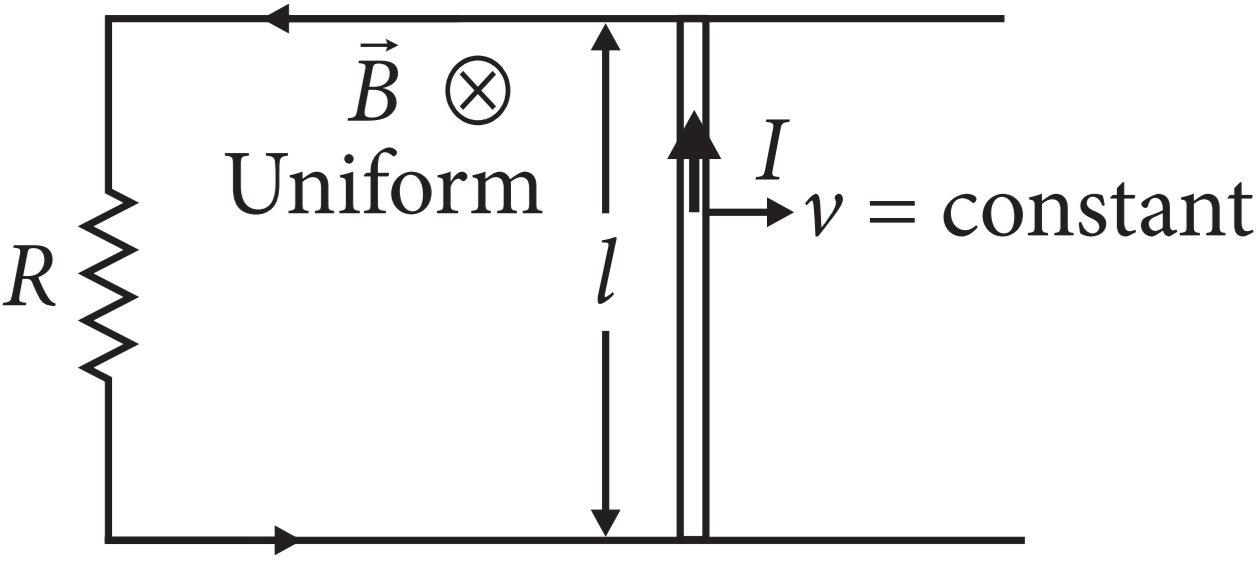
The emf induced across the ends of a conductor due to its motion in a magnetic field is called motional emf. It is produced due to the magnetic Lorentz force acting on the free electrons of the conductor. For a circuit shown in figure, if a conductor of length l moves with velocity v in a magnetic field B perpendicular to both its length and the direction of the magnetic field, then all the induced parametres are possible in the circuit.

  1. Direction of current induced in a wire moving in a magnetic field is found using
  1. Fleming's left hand rule.
  2. Fleming's right hand rule.
  3. Ampere's rule.
  4. Right hand clasp rule.
  1. A conducting rod of length l is moving in a transverse magnetic field of strength B with velocity v. The resistance of the rod is R. The current in the rod is:
  1. $\frac{\text{Blv}}{R}$

  2. $\frac{\text{B}^2\text{v}^2\text{l}^2}{\text{R}}$

  3. Blv
  4. Zero
  1. A 0.1m long conductor carrying a current of SO A is held perpendicular to a magnetic field of 1.25mT. The mechanical power required to move the conductor with a speed of I m s-1 is:
  1. 62.5 mW
  2. 625 mW
  3. 6.25 mW
  4. 12.5 mW
  1.  A bicycle generator creates 1.5 Vat 15km/ hr. The EMF generated at 10km/ hr is:
  1. 1.5 volts
  2. 2 volts
  3. 0.5 volts
  4. 1 volt
  1. The dimensional formula for emf E in MKS system will be:
  1. [ML2T-3A-1]
  2. [ML2T-1A]
  3. [ML2A]
  4. [MLT-3A-1]